
Heads up: Some links on this page are affiliate links. If you buy through them, we may earn a commission at no extra cost to you. As an Amazon Associate, we earn from qualifying purchases. This page also has one Tesla referral link, labeled where it appears. Full disclosure
How we put this together: We haven’t installed or tested any of these systems ourselves. Costs come from Generac, EnergySage, and HomeGuide; specs come from each maker’s own datasheet. Everything was checked Oct 19, 2026. Prices change, so treat every dollar figure as a starting point and get local quotes.
Bottom line: For most U.S. households, we start with a portable power station. It costs a fraction of an installed system, needs no electrician or permit, runs quietly indoors, and goes with you. Add solar or a second battery later. A home battery (Tesla Powerwall, Enphase, FranklinWH) is worth a look if you’re adding solar or have local incentives, and a standby generator (like a Generac) still fits big homes with long, multi-day outages.
Our portable picks: the EcoFlow DELTA 3 Plus (expandable to about 5 kWh, per EcoFlow), the BLUETTI AC180 (1,152 Wh), and the Jackery Explorer 1000 v2 (about 23.8 lb).
The three options at a glance
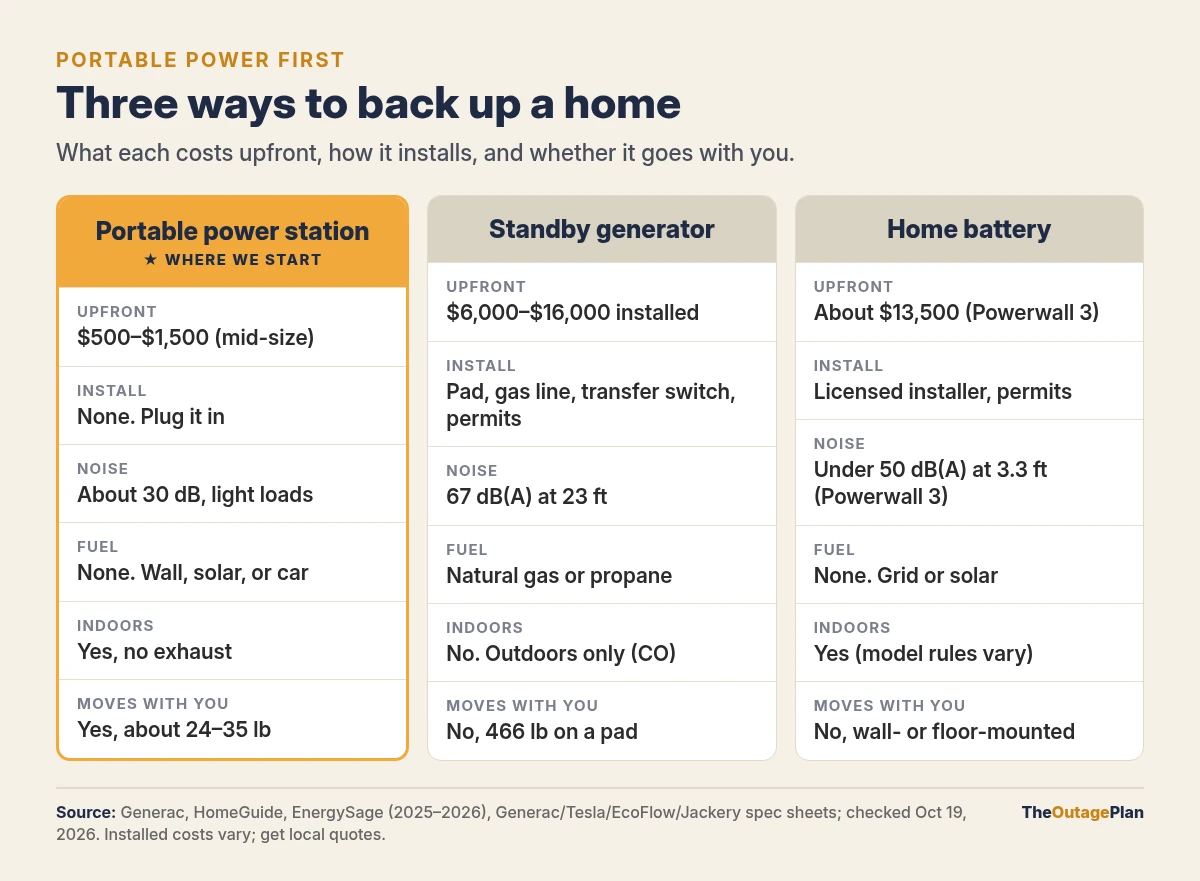
| Portable power station kit | Whole-home standby generator | Home battery | |
|---|---|---|---|
| Example | EcoFlow DELTA 3 Plus, BLUETTI AC180, Jackery Explorer 1000 v2 | Generac Guardian 22 kW | Tesla Powerwall 3, Enphase IQ Battery 5P, FranklinWH aPower 2 |
| Typical upfront cost | Mid-size units typically run $500–$1,500 (EnergySage, Mar 2026) | $8,000–$16,000 installed, per Generac; $6,000–$11,000 national average installed, per HomeGuide | About $13,473 installed for one Powerwall 3; $15,647 for a typical 13.5 kWh battery (EnergySage, 2026) |
| Install, permits, electrician | None. Plug it in | Yes: pad, gas line, transfer switch, permits | Yes: licensed installer, permits, utility sign-off |
| Noise (maker spec) | About 30 dB at lighter loads (EcoFlow, Jackery) | 67 dB(A) at 23 ft under normal load; 57 dB(A) in weekly test mode | Powerwall 3 <50 dB(A) typical at 3.3 ft; Enphase <30 dBA; FranklinWH 30 dBA typical |
| Fuel and upkeep | No fuel. Recharge from the wall, solar, or a car | Natural gas or propane; automatic exercise runs; yearly service | No fuel. Little routine upkeep |
| Indoors / CO | Indoors, no exhaust | Outdoors only; burns fuel and makes exhaust | No exhaust; rated indoor/outdoor (Enphase: garage or outdoors only) |
| Mobility | Carry it: about 24–35 lb | Fixed in place: 466 lb on a pad | Fixed in place: 174 lb (Enphase 5P) to 287 lb (Powerwall 3), wall- or floor-mounted |
| Coverage | About 1 kWh: essentials for a night or a day; expandable models go further | Whole home for as long as the fuel lasts | 13.5 kWh per Powerwall: whole house for hours or essentials for days (EnergySage), longer with solar |
| Best for | Renters, apartments, most homes with hours-to-a-day outages, anyone on a budget | Large homes with frequent multi-day outages and gas service | Owners adding solar, or with strong local incentives |
Sources for every figure are in the sections below.
Upfront cost
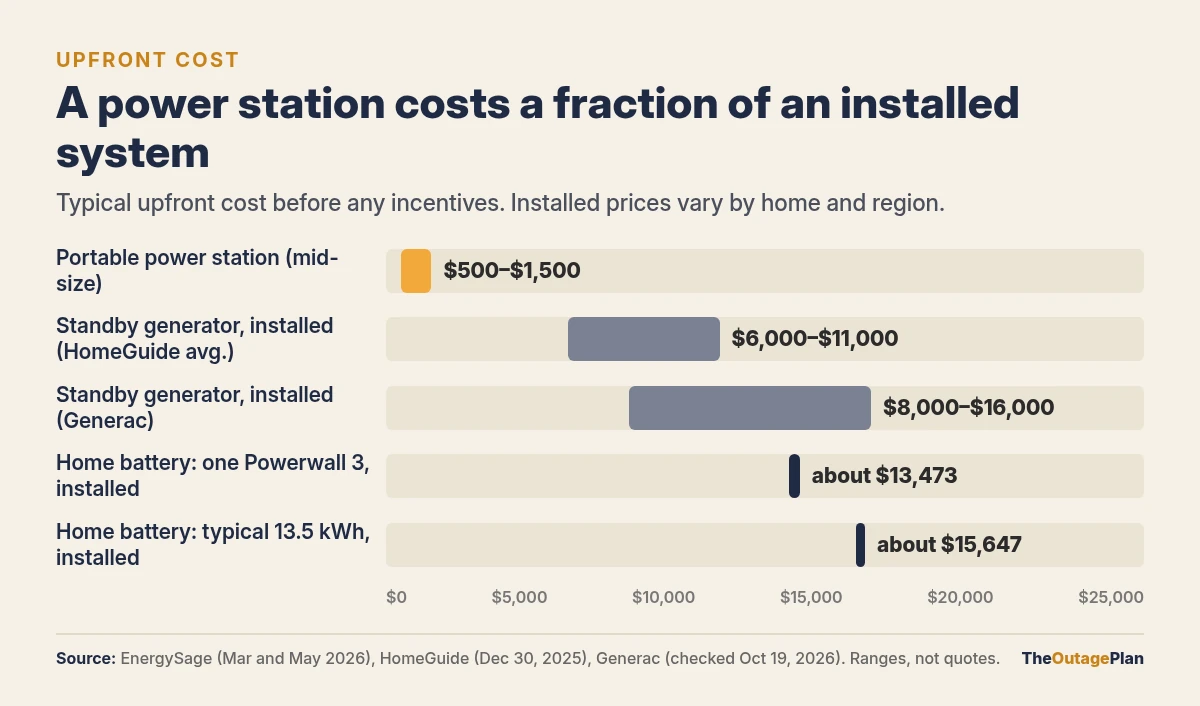
Portable power station. EnergySage says mid-size portable power stations “typically run $500 to $1,500” and need “no installation, no electrician, no landlord permission” (EnergySage, updated Mar 13, 2026). Folding solar panels and extra batteries are optional add-ons you can buy later. We don’t list product prices here because they change constantly, so check the current price at the retailer.
Standby generator. Generac says home standby installs average $8,000–$16,000 including the generator (Generac, checked Oct 19, 2026). HomeGuide puts the national average at $6,000–$11,000 installed, and $9,500–$24,000 for long runs or units over 20 kW (HomeGuide, Dec 30, 2025).
Home battery. EnergySage’s 2026 marketplace data puts a Tesla Powerwall 3 at about $13,473 installed before incentives, about $998 per kWh (EnergySage, updated May 15, 2026). Across brands, a typical 13.5 kWh battery is about $15,647 before incentives; EnergySage lists averages of $1,429/kWh for Enphase and $1,232/kWh for FranklinWH (EnergySage battery costs, updated Jul 13, 2026). EnergySage adds that for whole-home power, “you’ll need more storage than that,” which means more batteries and a higher bill (EnergySage).
Incentives changed. The 30% federal Residential Clean Energy Credit, which covered home batteries, isn’t allowed for expenditures made after December 31, 2025 (IRS). State and utility programs still exist in some places, so ask installers what applies to your address. If it varies or you can’t find it, assume full price until a quote says otherwise.
Installation, permits, and an electrician
- Power station: none. You charge it from a wall outlet and plug things into it. If you ever want it to feed house circuits, that takes a transfer switch installed by a licensed electrician.
- Standby generator: Generac’s dealers prepare a site “often with a concrete slab or pea gravel,” connect the fuel line, and install a transfer switch next to your main breaker box. Generac says the install itself usually takes hours, but preparing for it, including permits and gas-line work, “takes multiple weeks” (Generac). HomeGuide lists permits at $80–$450, a concrete pad at $150–$400, and an automatic transfer switch at $600–$2,500 (HomeGuide).
- Home battery: installed by a qualified installer to local codes. Enphase, for example, tells installers to follow “local codes and requirements of the Authority Having Jurisdiction” (Enphase IQ Battery 5P datasheet). Panel upgrades or long wire runs add cost; get the scope in writing.
Noise
Manufacturers measure noise at different distances, so read the fine print:
– Generac Guardian 22 kW: 67 dB(A) at 23 ft under normal load, and 57 dB(A) in its Quiet-Test low-speed exercise mode, which runs 5 minutes on a weekly, biweekly, or monthly schedule (Generac spec sheet). HomeGuide notes most standby units make 60–70 dB from 25 feet away and that local noise ordinances may apply (HomeGuide).
– Tesla Powerwall 3: less than 50 dB(A) typical and less than 62 dB(A) maximum at 3.3 ft (1 m) (Tesla datasheet).
– Enphase IQ Battery 5P: less than 30 dBA maximum at 3.3 ft, with natural-convection cooling (Enphase).
– FranklinWH aPower 2: 30 dBA typical, 45 dBA maximum (FranklinWH).
– Portable power stations: EcoFlow lists the DELTA 3 Plus at under 30 dB at 600 W, and Jackery lists 30 dB for the Explorer 1000 v2 (EcoFlow, Jackery). Fans speed up under heavy loads and while charging.
Because the Generac figure is measured from 23 ft and the battery figures from about 3 ft, the generator is louder than the raw numbers suggest.
Fuel and maintenance
- Standby generator: runs on natural gas or propane. At full load, Generac lists the 22 kW Guardian at 327 cubic feet per hour of natural gas or 3.90 gallons per hour of propane, and 2.53 gallons per hour of propane at half load (Generac spec sheet). Propane homes need a tank (HomeGuide: $400–$1,800 installed). HomeGuide puts annual maintenance at $200–$650, including oil and filter changes (HomeGuide).
- Home battery: no fuel. Tesla says Powerwall is designed to run “with minimal service or maintenance” (Tesla).
- Power station: no fuel. Keep it topped up in storage (BLUETTI, for example, says to keep the AC180 at 40–60% and recharge every 3–6 months), and charge it fully before a storm.
Indoor use and carbon monoxide
- Power station: no combustion and no exhaust, so it can sit next to the fridge or the bed. Keep it dry and ventilated, per the maker’s manual.
- Standby generator: it burns fuel, so it lives outdoors. HomeGuide says to site it at least 5 ft from doors, windows, vents, and flammable material (HomeGuide); follow your installer and Generac’s manual. Any fuel-burning equipment is a CO risk, so keep battery-operated or battery-backup CO alarms on every level (CPSC). A battery-powered alarm like the First Alert CO710 keeps working when the power is out.
- Home battery: no exhaust. Powerwall 3 is “indoor and outdoor rated” (Tesla datasheet), and FranklinWH says the same for aPower 2. Enphase says to use “a non-habitable indoor location (like a 2-car garage) or an outdoor location” (Enphase).
Never run a portable gas generator indoors, in a garage, or on a porch. See our power station vs. gas generator guide for the CPSC rules.
Mobility: it goes where you go
This is the part most comparisons skip. A standby generator and a home battery are bolted to your house. A Generac 22 kW weighs 466 lb and sits on a pad (Generac); a Powerwall 3 weighs 287 lb and mounts on a wall or floor (Tesla). If you rent, move, or sell, the money stays with the house.
A portable station is about 24–35 lb for the ~1 kWh models we cover. The same box that runs the fridge in an ice storm can:
– power a campsite, a tailgate, or a cabin trip (EnergySage calls them “ideal for short outages, camping trips” and home offices),
– ride along on a road trip or a hurricane evacuation,
– move with you to the next apartment or house, with no landlord permission needed.
Coverage: what each can power, and for how long
- Power station (~1 kWh): 1,500–1,800 W of AC output on the three we cover. As our estimates using Jackery’s capacity × 0.85 ÷ watts formula, a DELTA 3 Plus runs an average fridge for about 12–13 hours or a CPAP for about 15 hours. It won’t run central AC, an electric range, or a well pump for long. Expandable models (the DELTA 3 Plus goes to about 5 kWh, per EcoFlow) and solar panels stretch that into multiple days. Do your own math with our sizing guide. For 120/240 V stations that connect to your panel, see our big power station picks.
- Standby generator: a 22 kW Guardian puts out up to 22,000 W on propane or 19,500 W on natural gas (Generac), enough for many whole homes including central AC, for as long as fuel lasts. HomeGuide says manufacturers recommend up to about 500 hours of continuous running.
- Home battery: a Powerwall 3 stores 13.5 kWh and delivers 11.5 kW continuous (Tesla). EnergySage says systems like the Powerwall or FranklinWH “can power your entire house for hours, or keep your essentials running for days” (EnergySage). With solar, it recharges every sunny day.
Home batteries: worth considering, especially with solar
We like home batteries. They’re quiet, there’s no fuel, and they switch over automatically. Their best case is a home that’s adding solar: the battery stores daytime solar for night and keeps recharging during a long outage, and in some areas it also cuts bills on time-of-use rates or pays you through grid programs. EnergySage notes that if you’re already installing solar, “it really makes sense” to consider whole-home battery backup at the same time (EnergySage). The tradeoffs are cost, a permitted install, and that it stays with the house.
Get at least three quotes, and ask what state or utility incentives apply where you live.
Thinking about Tesla Solar? Our referral link gets you $400 off solar panel installation (per Tesla’s current offer, listed as “Solar Panels & Powerwall: $400 Off”; terms apply). This is a referral link; we may receive a reward from Tesla if you buy through it. Per Tesla’s terms, the buyer benefit is for your first qualifying Tesla product, solar panels count only when Tesla installs them, and the link must be used before you order. Tesla’s terms don’t list a Powerwall-only purchase as a qualifying product, so confirm with Tesla before ordering one on its own.
Standby generators: the right call for some homes
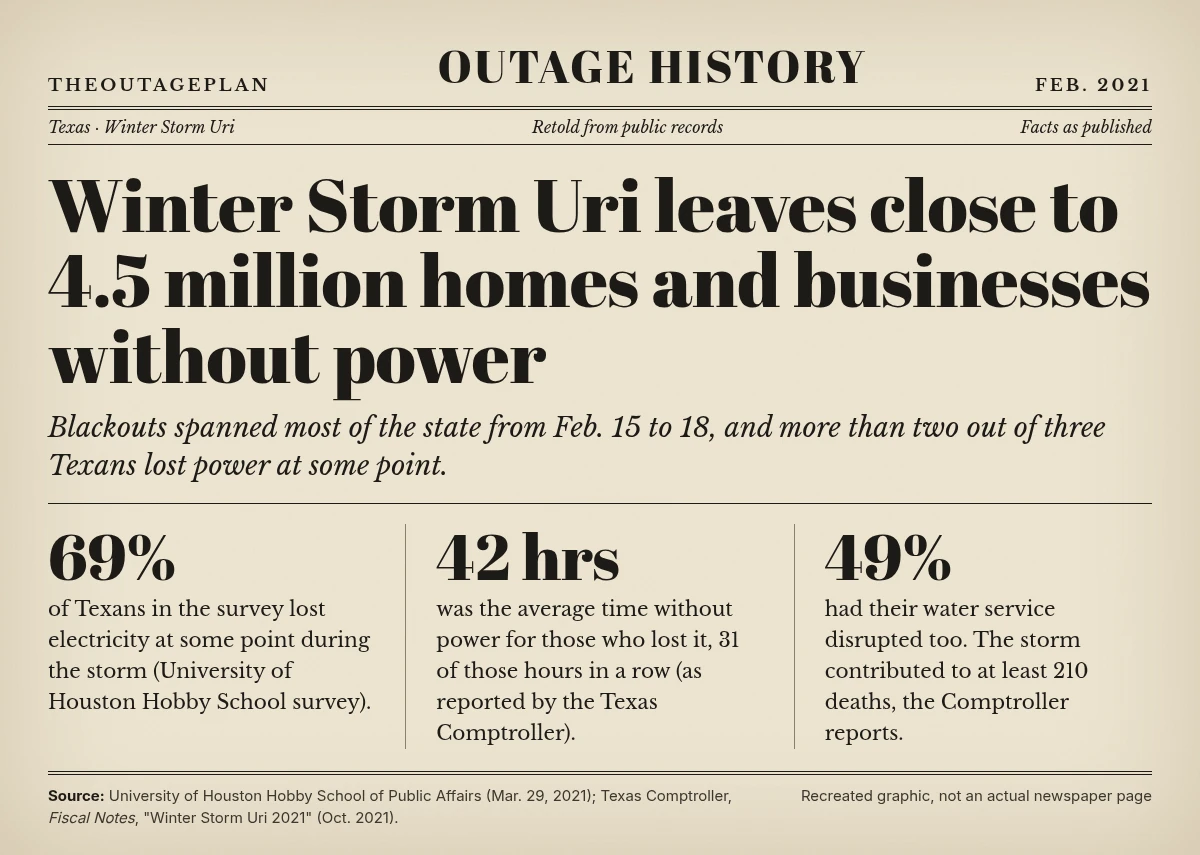
Multi-day outages do happen. One example:
If you have a large home, natural gas service, and outages that regularly run for days (ice storms, hurricanes), a standby generator is hard to beat. It starts automatically, runs the whole house including central AC, and keeps going as long as the gas does. Budget for the install, the yearly service, and the noise, and keep CO alarms on every level.
Who each one is right for
- Start with a portable power station if you rent or live in an apartment; your outages usually last hours to a day; you want the fridge, Wi-Fi, phones, lights, and a CPAP covered; you’d rather spend hundreds than thousands; or you want backup power you can take camping or move with you. Add solar panels or a second battery later.
- Consider a home battery if you own your home, plan to stay, are adding or already have solar, and your state or utility offers incentives or time-of-use savings.
- Consider a standby generator if you have a large home, gas service, frequent multi-day outages, and need whole-home power, including central AC or electric heat.
- Lots of households combine them: a portable station inside for quiet overnight essentials, plus a generator outside or a home battery for the big loads.
Where to go next
- How to size a power station
- Power station vs. gas generator
- EcoFlow vs. Jackery vs. BLUETTI for home backup
- Best power station for a refrigerator and freezer
- Recharging a power station with solar
- Everything on our Gear page
Costs and specs checked Oct 19, 2026, from Generac, Tesla, Enphase, FranklinWH, EcoFlow, Jackery, BLUETTI, EnergySage, HomeGuide, and the IRS. Run times are our estimates, not manufacturer claims. This is general information, not electrical or financial advice. Get local quotes before you buy an installed system.