
Heads up: Some links on this page are affiliate links. If you buy through them, we may earn a commission at no extra cost to you. As an Amazon Associate, we earn from qualifying purchases. Full disclosure
Testing note: We haven’t hands-on tested these stations. Specs come from EcoFlow, Jackery, Anker SOLIX and BLUETTI product pages, manuals and spec sheets, checked Oct 19, 2026. Run times are our math, not maker claims.

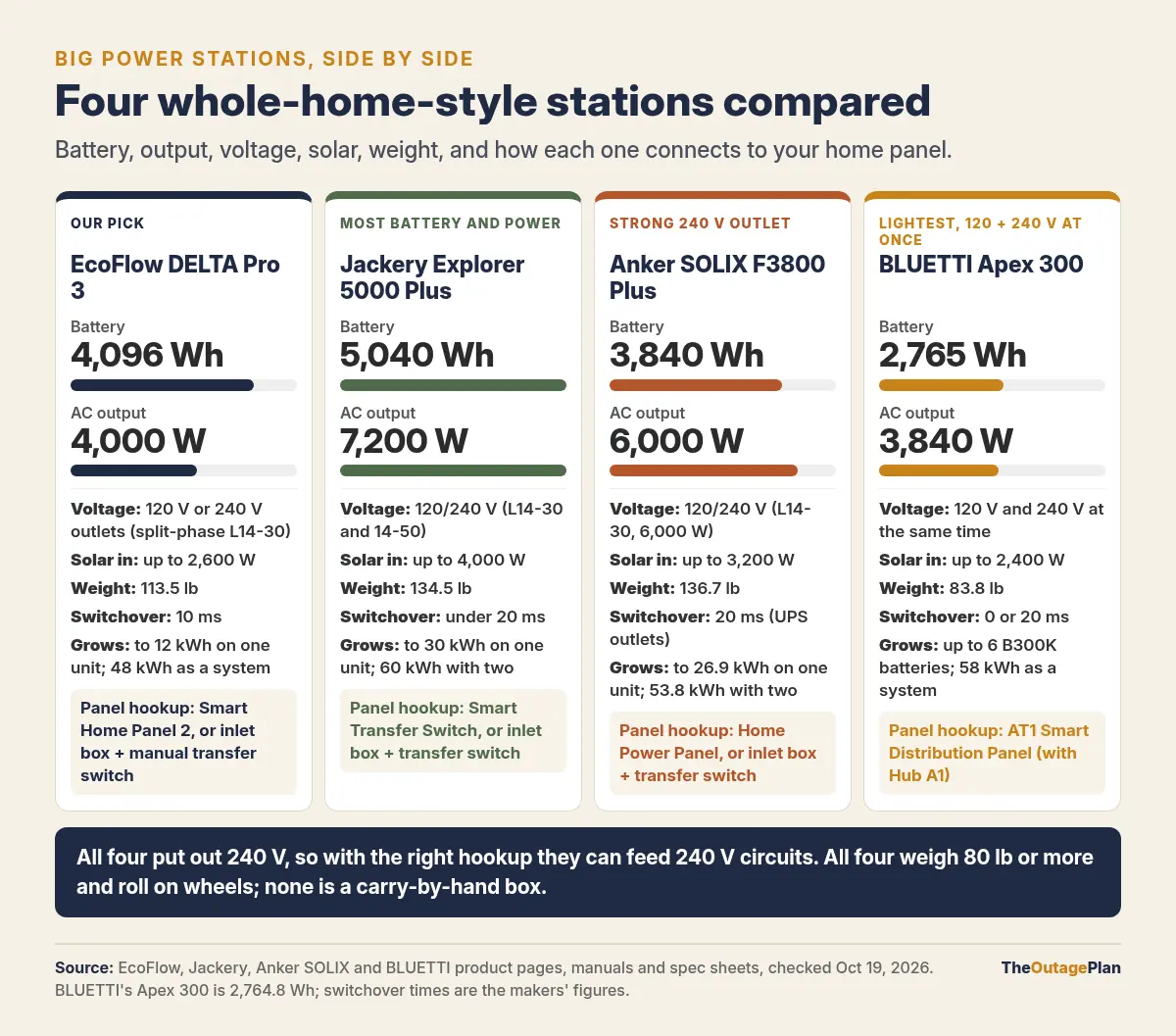
Bottom line: A big power station (about 2.7 to 5 kWh, with 120 V and 240 V output) sits between a ~1 kWh portable and an installed home battery. Wired to a transfer switch or the maker’s own panel, it can run the circuits you choose, including 240 V ones, with no fuel and no fumes. For most homes we’d pick the EcoFlow DELTA Pro 3.
Our pick
EcoFlow DELTA Pro 3: 4,096 Wh, 4,000 W of 120/240 V output and a 10 ms switchover. It grows to 12 kWh with two extra batteries and connects to your panel through EcoFlow’s Smart Home Panel 2 or an inlet box and manual transfer switch.
Want the most battery and power in one box? The Jackery Explorer 5000 Plus. The lightest of the four? The BLUETTI Apex 300.
Is a big station really “whole-home” backup?
Not on one charge. These stations put out 3,840 to 7,200 W, enough for many 240 V appliances, but the battery is the limit. Think “the circuits that matter for a day or two,” then add batteries, solar or a generator outdoors to go longer.
Weighing a standby generator or a Powerwall instead? Our portable vs. standby generator vs. home battery comparison covers cost, install and noise. For a gas generator, see power station vs. generator.
What one charge covers
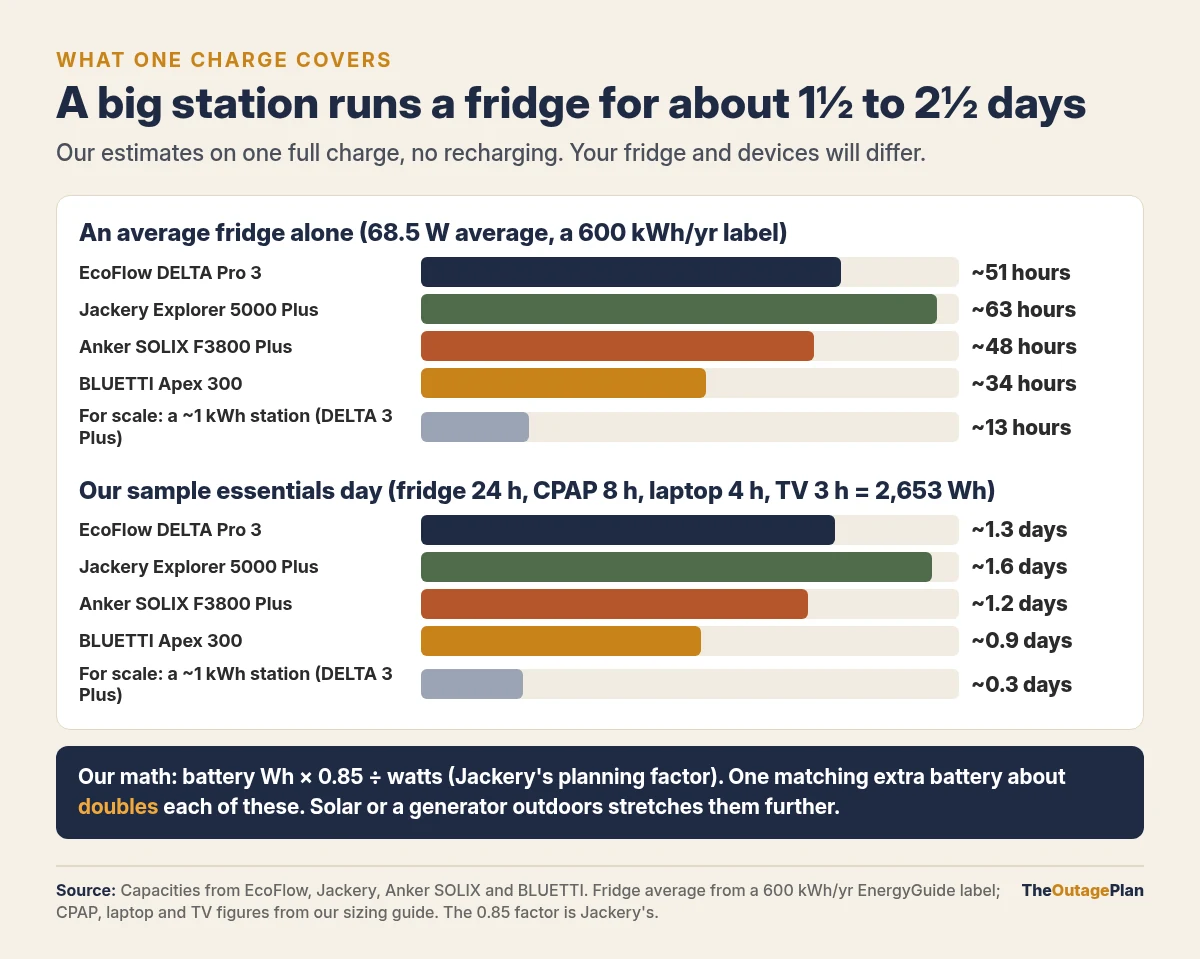
A typical fridge runs about 1½ to 2½ days on one charge, by our math. Bigger loads drain it fast. EcoFlow says the DELTA Pro 3 can run a 3-ton central AC (in its lab, with a soft starter), and Jackery estimates about 2 hours of central AC (2,200–3,050 W) on one Explorer 5000 Plus (Jackery). Have a well? Check the pump’s startup surge in our well pump guide first. To size your own list, use our sizing guide.
How it connects to your home panel

- EcoFlow: the Smart Home Panel 2 takes up to three DELTA Pro 3 units, switches over in 20 ms and lets you control up to 12 circuits in the app. Or run the station’s L14-30 outlet to an inlet box and manual transfer switch (EcoFlow).
- Jackery: the Smart Transfer Switch handles 12 circuits at 120 V or 6 at 240 V and switches in 20 ms or less with UPS turned on in the app (about 5 seconds without it). Jackery also lists a transfer switch or inlet box (Jackery).
- Anker: the Home Power Panel, or a transfer switch or inlet box from the L14-30 outlet (Anker SOLIX).
- BLUETTI: the AT1 Smart Distribution Panel, connected through the Hub A1 (BLUETTI).
Every panel option needs an electrician, and permits may apply. Get a quote and pick your circuits before you buy the station.
Our four picks
Best for most homes: EcoFlow DELTA Pro 3
4,096 Wh, 4,000 W (8,000 W surge) and a 10 ms switchover. It has 120 V outlets plus a 240 V outlet and a split-phase L14-30, the plug a transfer switch uses. Solar input reaches 2,600 W, and it charges at 32–113°F (EcoFlow).
The catch: at 113.5 lb, it’s a roll-around, not a carry. Its 120 V and 240 V outlets work one group at a time, and the main unit isn’t water-resistant, so keep it indoors or under cover.
Most battery and power: Jackery Explorer 5000 Plus
5,040 Wh, 7,200 W (14,400 W surge) at 120/240 V through L14-30 and 14-50 outlets, under 20 ms switchover (0 ms in online UPS mode), and up to 4,000 W of solar. It weighs about 134.5 lb and grows to 30 kWh with five Battery Packs (Jackery).
The catch: Jackery doesn’t recommend its stations for medical devices. Its site says the 5-year warranty is for Jackery.com purchases, while the Amazon listing says 5 years, so confirm before you buy. On the Smart Transfer Switch, it can’t charge from its 120 V input.
Strongest 240 V outlet: Anker SOLIX F3800 Plus
3,840 Wh and 6,000 W, all of it available from the 120/240 V L14-30 outlet. Solar input is 3,200 W across two 11–165 V ports, and the Amazon listing says six extra batteries take it to 26.9 kWh (Anker SOLIX).
The catch: at 136.7 lb, it’s the heaviest here. Its 20 ms UPS covers three outlets, and only while it’s on wall power. Anker says it can’t recharge from rooftop solar through the Home Power Panel during an outage.
Lightest, with 120 V and 240 V at once: BLUETTI Apex 300
2,764.8 Wh and 3,840 W, with 120 V and 240 V running at the same time. It switches in 0 or 20 ms depending on mode, takes 2,400 W of solar (4,000 W with BLUETTI’s SolarX 4K) and weighs 83.8 lb (BLUETTI, spec sheet).
The catch: it has the smallest battery, so plan on a B300K expansion battery for multi-day outages. It charges only at 32–104°F, and the automatic panel route needs both the AT1 and the Hub A1.
Before you buy
- Plan where it lives. These weigh 84 to 137 lb. Pick a dry garage or utility room near your panel, and bring it above freezing before you charge it.
- Check the seller and the return policy. On our Oct 19 check, Amazon listed all four as non-returnable (hazardous-materials shipping), with refunds or replacements only if one arrives damaged or defective.
- Plan the recharge. Add solar (our solar kit picks cover smaller stations), or run a gas generator outside only, at least 20 feet from the home (Ready.gov).
- Medical devices: talk to your provider first. See our CPAP backup guide.
Why portable first: a ~1 kWh station covers a fridge for about half a day, plus Wi-Fi and phones, for far less upfront. Compare them in EcoFlow vs. Jackery vs. BLUETTI or our spec table.
FAQ
Can a big power station run central air?
For a while, sometimes. Starting surge is the hard part. EcoFlow’s 3-ton claim comes from a lab test with a soft starter, and Jackery estimates about 2 hours of central AC per Explorer 5000 Plus charge. Ask your HVAC tech about a soft starter and the compressor’s startup draw.
Do you need an electrician?
Not to plug appliances into the station. To power house circuits, yes. Never plug a station into a wall outlet to feed the house. That backfeeds the wiring and can electrocute utility workers (OSHA).
Big station or a home battery like a Powerwall?
A big station rolls out of the way, moves with you and can start as plug-in backup. An installed home battery stays with the house and pairs with rooftop solar. Our three-way comparison lays out the tradeoffs.
Specs last checked Oct 19, 2026, from EcoFlow, Jackery, Anker SOLIX and BLUETTI pages, manuals and spec sheets, plus the Amazon listings. If a maker updates a spec, their page wins. Tell us and we’ll fix ours.