
Heads up: Some links on this page are affiliate links. If you buy through them, we may earn a commission at no extra cost to you. As an Amazon Associate, we earn from qualifying purchases. Full disclosure
Testing note: We haven’t hands-on tested any power station with a well pump. Pump electrical data comes from Franklin Electric’s 2026 AIM manual and SubDrive Utility specs, Grundfos’s SQ/SQE data booklet, Goulds’ jet pump manual, and Red Lion’s spec sheet and owner’s manual. Tank figures come from Amtrol, and station specs come from EcoFlow, BLUETTI, and Jackery, all checked Oct 19, 2026. Runtimes, gallons, and watt-hour figures are our estimates.
Bottom line: Usually not, and it’s never as simple as plugging in.
- Most well pumps run on 230 V. Franklin, Grundfos, and Goulds sell 115 V motors only at 1/2 HP and smaller, or as dual-voltage jet pumps. All three ~1 kWh stations we cover put out 120 V only.
- The startup surge is the wall. Franklin lists 64.4 locked-rotor amps for its 1/2 HP, 115 V two-wire motor. That’s about 7,400 VA by our arithmetic, roughly twice the biggest surge rating of the three.
- The best fit is a 115 V soft-start pump. Grundfos’s 115 V SQE pumps draw 4.2 to 8.6 A and soft-start, so a station’s inverter may be able to run one. A ~1 kWh station gives about 1 to 2 hours of pump time, by our math.
- Every setup needs an electrician. Well pumps are hardwired. That means a transfer switch or a code-approved inlet, never a homemade cord.
- Stored water is the dependable backup. The CDC says to store at least 1 gallon per person per day for 3 days, and 2 weeks if you can.
Why the water stops when the power goes out
A private well has no water tower behind it. An electric pump pushes water into a pressure tank, and a pressure switch turns the pump on and off. When the power goes out, the pump stops. You get whatever water is stored in the tank, and then the faucets go dry.
When a big storm takes down the grid across a region, every electric well pump on those lines stops with it. One example:

How much is in the tank? Amtrol’s Well-X-Trol chart lists the drawdown, the water delivered between the pump’s cut-out and cut-in pressures. A 20-gallon WX-202 gives about 6.2 gallons at a 30/50 psi setting. A 44-gallon WX-250 gives 13.6 gallons, and a 119-gallon WX-350 gives 36.8 gallons. Amtrol notes that temperature and pressure affect drawdown (Amtrol).
That’s a few toilet flushes. The federal standard for new toilets is 1.6 gallons per flush, and older toilets can use as much as 6 gallons (EPA WaterSense). A standard showerhead uses 2.5 gallons per minute (EPA WaterSense).
Know your pump first
The answer depends on what kind of pump you have and what voltage it runs on. Check the motor nameplate, the pressure switch, or the circuit breaker label, or ask your well contractor.
Submersible pumps sit down in the well. Franklin’s motor tables list single-phase 4-inch motors in two styles (Franklin Electric):
- Two-wire motors have the starting parts built in.
- Three-wire motors use a separate control box at the surface.
Jet pumps sit above ground, near the tank, and pull water up. Red Lion’s shallow-well jet pumps are for wells where the water level is within 25 feet of the pump, including drawdown (Red Lion).
Constant-pressure systems use a drive to vary pump speed instead of switching it fully on and off. Grundfos’s SQE with a CU 301 control is one. Franklin’s SubDrive is another, and Franklin says its single-phase submersible motors can be used with a variable-speed drive only through its own constant-pressure controller (Franklin Electric).
120 V or 240 V: the first thing that rules a station out
Most well pumps run on 230 V, the 240 V circuit in a home panel. Here’s what the makers sell (Franklin Electric, Grundfos, Goulds, Franklin SubDrive Utility), and what our stations put out:
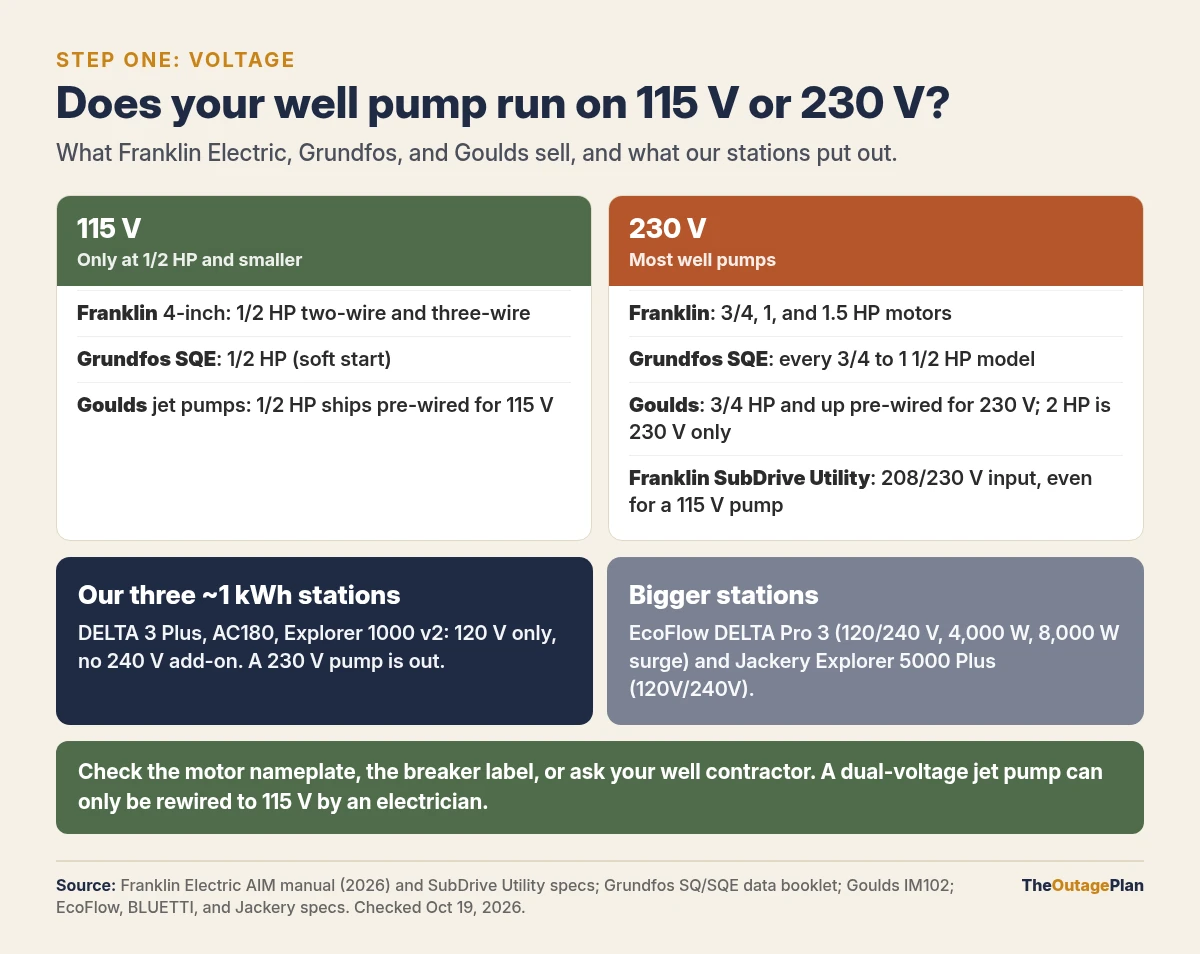
Our three stations put out 120 V only (EcoFlow manual, BLUETTI, Jackery). EcoFlow’s extra batteries add capacity, not a 240 V output (EcoFlow), and none of the three lists a 240 V add-on, so none can run a 230 V well pump. Even with a 115 V pump, Franklin’s SubDrive Utility drive needs 208/230 V input.
Bigger stations can. EcoFlow’s DELTA Pro 3 lists 120/240 V output at 4,000 W with an 8,000 W surge, including a 120/240 V L14-30 outlet. EcoFlow says it can power a 1 HP water pump (EcoFlow DELTA Pro 3). Jackery lists its Explorer 5000 Plus as 120V/240V dual voltage (Jackery Explorer 5000 Plus). These are a different class of machine; our big power station picks compare them. Before buying one for a well, give your pump’s nameplate and the surge figures below to the station maker and your pump installer.
The startup surge: locked-rotor amps
A motor draws far more current for a moment as it starts than while it runs. Franklin calls that current locked-rotor amps (LRA). Franklin also warns that a bound or sand-locked pump draws locked-rotor amps and trips the overload (Franklin Electric).
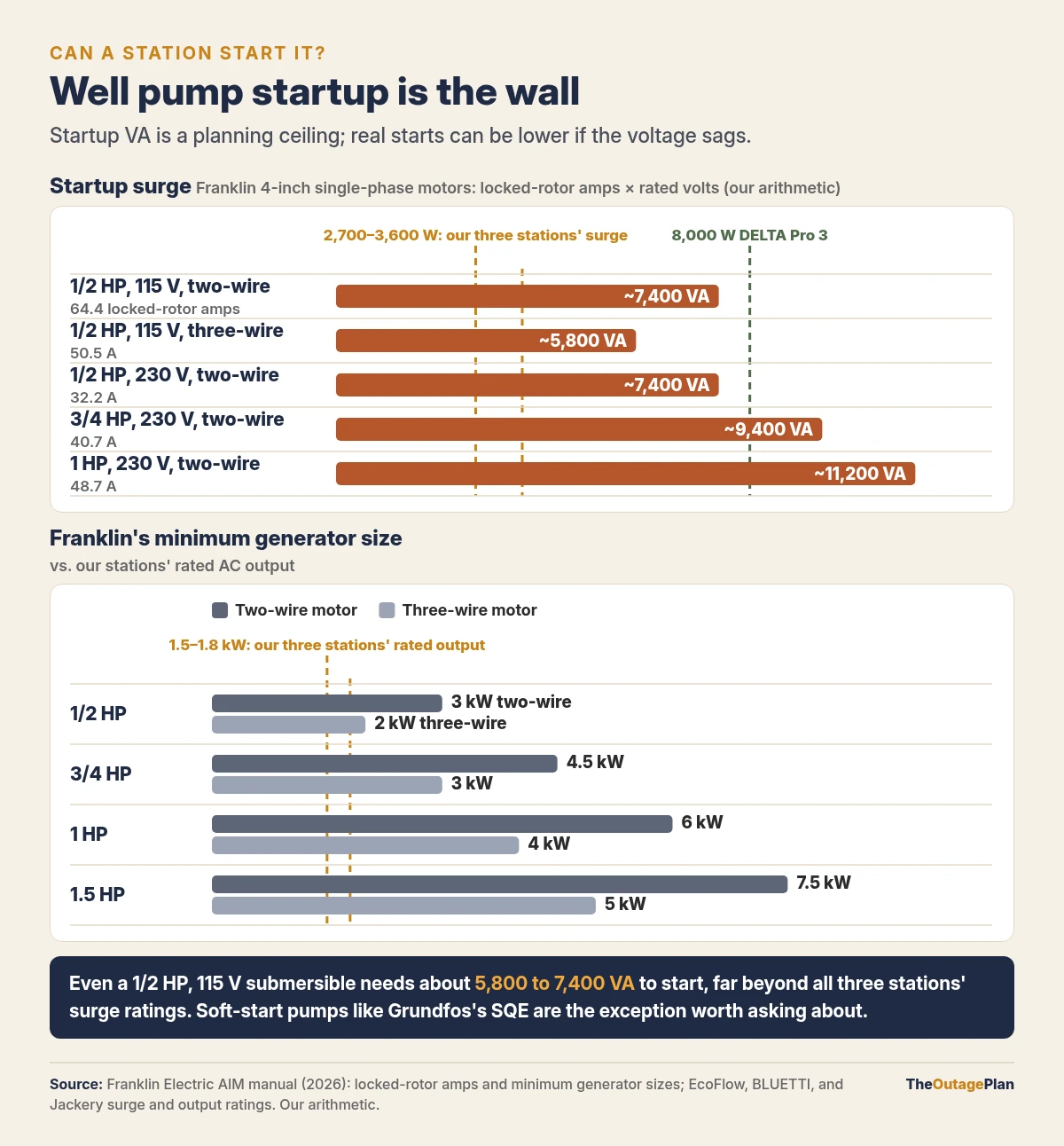
Startup VA is locked-rotor amps times the rated voltage (our arithmetic from Franklin’s tables). Real starts can be lower if the voltage sags, but that’s the scale. Compare it with the surge ratings: 3,600 W for the EcoFlow DELTA 3 Plus, 2,700 W for the BLUETTI AC180, and 3,000 W peak for the Jackery Explorer 1000 v2 (EcoFlow, BLUETTI, Jackery). We wouldn’t expect a ~1 kWh station to start a standard 115 V submersible.
The 230 V numbers matter for larger stations. Franklin’s 1 HP two-wire motor works out to about 11,200 VA at startup, which is above the DELTA Pro 3’s 8,000 W surge rating. EcoFlow says the DELTA Pro 3 can power a 1 HP water pump, so ask EcoFlow about your exact motor before you count on it.
Jet pumps: Goulds lists 10.8 A at 115 V and 968 W maximum load for the 1/2 HP J5S. Red Lion lists 11.2 A at 115 V for its 1/2 HP RJS-50 (Goulds, Red Lion). Neither publishes a locked-rotor figure. Red Lion’s premium RJS-PREM line says it has a capacitor “for increased starting power” (Red Lion). Running power fits under every station’s rating. Whether a station can start one is something only a test with your electrician will tell you.
Soft-start pumps: the case where a station might work
Grundfos’s SQ and SQE pumps have a built-in soft starter. Grundfos says it reduces the starting current and prevents overloading the supply during start-up, with a run-up time of 3 seconds at most and no limit on starts per hour. Its booklet says the starting current “is equal to the highest value stated on the motor nameplate,” and it lists a power factor of 1 (Grundfos).
The 115 V models: the 1/2 HP SQE pumps draw 4.2 to 8.6 A at full load, and the motor table lists 11 A overload amps at 115 V. At a power factor of 1, that’s about 480 to 990 W running (our arithmetic).
Grundfos’s generator rule: generator output should equal the motor’s input power plus 50%, and at least plus 10%. For a ~990 W pump, that’s about 1,480 W, or 1,090 W at the minimum (our arithmetic). That falls under the 1,800 W rating of the DELTA 3 Plus and AC180 and just under the Explorer 1000 v2’s 1,500 W. A station isn’t a generator, and Grundfos doesn’t rate its pumps for battery inverters. So treat this as a reason to ask Grundfos and your installer, not as an approval.
How long a ~1 kWh station runs a well pump
We use the same formula as our other guides: runtime ≈ battery capacity × 0.85 ÷ watts. The 0.85 covers inverter losses. These are minutes of pump-on time, and they assume the station can start the pump.
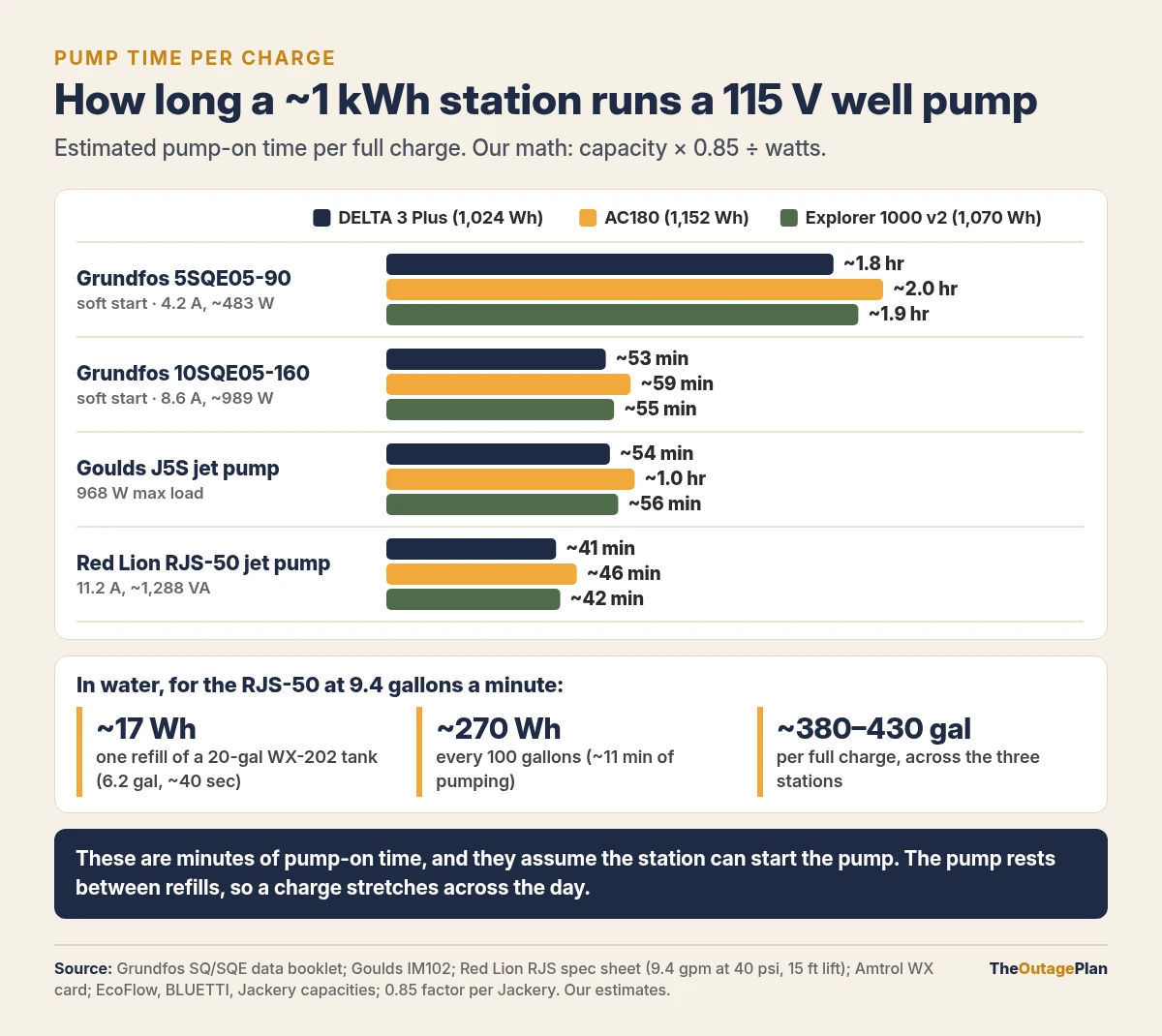
A well pump runs only when the tank needs refilling, so a charge lasts longer than the pump-on times suggest. The water figures use the Red Lion RJS-50’s 9.4 gallons per minute (Red Lion’s figure at 40 psi and 15 feet of suction lift) (Red Lion) and are our estimates.
That’s enough for drinking, cooking, and flushing for a while, if the station can start the pump and the voltage matches. A DELTA 3 Plus expanded to 5 kWh (EcoFlow) holds about five times as much. To refill a station with panels, see how much solar you need.
Don’t let the station shut itself off. A pump sits at zero watts between cycles, and an idle station may turn its AC outlets off. EcoFlow says to set the DELTA 3 Plus’s AC timeout to “never” for loads that cycle (EcoFlow manual). Our gas furnace guide covers the Jackery setting too.
The hard part: getting power to the pump
Well pumps are hardwired. Red Lion says to employ a licensed electrician and to run a separate circuit from the panel to the pump. It also recommends a GFI-protected circuit and a fused disconnect, and it warns that undersized wire limits the motor’s starting ability (Red Lion). There’s no plug for a station to feed.
Never backfeed. Plugging a generator into a wall outlet “is extremely dangerous,” the CPSC warns. It can electrocute utility workers and neighbors on the same transformer (CPSC). Franklin says automatic or manual transfer switches must be used any time a generator backs up power lines (Franklin Electric). The Red Cross says to have a licensed electrician install a transfer switch that meets the National Electrical Code (Red Cross).
A furnace switch won’t fit a 230 V pump. Reliance Controls’ single-circuit Easy/Tran TF switches are rated at 125 V AC for a 120 V circuit (Reliance Controls). A 230 V pump needs a 240 V-rated transfer setup, which an electrician can size for your panel.
The generator alternative
For a typical 230 V submersible, a generator with a transfer switch is the usual answer. Franklin’s minimum generator sizes run from 2 to 3 kW for a 1/2 HP motor up to 5 to 7.5 kW at 1.5 HP (the second chart above) (Franklin Electric). Even the smallest is above the 1,500 to 1,800 W our three stations deliver. Franklin also says:
- The generator must deliver at least 65% of the motor’s rated voltage during starting.
- Start the generator before turning on the pump, and turn the pump off before shutting the generator down.
- Letting the generator coast down or run out of fuel with the motor running can damage the motor’s thrust bearing.
Run it safely. Ready.gov says to use generators only outdoors, at least 20 feet from windows, doors, and attached garages, and to install battery-backup CO detectors on every level (Ready.gov). Our power station vs. generator guide compares the two.
The dependable fallback: stored water
Unless a well setup has been tested on backup power, plan as if the well will be off for the whole outage. Stored water doesn’t need a pump, an inverter, or an electrician.
How much: the CDC says to store at least 1 gallon per person per day for 3 days, and to try for a 2-week supply. Store more for pregnant women, people who are sick, pets, or a hot climate (CDC). Ready.gov adds that in very hot weather, water needs can double (Ready.gov). For a family of four, that’s 12 gallons for 3 days and 56 gallons for 2 weeks (our arithmetic).
How to store it (CDC):
- Use food-grade containers with tight lids, like the Reliance Aqua-Tainer 7-gallon container.
- Sanitize them first with 1 teaspoon of unscented bleach per quart of water, using bleach with 5% to 9% sodium hypochlorite.
- Label each one with the date and replace the water every 6 months.
- Store it at 50 to 70°F, out of direct sunlight, and away from gasoline and pesticides.
- Keep a bottle of unscented bleach on hand for disinfecting water.
Plan flush water separately. At 1.6 gallons a flush, a 7-gallon container covers about four flushes (our arithmetic). Drinking water is the one to protect. Our water storage guide covers containers, rotation, and treating water.
After the outage: check the well before you drink
- If the well flooded, don’t turn on the pump. EPA warns of electrical shock and damage to the well or pump. Once things dry out, have a qualified electrician, well contractor, or pump contractor check the wiring (EPA).
- After a disaster, drink bottled water until you’re sure the well water is safe, the CDC says. Water with fuel or chemical contamination won’t be made safe by boiling or disinfection (CDC).
- Have the wiring checked. Before power goes back on to a damaged well, a qualified electrician, well contractor, or pump contractor should check the equipment wiring (CDC).
- Call your health department if you think the well is contaminated. Private wells aren’t regulated, so their safety is the owner’s job, and the CDC recommends testing every year (CDC).
Well pump outage checklist
- ☐ Pump type, horsepower, and voltage checked (nameplate, breaker, or well contractor)
- ☐ Pressure tank model and drawdown noted
- ☐ Licensed electrician consulted about a transfer switch or code-approved inlet rated for your pump’s voltage
- ☐ If you’re relying on a station: pump starts tested on it, with your electrician, on a mild day
- ☐ Station auto-off settings turned off
- ☐ Generator sized to your pump maker’s minimum, with a transfer switch, kept 20 ft from the house
- ☐ At least 1 gallon per person per day stored for 3 days, 2 weeks if possible
- ☐ Separate water set aside for flushing
- ☐ Unscented bleach and a way to boil water
- ☐ Health department and well contractor numbers saved
FAQ
Can you plug a well pump into a power station?
Not directly. Well pumps are hardwired, and most run on 230 V, which our three ~1 kWh stations don’t supply. A 115 V pump can only be connected through a transfer switch or a code-approved inlet that a licensed electrician installs.
What size power station do you need for a well pump?
It needs the right voltage and enough surge. A 230 V pump needs a station with 240 V output. A standard 1/2 HP, 115 V submersible starts at about 7,400 VA by our arithmetic from Franklin’s figures. A 115 V soft-start pump like Grundfos’s SQE is the most realistic fit for a 1,800 W station.
How much water is in your pressure tank when the power goes out?
About the tank’s drawdown. Amtrol lists 6.2 gallons for its 20-gallon WX-202 and 13.6 gallons for its 44-gallon WX-250, at 30/50 psi. That’s a few flushes, so store water separately.
Is a generator better for a well pump?
For most 230 V pumps, yes. Franklin’s minimum generator size starts at 2 to 3 kW for a 1/2 HP motor. It must run outdoors, at least 20 feet from the house, and connect through a transfer switch.
The three stations, water containers, and bleach are on our Gear page. To size a station for everything else in an outage, start with our power station sizing guide, and for a basement pump see sump pump backup.
Pump data checked Oct 19, 2026, from Franklin Electric’s 2026 60 Hz AIM manual and SubDrive Utility UT2W specifications, Grundfos’s SQ, SQE, SmartFlo and SP data booklet, Goulds’ jet pump manual IM102R13, and Red Lion’s RJS spec sheet and owner’s manual. Tank drawdown is from Amtrol’s Well-X-Trol card MC7025. Station specs are from EcoFlow, BLUETTI, and Jackery, and safety and water guidance from the CDC, EPA, CPSC, Ready.gov, and the Red Cross. Startup VA, runtimes, gallons, and watt-hours are our estimates, not manufacturer claims. Your pump’s nameplate and manual win. This is general information, not electrical or plumbing advice. Hire a licensed electrician for any connection to your home’s wiring.