
Heads up: Some links on this page are affiliate links. If you buy through them, we may earn a commission at no extra cost to you. As an Amazon Associate, we earn from qualifying purchases. Full disclosure
Testing note: We haven’t hands-on tested any power station with a furnace or boiler. Furnace electrical data comes from Goodman’s spec sheet and Carrier’s product data and installation manual, the generator rules from Carrier’s and Lennox’s installation instructions, and station specs from EcoFlow, BLUETTI, and Jackery, all checked Oct 19, 2026. Runtimes and duty-cycle figures are our estimates.

Updated for winter 2026–27: If your furnace needs a transfer switch or inlet, have a licensed electrician install it before the first hard freeze, not during an outage. For this season, see NOAA’s winter outlook (Oct. 15, 2026) and the National Weather Service’s cold-weather alerts.
Bottom line: Sometimes, for a few hours, and only if it’s hooked up the right way.
- A gas furnace won’t heat without electricity. The blower, inducer, igniter, and controls run on 115 to 120 V.
- The draw is usually smaller than a space heater’s. Goodman lists about 100 to 410 W for the blower alone at heating speed. Carrier’s maximum input runs 5.1 to 12.9 A.
- A ~1 kWh station runs our ~342 W example furnace for roughly 2.6 to 2.9 hours of blower time by our math, spread longer as the furnace cycles on and off.
- Many furnaces are hardwired. Getting station power to one takes a transfer switch or a code-approved cord and inlet installed by a licensed electrician, never a homemade cord or a wall outlet.
- Carbon monoxide comes first. Battery-powered CO alarms, clear vents, and no generators, grills, or ovens for heat indoors.
What a gas furnace needs electricity for
The gas heats the house, but electricity runs the furnace. Goodman’s spec sheet for its GR9S80 line lists a hot-surface igniter, a draft inducer, a self-diagnostic control board, and a multi-speed ECM blower motor, and says all of these furnaces are built for 115 VAC, 60 Hz power (Goodman). Carrier’s 59SC5B lists a 104 to 127 V operating range, a silicon nitride igniter, and a 24 V control transformer (Carrier).
When the power goes out, the furnace stops, even though the gas is still on.
Boilers are similar. Weil-McLain’s Ultra gas boiler manual calls for a minimum 15-amp, 120 VAC supply and allows up to 2.2 A per circulator pump (Weil-McLain). A small ECM circulator like Taco’s 007e draws up to 44 W (Taco), and the boiler’s blower and controls add more.
How many watts does a furnace draw?
Goodman’s blower watts. Goodman’s airflow tables list blower watts at each speed. At the default heating speed and 0.5 in. of static pressure, the GR9S80 line runs from about 102 W (40,000 BTU) to 408 W (120,000 BTU), and 7 of its 10 sizes fall between 184 and 257 W. The 80,000 BTU GR9S80 0803B lists 242 W (Goodman). That’s the blower only.
Carrier’s maximum input amps. For the whole furnace, Carrier lists 5.1 A on the 26,000 BTU 59SC5B up to 12.9 A, and 7.1 A on the 60,000 BTU 060E14 (Carrier). At 115 V, that’s about 590 to 1,480 VA (our arithmetic). It’s a ceiling, not a typical heating draw, since the blower can run faster for cooling.
Our allowance for everything else. On most Carrier sizes, maximum input amps run under 1 A above the blower motor’s full-load amps. So we add 100 W to Goodman’s blower watts for the inducer, igniter, and controls. That’s our planning allowance, not a maker figure. Your furnace’s rating plate lists its own volts and amps.
How long a ~1 kWh station runs a furnace
We use the same formula as our other guides: runtime ≈ battery capacity × 0.85 ÷ watts. The 0.85 covers inverter losses. A furnace runs and rests as the thermostat calls for heat, so real runtime stretches past the nonstop figures. The cycling rows are our estimates for the ~342 W example:
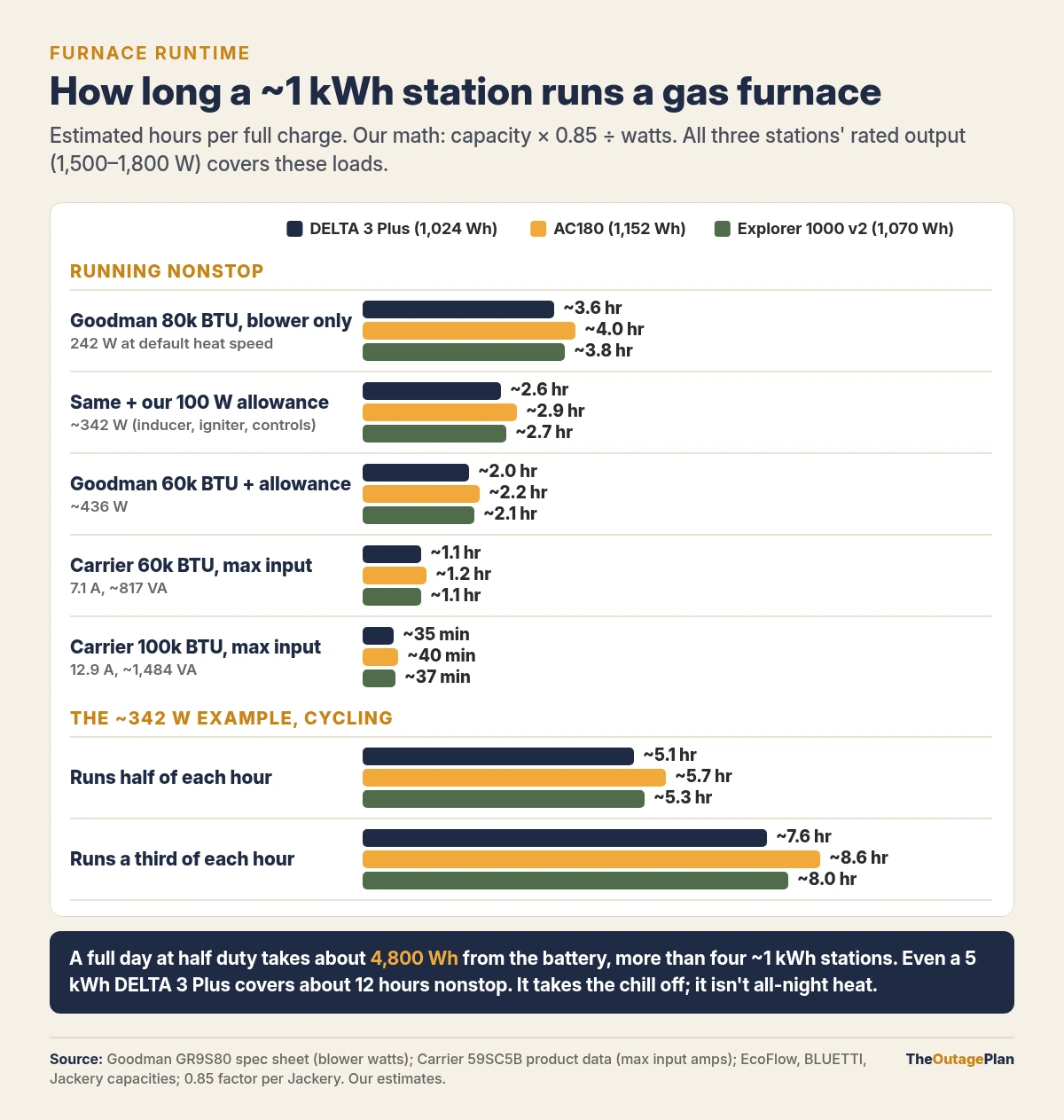
Rated AC output is 1,800 W on the EcoFlow DELTA 3 Plus (3,600 W surge) and the BLUETTI AC180 (2,700 W surge), and 1,500 W on the Jackery Explorer 1000 v2 (3,000 W surge peak) (EcoFlow, BLUETTI, Jackery), so all three cover these loads. Carrier’s 12.9 A worst case sits just under the Jackery’s limit. Neither furnace sheet lists a startup surge figure.
The station also uses power while the furnace rests: BLUETTI figures about 15 W of self-consumption for the AC180, and Jackery lists 18 W standby for the Explorer 1000 v2 (BLUETTI, Jackery).
What a full day takes
A ~342 W furnace running half the day uses about 4,100 Wh at the furnace, or about 4,800 Wh from the battery (our math). A DELTA 3 Plus expanded to its 5 kWh maximum (EcoFlow) covers roughly a day at half duty.
Winter sun won’t close that gap: by our math in how much solar you need, 400 W of panels makes about 600 Wh on a 2-sun-hour December day. A ~1 kWh station takes the chill off a few times a day. It isn’t all-night heat.
The hard part: getting power to the furnace
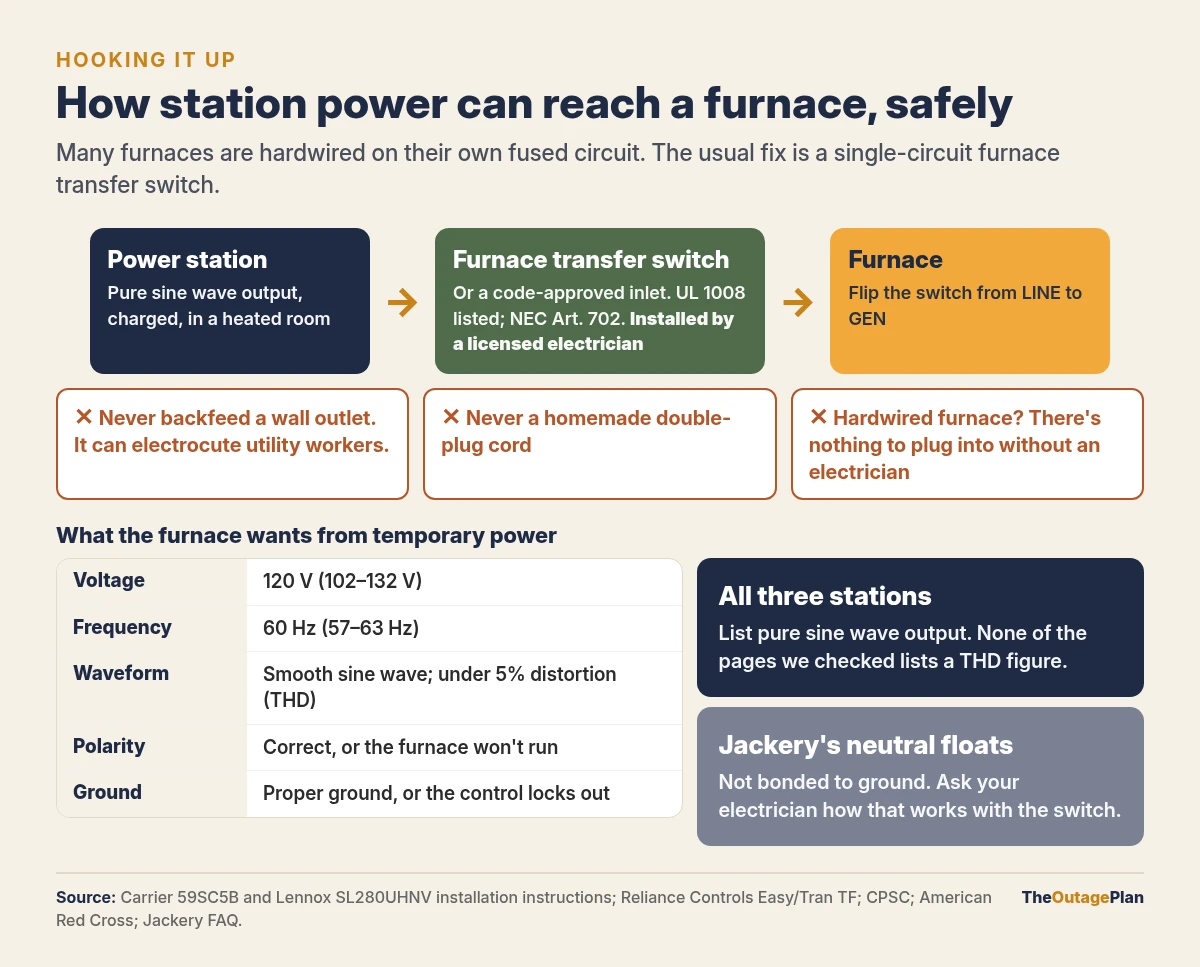
Many furnaces don’t have a plug. Carrier’s installation manual calls for a separate, fused branch circuit with a disconnect within sight of the furnace. It allows a listed, grounded power cord only where local code permits (Carrier). If yours is hardwired, a station’s outlets have nothing to plug into.
Never backfeed. Plugging a generator into a wall outlet “is extremely dangerous,” the CPSC warns. It can electrocute utility workers and neighbors on the same transformer (CPSC). The same goes for any homemade double-plug cord. To power a house circuit, the Red Cross says to have a licensed electrician install a transfer switch that meets the National Electrical Code (Red Cross).
The usual fix is a single-circuit furnace transfer switch, such as Reliance Controls’ Easy/Tran TF series. Reliance says transfer switches are required for portable generators by Article 702 of the National Electrical Code, that its switch is UL 1008 listed, and that a qualified electrician must install it. The 15-amp TF151 is rated for 1,875 running watts (Reliance Controls). You plug the power source into its inlet and flip it from LINE to GEN. Your electrician may suggest another code-approved setup.
Power quality: the furnace has to like the station
Furnace control boards are picky. Carrier says its furnace is designed for utility power’s “smooth sinusoidal waveform,” and that power that isn’t sinusoidal “may damage the furnace electronics or cause erratic operation” (Carrier). Lennox lists the voltage, frequency, distortion, polarity, and ground limits in the chart above for temporary power (Lennox), and Carrier says reversed polarity or a missing ground stops the furnace. All three stations list a pure sine wave output (EcoFlow manual, BLUETTI, Jackery), but none lists a THD figure, and Jackery says the Explorer 1000 v2’s neutral is floating. Ask your electrician and the station maker how that works with your transfer switch.
Jackery’s own warning
Jackery doesn’t recommend its stations for equipment “where a power interruption could lead to serious safety risks or significant property damage” (Jackery). In a hard freeze, a furnace that stops when the battery dies can mean frozen pipes. Treat any station as a short bridge, and keep the pipe plan below ready. Our frozen pipes outage guide covers when to shut off and drain the water.
If an electrician has set it up: tips for outage day
- Turn off auto-shutoff features. EcoFlow says the DELTA 3 Plus AC outlets turn off after sitting idle and that cycling loads can trigger it. Set the AC timeout to “never” in the app (EcoFlow manual). Jackery’s Energy Saving Mode, on by default, shuts all outputs off after 12 hours when the AC load is 25 W or less (Jackery manual). Turn it off before the storm.
- Keep the station in a heated room. Charging needs 32°F or warmer: 32–104°F for the AC180 and 32–113°F for the Explorer 1000 v2 (BLUETTI, Jackery).
- Run it in bursts. Warm the house, then let the station rest while everyone layers up (our suggestion).
- Clear the furnace vents. The CPSC says to keep snow away from outside vents for furnaces and other fuel-burning appliances so CO doesn’t build up indoors (CPSC).
- Recharge safely. A generator recharging the station runs outdoors only, at least 20 feet from windows, doors, and attached garages (Ready.gov). See power station vs. gas generator for that tradeoff.
- Test it on a mild day, with one full heat cycle on station power before winter.
If you can’t power the furnace
Heat the people, not the house. The CDC lists extra blankets, sleeping bags, and warm coats as backup heat sources, and says to close off unneeded rooms, stuff towels in the cracks under doors, and cover windows with blankets at night. Infants under one year should never sleep in a cold room (CDC). Our guide to running a space heater on a power station covers heated bedding and the one-warm-room setup.
Know where to go. Ready.gov says to go to a community location with power if the cold is extreme and to check with local officials about warming locations near you (Ready.gov).
Protect the pipes. The Red Cross recommends (Red Cross):
- Open kitchen and bathroom cabinet doors so warmer air reaches the plumbing.
- Let cold water drip from faucets served by exposed pipes.
- Keep the garage door closed if water lines run through it.
- If only a trickle comes out, suspect a frozen pipe. Keep the faucet open and warm the pipe with a hair dryer, an electric heating pad, or towels soaked in hot water. Never use an open flame. Call a licensed plumber if you can’t find or thaw it.
Improvised heat is also where home heating fires start:

Never heat with the oven or stove. Ready.gov says never to heat your home with a gas stovetop or oven (Ready.gov).
Carbon monoxide comes first
Furnaces, generators, and grills all make carbon monoxide. Each year more than 400 Americans die from unintentional CO poisoning not linked to fires, per the CDC. Common symptoms are headache, dizziness, weakness, upset stomach, vomiting, chest pain, and confusion (CDC).
- Generators and grills stay outdoors. Ready.gov says to use generators and grills only outdoors and away from windows (Ready.gov). The CPSC says never to run one in a home, garage, basement, or crawlspace, since open windows won’t vent enough CO, and counts nearly 100 deaths a year from generator CO (CPSC).
- Battery-powered CO alarms. The CPSC says to put battery-operated or battery-backup CO alarms on each level and outside sleeping areas, test them monthly, and get outside and call 911 if one sounds. A sealed-battery alarm like the First Alert CO710 keeps working when a hardwired one without battery backup goes quiet. First Alert lists an 85 dB alarm and UL 2034 listing (First Alert).
- Service the furnace yearly by a qualified technician, the CDC says (CDC).
Furnace backup checklist
- ☐ Furnace rating plate checked for volts and amps (photo saved on your phone)
- ☐ Furnace manual checked for generator or alternate-power rules
- ☐ Licensed electrician consulted about a furnace transfer switch or code-approved inlet
- ☐ Station auto-off settings turned off (EcoFlow AC timeout, Jackery Energy Saving Mode)
- ☐ Station charged and stored in a heated room
- ☐ One test heat cycle run on station power on a mild day
- ☐ Battery-powered CO alarms on every level and outside sleeping areas
- ☐ Outside furnace and water heater vents located so you can clear snow and ice
- ☐ Pipe plan ready: cabinet doors, dripping faucets, no-flame thawing
- ☐ Warm room and warming location picked in case the furnace stays off
For the full winter list, see our winter storm power outage checklist and 7 winter storm outage lessons.
FAQ
Can you plug a furnace into a power station?
Only if it has a cord and plug that your local code allows, or an electrician has installed a transfer switch or inlet. Many furnaces are hardwired. Never use a double-plug cord or backfeed a wall outlet.
How big a power station do you need to run a furnace?
The inverter must cover the furnace’s draw: a few hundred watts up to about 1,500 VA at Carrier’s maximum for the furnaces we checked. Battery size sets runtime: about 2 to 3 hours nonstop for a ~342 W furnace on ~1 kWh, by our math.
Will a power station damage your furnace?
Carrier warns that non-sinusoidal power can damage furnace electronics. All three stations here list a pure sine wave output, but furnace makers also care about voltage, frequency, polarity, and ground. Follow your furnace manual and your electrician.
Is a generator better for running a furnace?
A generator can run for days on fuel, which a ~1 kWh battery can’t match. It must run outdoors, at least 20 feet from the house, and connect through a transfer switch. Our power station vs. generator guide compares the two.
The three stations and the CO alarm are on our Gear page. To size a station for everything else in an outage, start with our power station sizing guide.
Furnace electrical data checked Oct 19, 2026, from Goodman’s GR9S80/GD9S80 spec sheet and Carrier’s 59SC5B product data and installation instructions. Generator and alternate-power rules are from Carrier’s and Lennox’s installation instructions, transfer switch details from Reliance Controls’ Easy/Tran TF instructions, and boiler data from Weil-McLain and Taco. Station specs are from EcoFlow, BLUETTI, and Jackery. Runtimes, the 100 W allowance, and duty-cycle figures are our estimates, not manufacturer claims. Your furnace’s rating plate and manual win. This is general information, not electrical or HVAC advice. Hire a licensed electrician for any connection to your home’s wiring.