
Heads up: Some links on this page are affiliate links. If you buy through them, we may earn a commission at no extra cost to you. As an Amazon Associate, we earn from qualifying purchases. Full disclosure
Testing note: We haven’t hands-on tested these products. Guidance comes from the American Red Cross, IBHS, State Farm, the EPA, the CDC, Ready.gov and Purdue Extension. Specs come from the makers and the Amazon listings, checked Oct 19, 2026.
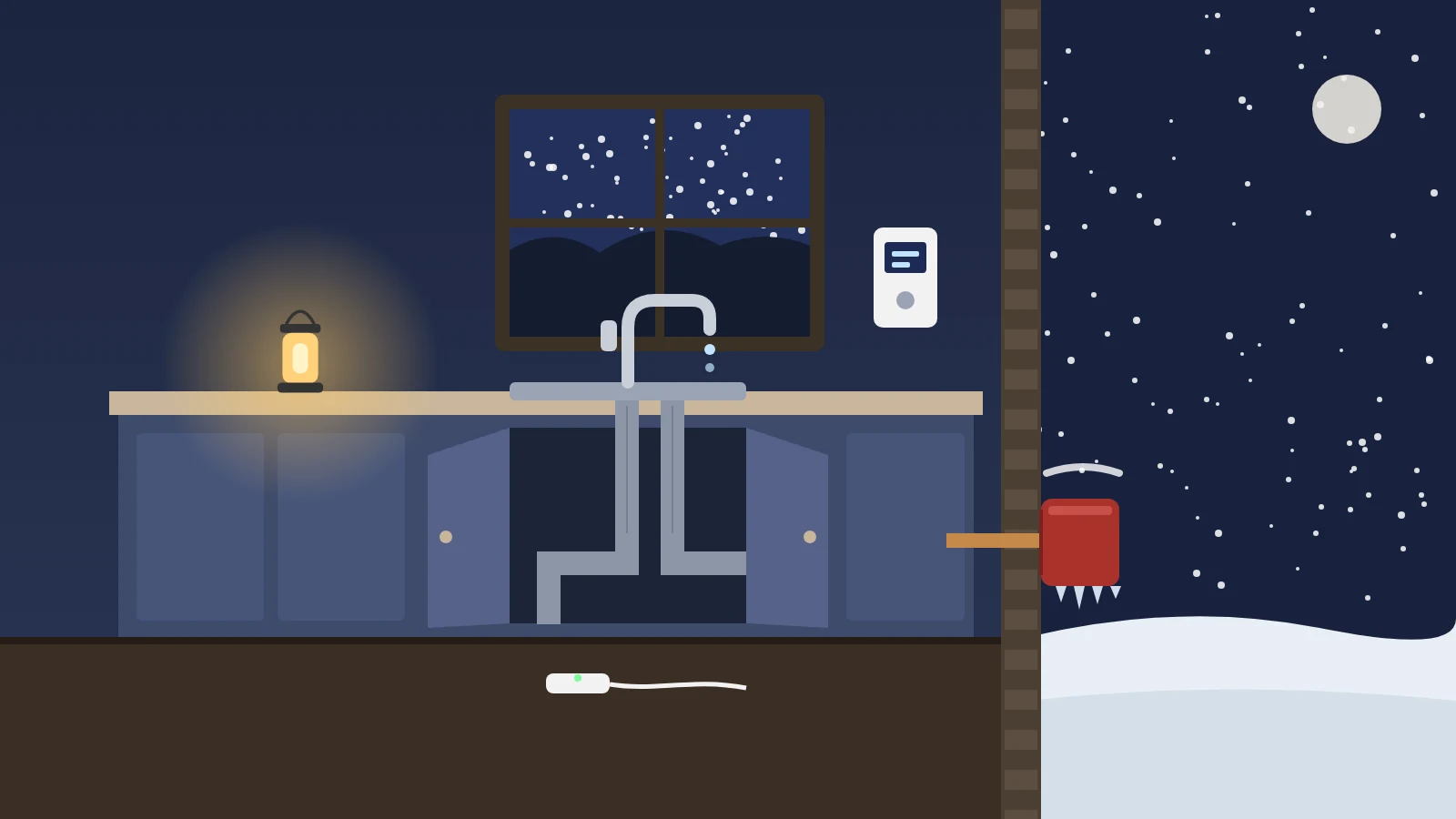
Bottom line: When the power goes out in a freeze, the furnace stops and the pipes are on their own. Cover outdoor faucets and wrap exposed pipes now. During the outage, keep faucets dripping and watch the temperature. If the house can’t stay warm, shut off the water and drain it.
Our pick
Frost King FC1 foam faucet covers (4-pack): insulated covers for outdoor faucets, one of the spots where pipes freeze most often. Reusable every winter.
Then wrap exposed pipes, put a battery leak alarm by the water heater, and keep a thermometer that alerts your phone.
Our winter storm checklist, winter storm lessons and furnace guide have short pipe checklists. This page goes deeper.
Where pipes freeze first
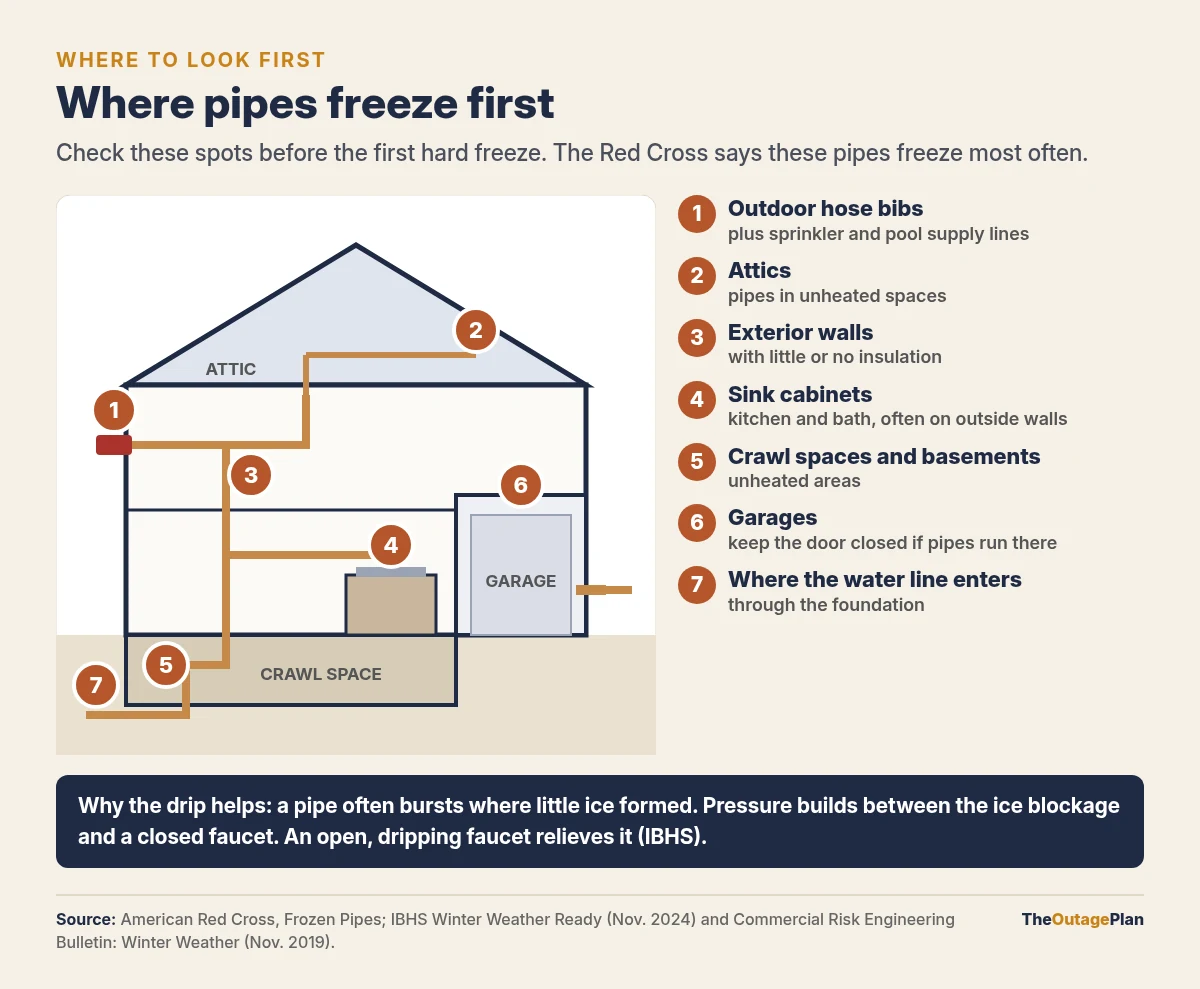
Pipes in unheated spaces and along exterior walls go first (Red Cross). IBHS says pipes along exterior walls are common in warmer regions, so homes where hard freezes are rare are at risk too, and that homes built before 2010 typically don’t have frost-proof outdoor faucets (IBHS).
How long until a house without heat gets cold enough? We won’t guess. It depends on your insulation, the wind and how cold it is outside. A thermometer in the coldest spot tells you. IBHS’s FORTIFIED program suggests a monitor that alerts you if the inside temperature dips below 55°F (FORTIFIED).
What to buy now
Outdoor faucets: Frost King FC1 foam covers (4-pack)
Each cover has a 5/8 in expanded-polystyrene shell and a 3/4 in foam gasket (Amazon listing). Frost King calls foam “your best bet” for keeping faucets from freezing (Frost King). First, remove and drain the hose, close the indoor valve that feeds the faucet, and open the outside faucet so it drains (Red Cross).
The catch: a cover protects the faucet, not the pipe behind it. Shutting the indoor valve and draining that line protects the short span just inside the house (State Farm). Where a cover might get knocked, Frost King’s hard-plastic FC2 is sturdier (Frost King).
Exposed pipes: Frost King FV15 foam-and-foil wrap
A self-adhesive foam-and-foil tape, 2 in × 1/8 in × 15 ft, for hot and cold pipes (Amazon listing). IBHS says to wrap pipes in attics, crawl spaces and along exterior walls with “pipe insulation tubes, wrap or even tape” (IBHS). Tape suits valves, bends and short runs.
The catch: it’s thin. For long straight runs, foam tube sleeves are thicker. The ones we found sold by Amazon or the brand were out of stock, so pick them up at a hardware store, sized to your pipe.
Leak alarm, no Wi-Fi: Honeywell Home RWD42
A 100 dB alarm with a 5 ft sensing cable that detects water along its whole length, on 2 AA batteries, with a low-battery chirp (Honeywell Home). No Wi-Fi, so it works in an outage. Run the cable around the water heater or under a sink.
The catch: it only sounds locally, so someone has to be home to hear it.
Freeze watch: Govee H5075 thermometer
A battery thermometer with a large LCD, min and max records, and app alerts when the temperature leaves the range you set (Govee). It’s Bluetooth only, so it doesn’t need Wi-Fi or internet. Govee lists two AAA batteries lasting about 6 months. Put it in the coldest spot with pipes, like a sink cabinet on an outside wall.
The catch: alerts reach your phone only within Bluetooth range (Govee lists up to 164 ft in the open). For alerts while you’re away, you need a Wi-Fi monitor, plus a powered router (our Wi-Fi guide).
What about heat tape?
UL-listed heat tape or heat cable helps on exposed pipes (Red Cross), and State Farm points to thermostatically controlled cables (State Farm). But it plugs in, so it does nothing in an outage unless you run it on a power station or a generator (outdoors only). Check its watts with our sizing guide first.
The outage plan: before, during, after
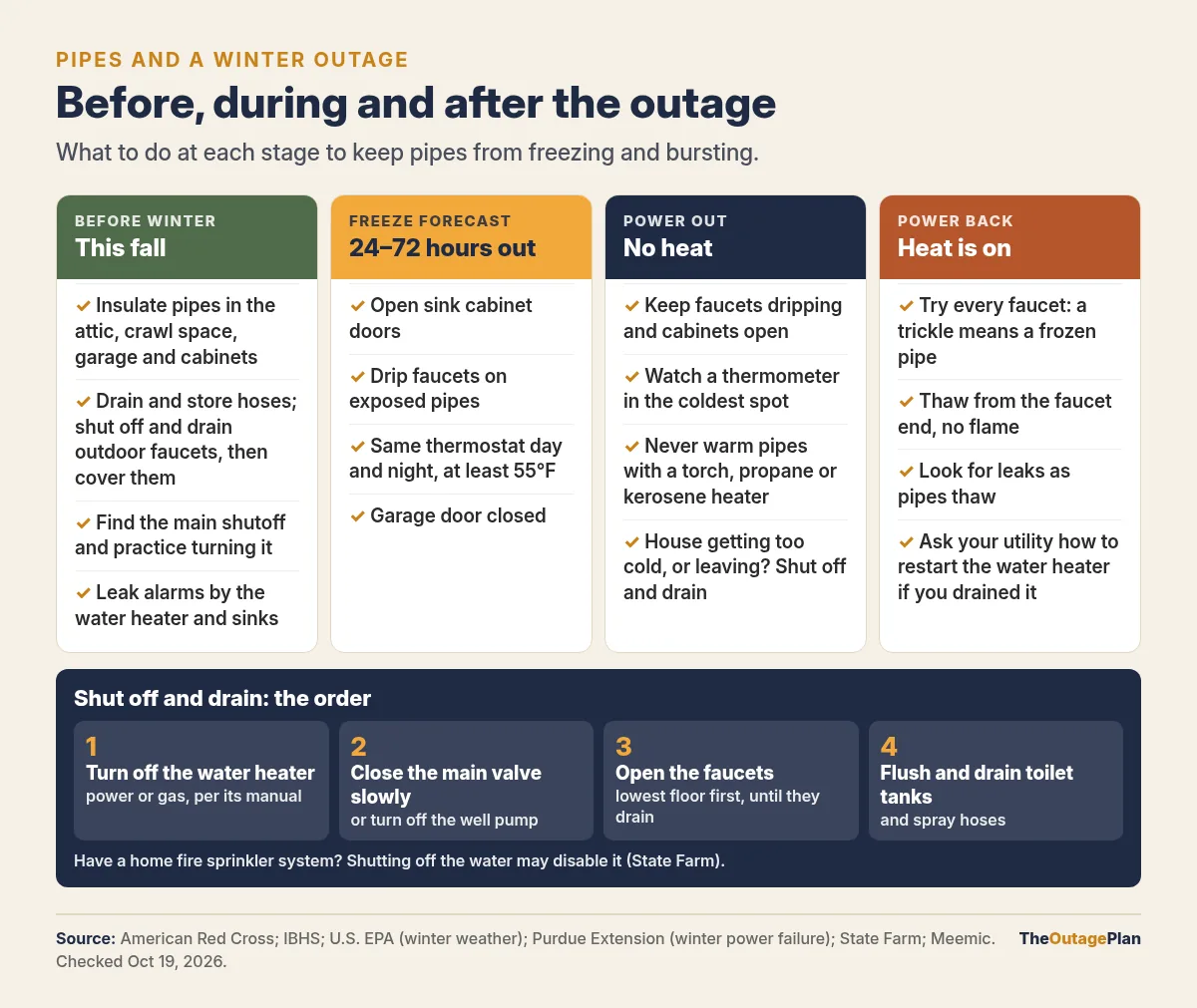
During a multi-day outage with no heat:
- Keep faucets on exterior walls dripping and cabinet doors open. The EPA gives this advice for when “the power and heat are out” (EPA). A drip also relieves the pressure that bursts pipes (IBHS).
- Keep the garage door closed if water lines run through it (Red Cross).
- Store water first. If pipes freeze or break, the CDC says to use bottled water (CDC). See our water storage picks. On a well? See well pump on a power station.
- No flame near pipes. No blowtorch, propane or kerosene heater, or charcoal stove (Red Cross). Heating your warm room with an indoor-rated propane heater? Follow its rules.
When to shut off and drain. If the house can’t stay warm and the freeze will last, or you have to leave, shut off the water and drain the lines (Purdue Extension, Farm Bureau Insurance of Tennessee):
- Turn off the power or gas to water-using appliances, including the water heater (Purdue).
- Close the main valve slowly (IBHS), or turn off the well pump and drain the pressure tank (Purdue).
- Open the faucets until they drain, starting on the lowest floor (IBHS, Purdue).
- Drain toilet tanks and spray hoses (Purdue).
Have a home fire sprinkler system? Shutting off the water may disable it (State Farm). After draining, Meemic suggests asking your utility how to protect the water heater (Meemic).
Thawing a frozen pipe, and what to do if one bursts
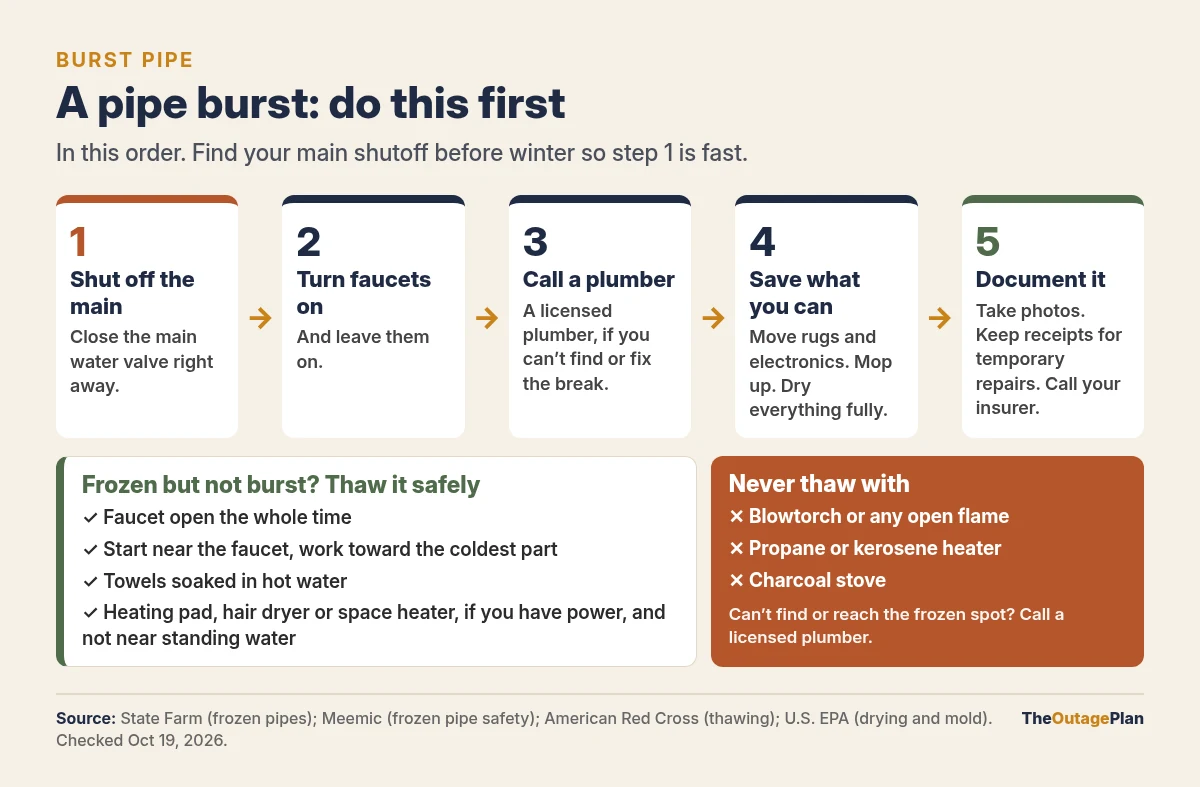
- A trickle from the faucet? Suspect a frozen pipe. Keep the faucet open and check every other faucet, because if one pipe freezes, others may too (Red Cross).
- Thaw from the faucet end toward the coldest section, and stay out of standing water when using a hair dryer (State Farm). Towels soaked in hot water work too (Red Cross).
- If it bursts, shut off the main, leave the faucets on, and call a plumber (State Farm). Mop up, move belongings, take photos, and keep receipts for temporary repairs (Meemic). Dry everything completely to head off mold (EPA).
FAQ
Should you drip hot or cold water?
The Red Cross says to let cold water drip from faucets served by exposed pipes (Red Cross). State Farm suggests warm water from a faucet on an outside wall (State Farm).
Can you thaw a pipe with a propane heater or torch?
No. The Red Cross says never to use a blowtorch, a kerosene or propane heater, a charcoal stove, or any open flame (Red Cross).
Can a power station keep your pipes from freezing?
It can run a gas furnace’s blower for a while. See our furnace on a power station guide. A space heater drains a battery fast (our math). Plan to drain the pipes if the outage outlasts the battery.
For the rest of your winter plan, see the winter storm checklist and Ready.gov.
Guidance last checked Oct 19, 2026, from the American Red Cross, IBHS, State Farm, the EPA, the CDC, Ready.gov, Purdue Extension and Meemic, and specs from Frost King, Honeywell Home, Govee and the Amazon listings. This is general information. When in doubt, call a licensed plumber, and follow the instructions for your water heater and well system.