
Heads up: Some links on this page are affiliate links. If you buy through them, we may earn a commission at no extra cost to you. As an Amazon Associate, we earn from qualifying purchases. Full disclosure
Testing note: We haven’t hands-on tested these heaters. Specs and safety rules come from Mr. Heater’s product pages and owner’s manuals, First Alert, the CPSC, the CDC and the NFPA, checked Oct 19, 2026. Cylinder counts are our math.
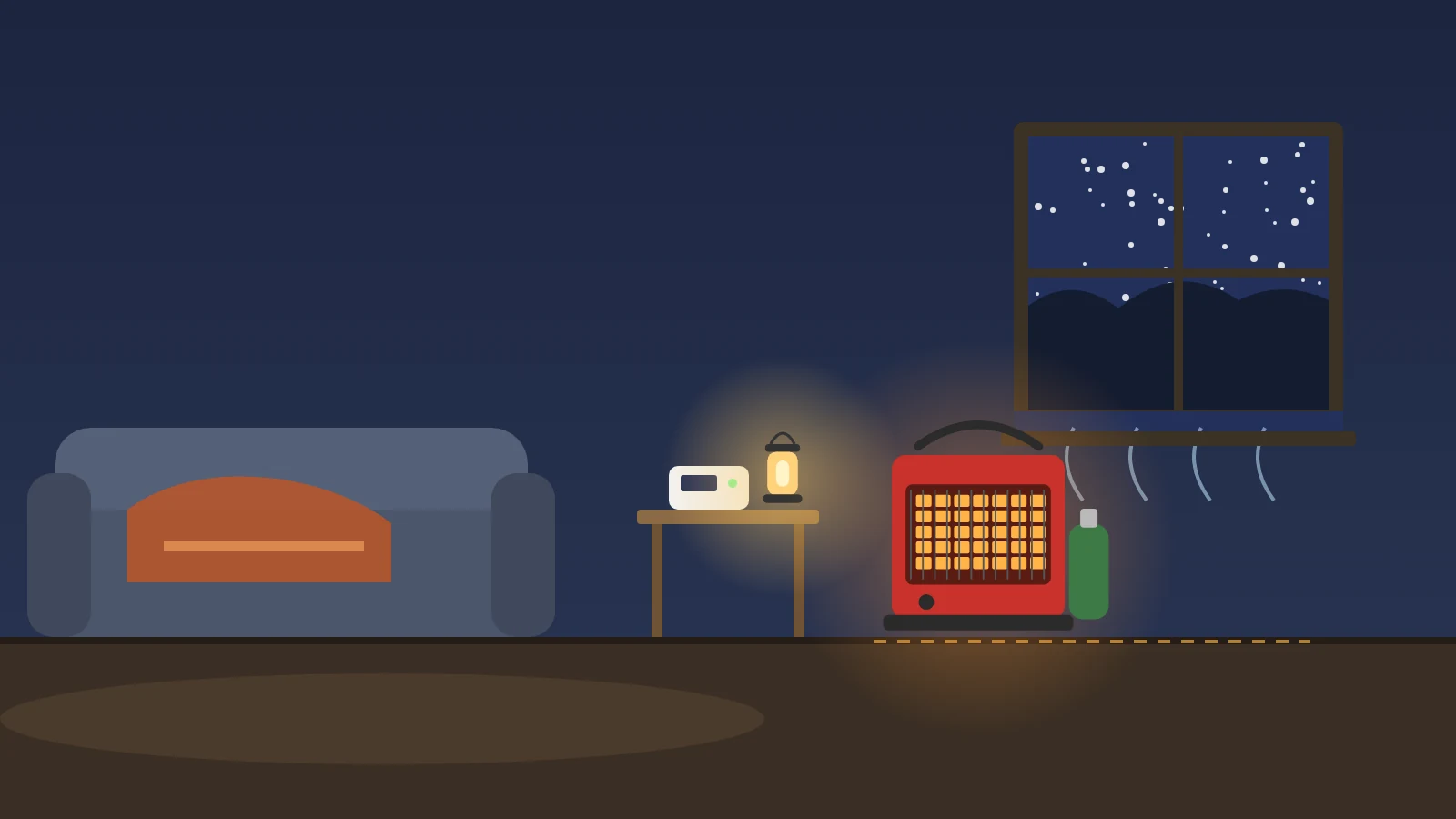
Bottom line: When the furnace stops, start with heat that burns nothing. If you want a fuel heater for your warm room, get one its maker rates for emergency indoor use, like the Mr. Heater Portable Buddy, plus a battery CO alarm for the same room. Run it on 1 lb cylinders, with fresh air, and only while you’re awake and in the room.
Our pick
Mr. Heater Portable Buddy (MH9BX): 4,000 or 9,000 BTU for rooms up to 225 sq ft, with a low-oxygen shutoff and a tip-over shutoff. Its manual allows emergency indoor heat on a disposable 1 lb propane cylinder.
Small room? The Little Buddy. Either way, add the First Alert CO710 battery CO alarm.
Which heat, in what order
A power station can’t run an electric space heater for long. Our space heater on a power station guide has the battery math, heated bedding, and the one-warm-room setup, so we won’t repeat it here.
Our picks

Best for most homes: Mr. Heater Portable Buddy (MH9BX)
Two settings, 4,000 or 9,000 BTU, for spaces up to 225 sq ft. It has a low-oxygen shutoff (an ODS, which turns the heater off when oxygen in the room drops too low) and a tip-over shutoff (Mr. Heater). The manual says it “may be used for emergency indoor heating when connected to a disposable 1 lb. propane cylinder,” which runs it for about 3 to 6 hours. It needs a fresh-air vent area of at least 9 sq in (3 × 3 in) at ceiling and floor level (manual).
Buy the standard version. The Massachusetts and Canada version is labeled outdoor-only (Mr. Heater). On our check, the listing below was the standard model, sold by Amazon itself.
The catch: never while sleeping. It’s a heater for waking hours, so plan nights around sleeping bags and heated bedding.
Small-room pick: Mr. Heater Little Buddy (MH4B)
One 3,800 BTU setting for spaces up to 95 sq ft, about 5.6 hours per 1 lb cylinder, and an 8 in round stand (Mr. Heater). It has the same low-oxygen and tip-over shutoffs and the same emergency-indoor rule. It needs at least 4 sq in (2 × 2 in) of vent area at ceiling and floor level (manual).
The catch: one setting, so it can’t turn up for a bigger room.
Must-have with either: First Alert CO710 battery CO alarm
An electrochemical CO sensor, a sealed 10-year lithium battery (so it works in an outage), an 85 dB alarm, and a display that shows the CO level, the peak reading and the room temperature. It’s listed to UL 2034 and sits on a table, so no install (First Alert).
The CPSC says to keep battery or battery-backup CO alarms on every level and outside sleeping areas, test them monthly, and get outside and call 911 if one sounds (CPSC). Keep your regular alarms, and put this one in the room with the heater.
What about the Big Buddy?
Mr. Heater’s Big Buddy goes up to 18,000 BTU for up to 450 sq ft (Mr. Heater). Its manual calls for twice the Buddy’s vent area and limits it to LO or MED in a bedroom (manual). That’s more heat than one warm room needs, so it isn’t one of our picks.
Cylinders: 1 lb only, and skip the hose
- Indoors, use only disposable 1 lb (16.4 oz) DOT cylinders. Pick them up at a hardware or outdoor store. We didn’t find a pack sold by Amazon or the brand.
- How many? By our math, 3 days at 4 hours of heat a day takes about 2 cylinders on the Buddy’s LO setting, 4 on HI, or 3 for the Little Buddy, plus a spare. The manuals say run time drops when it’s below 20°F.
- Skip the 20 lb tank and hose for home use. The manual allows a hose to a refillable tank only in a recreational enclosure, like a cabin or an ice shanty, with the tank outdoors, and says never bring a refillable cylinder indoors (manual).
Set it up safely

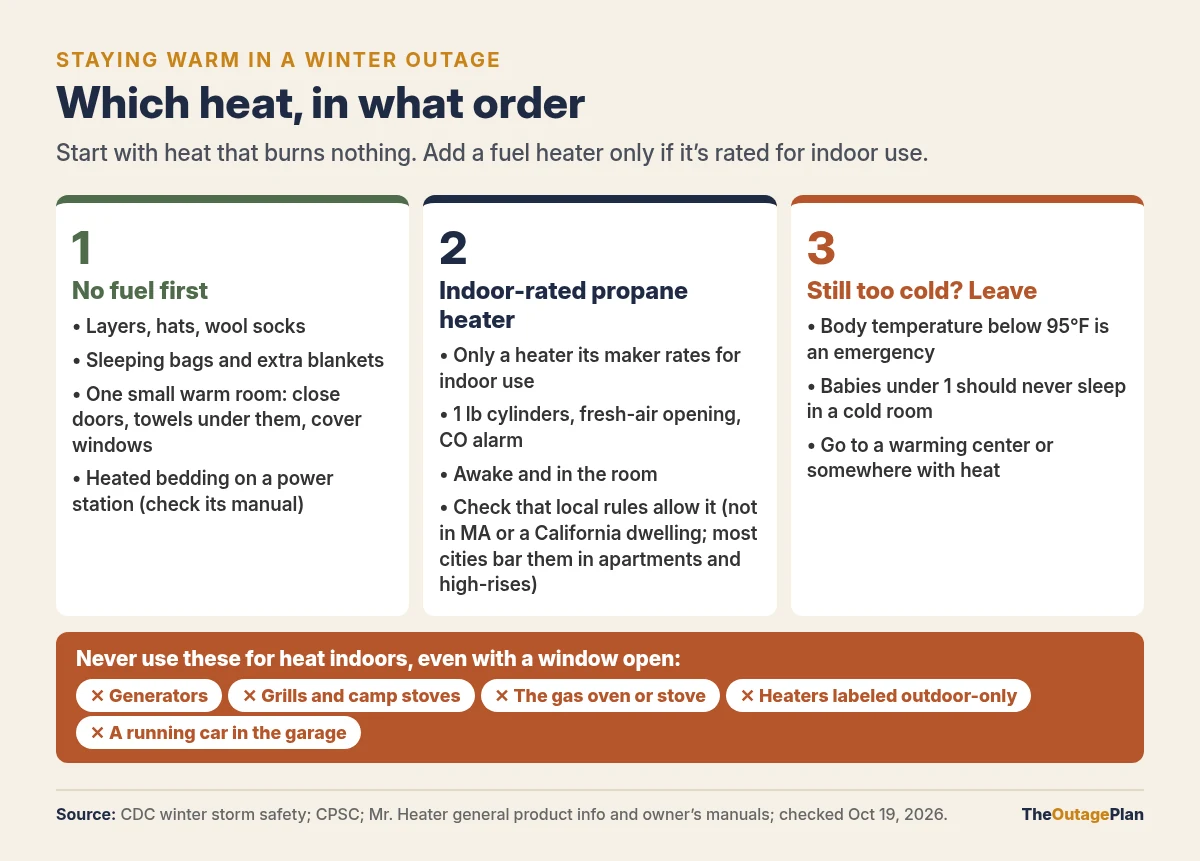
- Check that it’s allowed where you live. Mr. Heater says to check local, city and state codes. Massachusetts doesn’t allow propane heaters indoors, California doesn’t allow the Buddy in dwellings, and most cities don’t allow gas heaters in apartments or high-rises (Mr. Heater). Mobile homes need specially designed heating equipment (CPSC).
- Fresh air, every time. It burns the room’s oxygen. Provide the vent area in the manual, keep doors open to the rest of the house (CPSC), and don’t run any other fuel-burning appliance inside.
- Clearances. 24 in in front, 6 in at the sides, 30 in above, on a level floor (manual). The CPSC says to keep anything that can burn at least 3 ft away (CPSC).
- Awake and in the room. Never while sleeping and never unattended (manual). Turn it off when you leave the room or go to bed (CPSC).
- Swap cylinders outdoors, with the heater cool and away from flames. Store spares outside, not in the house or garage, out of reach of children (manual).
- Know the warning signs. Headache, dizziness or nausea can mean CO: get fresh air at once and have the heater serviced. Pregnant women, people with heart or lung disease or anemia, and anyone at high altitude are more affected. Above 7,000 ft the heater may shut itself off (manual). Smell gas? Get out and call from outside (CPSC).

FAQ
Is a Mr. Heater Buddy safe to use indoors in a power outage?
Its manual allows emergency indoor heat on a 1 lb cylinder, with the listed fresh-air vent area, never while sleeping, and never unattended. Add a battery CO alarm in the room, and check that local rules allow it.
Can you sleep with a Buddy heater on?
No. The manual says never to run it while sleeping. Turn it off before bed and stay warm with sleeping bags, blankets, and heated bedding where its manual allows (our guide).
Can you hook a Buddy heater to a 20 lb tank in the house?
No. A refillable tank never comes indoors, and the manual allows the hose only in recreational enclosures with the tank outside. Indoors at home, use 1 lb cylinders.
Can you use a propane heater in an apartment?
Often not. Mr. Heater says most cities don’t allow gas heaters in apartments or high-rises. Check your lease and local fire code. If it’s not allowed, stick with no-fuel heat, and see our apartment power station picks.
The CO alarm is also on our Gear page. For the rest of your winter plan, see the winter storm power outage checklist, our winter storm outage lessons, and can a power station run a gas furnace?
Specs and rules last checked Oct 19, 2026, from Mr. Heater’s product pages and 2020 owner’s manuals, First Alert, the CPSC, the CDC and the NFPA. If a maker updates its manual, the manual wins. This is general information, not a substitute for the instructions that come with your heater.