
Heads up: Some links on this page are affiliate links. If you buy through them, we may earn a commission at no extra cost to you. As an Amazon Associate, we earn from qualifying purchases. Full disclosure
Testing note: We haven’t hands-on tested these containers. Every spec below comes from the maker’s page or the Amazon listing, checked Oct 19, 2026. Weights are our math.
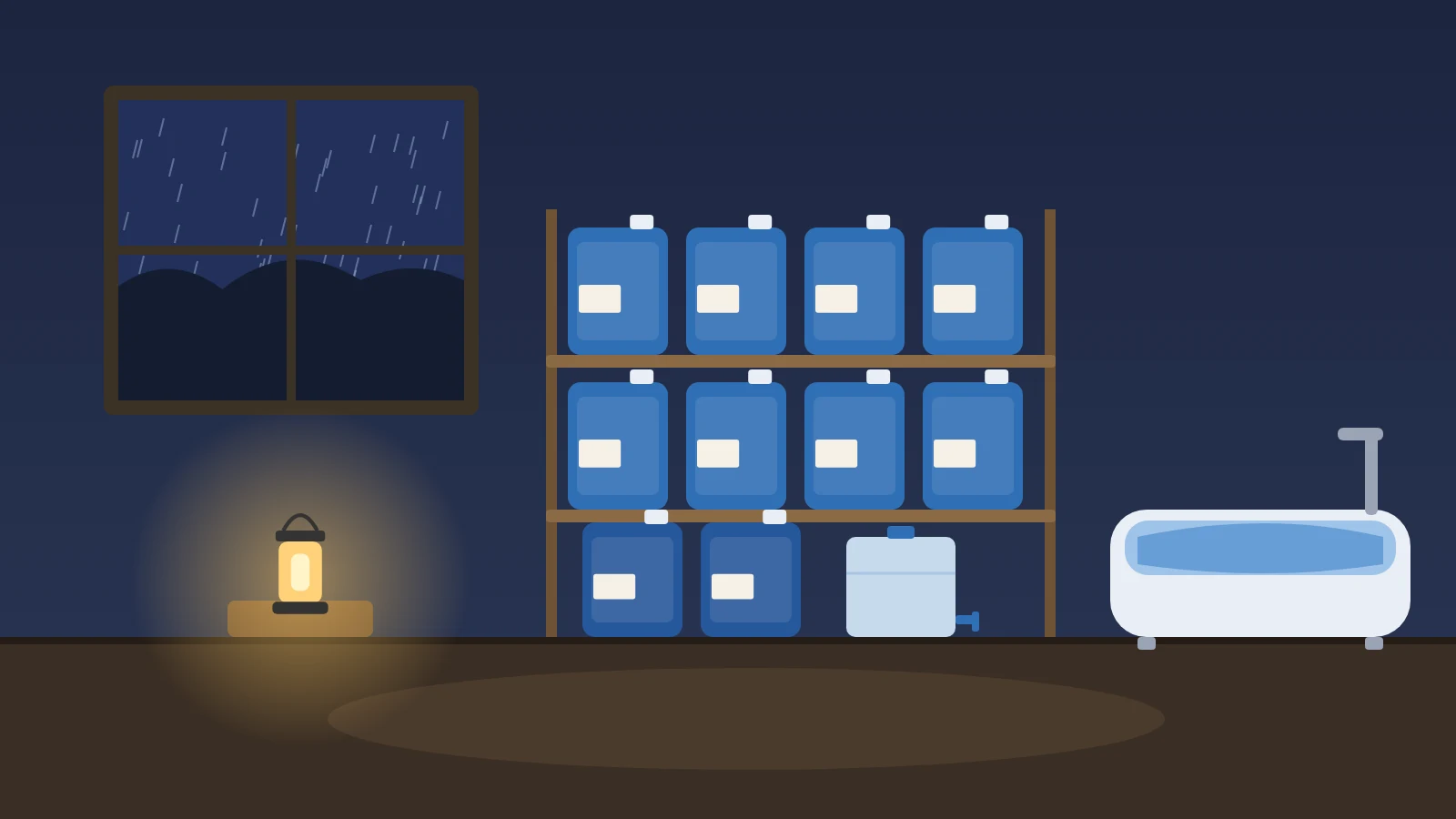
Bottom line: Plan on at least 1 gallon per person per day, and store a 2-week supply if you can (CDC). Not sure how much your household needs? Our water calculator guide does the math. This page is about what to put it in. For most homes, that’s food-grade 5-gallon jugs you can stack, plus a bathtub bladder you fill when a storm is coming.
Our pick
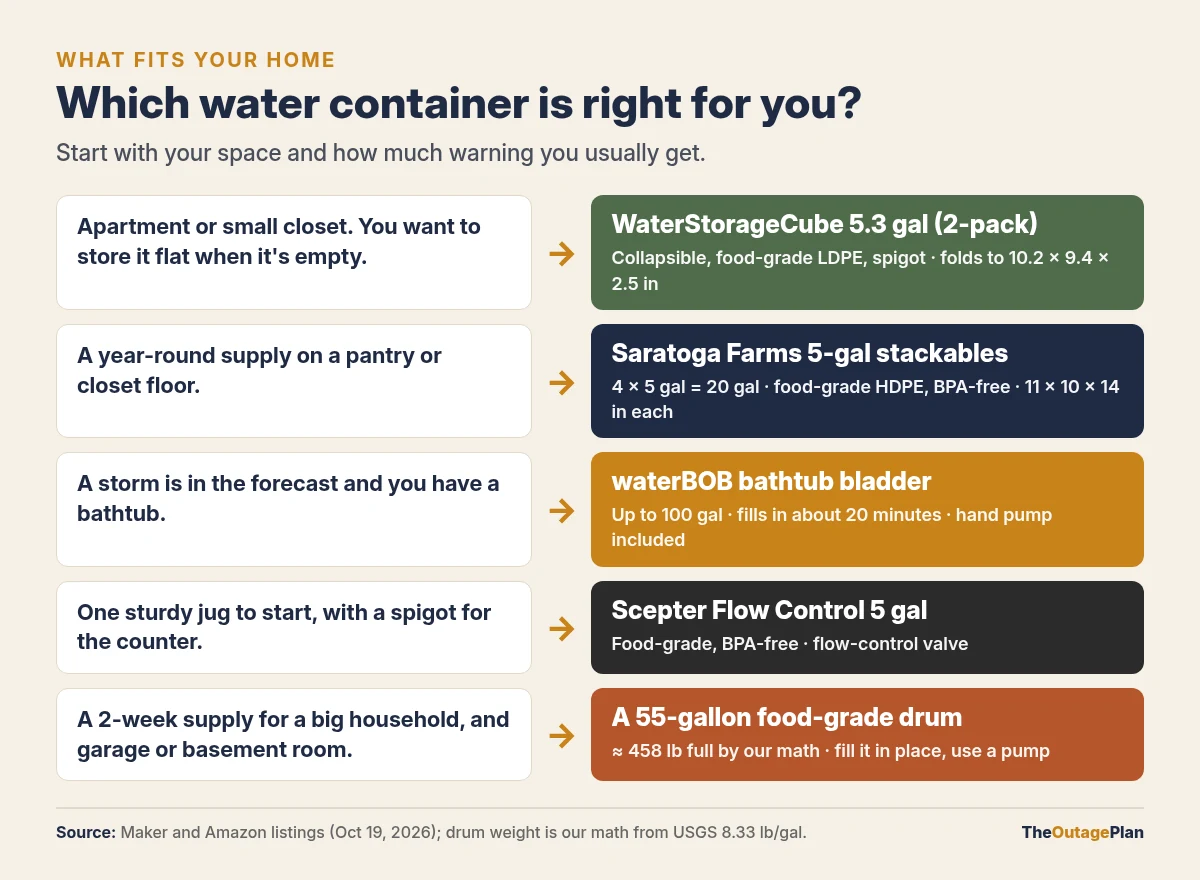
Saratoga Farms 5-Gallon Stackables (20-gallon kit): four 5-gallon containers made of food-grade, BPA-free HDPE. Each one measures 11 × 10 × 14 in and stacks, so 20 gallons fits on a closet floor. That’s 5 days of water for a family of 4 at 1 gallon per person per day.
Budget pick: the WaterStorageCube 5.3-gallon 2-pack, which folds flat when it’s empty. Storm in the forecast? Add a waterBOB for your bathtub.
What matters in a water container
- Food-grade material: the CDC says FDA-approved food-grade containers are best, because they won’t pass toxic substances into the water (CDC).
- Weight when full: water weighs about 8.3 lb per gallon (USGS). A full 5-gallon jug is about 42 lb by our math. Bigger than that, and it stays where you fill it.
- Opaque and sealed: a tight cap, kept in a cool, dark spot out of direct sunlight (CDC).
- A way to get water out: a spigot, a pump, or at least a narrow neck you can pour from.
- Fits your space: stackable for a closet, collapsible for small apartments, a drum for a garage or basement.

Our four picks
Best for most homes: Saratoga Farms 5-Gallon Stackables
The 20-gallon kit is four 5-gallon containers. The Ready Store, which sells Saratoga Farms, lists them as made in the USA from non-toxic, food-grade HDPE that’s BPA-free, 11 × 10 × 14 in each, with an opaque body that stacks to save space (The Ready Store). Each one holds about 42 lb of water when full, so it’s still a one-person carry.
The catch: there’s no spigot on the listing, so plan how you’ll pour or pump from a stacked jug.
Budget pick, best for small spaces: WaterStorageCube 5.3 gal (2-pack)
Each cube holds 5.3 gallons and weighs 10.4 oz empty. It folds to 10.2 × 9.4 × 2.5 in and opens to 11.4 × 11.4 × 13.2 in. The listing says food-grade LDPE with no BPA, PVC or DEHP, an adjustable spigot, and a range of -4°F to 127°F (Amazon listing). It’s a good fit if you rent and don’t want jugs taking up a closet year-round.
The catch: it’s soft-sided. Dry it completely before you fold it away, as the maker says.
Best when a storm is coming: waterBOB bathtub bladder
The waterBOB is a food-grade liner that sits in a standard bathtub and holds up to 100 gallons. The listing says it fills in about 20 minutes from the faucet, comes with a hand pump, is BPA-free and meets USFDA food-grade guidelines, and keeps water fresh for up to 16 weeks (Amazon listing). Empty, it weighs 1.3 lb, so it lives in a drawer until a hurricane or ice storm is in the forecast.
The catch: it only works if you fill it before the outage, while the tap still runs clean. Full, 100 gallons is about 833 lb of water, so it stays in the tub.
One sturdy jug to start: Scepter Flow Control 5 gal
Scepter makes this 5-gallon can from food-grade, BPA-free plastic with an adjustable flow-control valve, and says it’s leakproof and can be used to store water in an emergency (Scepter). It’s a good first jug for the kitchen counter, and a good way to pour from a bigger supply.
What about 55-gallon drums?
A food-grade 55-gallon drum holds 55 days of water for one person, or about 2 weeks for a family of 4. Full, that’s about 458 lb by our math, so fill it where it will live and plan on a pump to get water out. We don’t link a specific drum here. The listings we checked on Oct 19, 2026 were sold by third-party sellers, not by Amazon or the maker.
How to store it safely
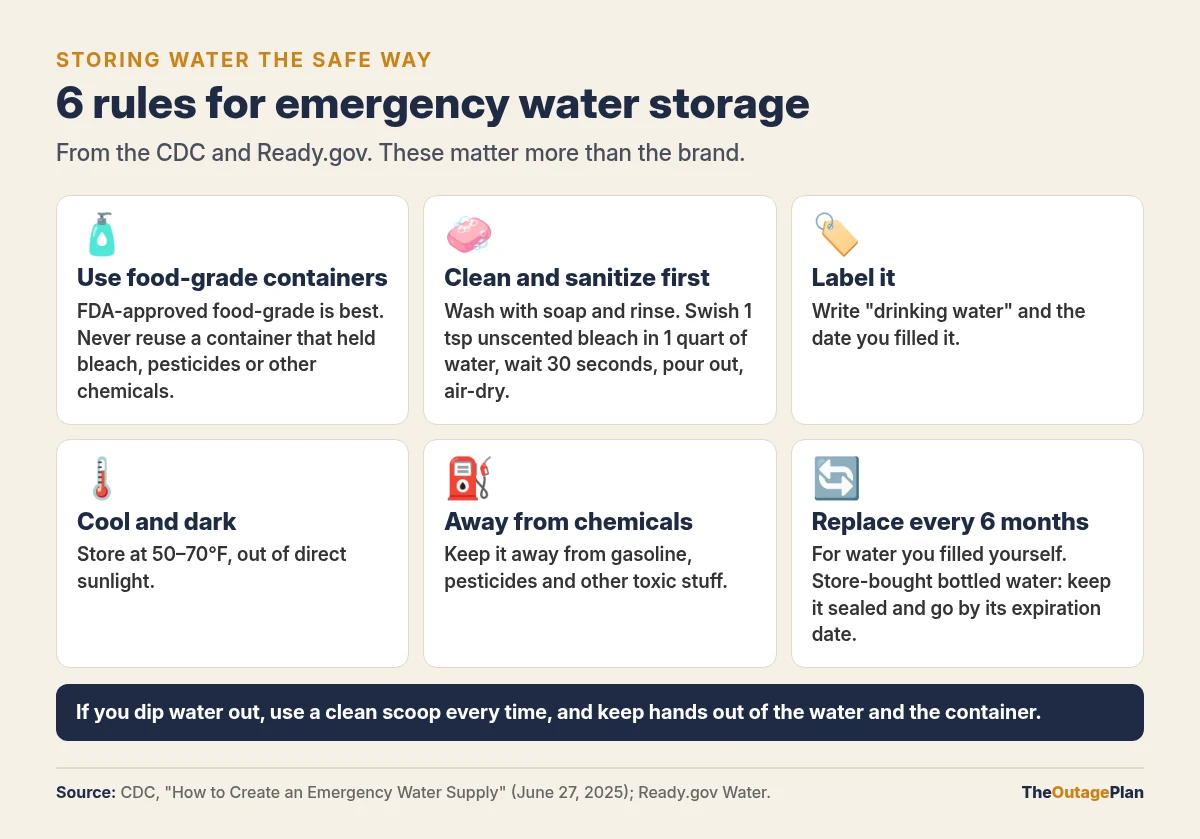
- Start clean: wash the container with soap and rinse it. Then sanitize it with 1 teaspoon of unscented liquid household bleach in 1 quart of water. Cover, shake, wait at least 30 seconds, pour it out, and let it air-dry (CDC).
- Never reuse a container that held chemicals like bleach or pesticides (CDC).
- Label it “drinking water” with the date. Replace water you filled yourself every 6 months (Ready.gov).
- Store it at 50–70°F, out of direct sunlight, away from gasoline and pesticides (CDC).
- Store-bought bottled water is the safest choice. Keep it sealed in its original container in a cool, dark place, and go by its expiration date (Ready.gov, CDC).
- Hot weather: water needs can double in very hot temperatures (Ready.gov). Store extra if you live somewhere hot.
Building out the rest of your kit? Use our 72-hour outage kit checklist or the water storage kit page. Heading into hurricane season? See our hurricane outage plan. More gear is on our Gear page.
FAQ
How much water do you need to store?
At least 1 gallon per person per day for 3 days, and a 2-week supply if you can (CDC). For a family of 4, that’s 12 gallons for 3 days or 56 gallons for 2 weeks. Our how much water to store guide covers pets and hot weather too.
How often should you replace stored water?
Every 6 months for water you put in your own containers. Keep store-bought water sealed and use it by its expiration date (Ready.gov, CDC).
Can you reuse old jugs or bottles?
Food-grade containers are best. If you use something else, the CDC says to pick one with a tight top, made of durable, unbreakable material (not glass), with a narrow neck if possible. Never use a container that held chemicals like bleach or pesticides (CDC).
How much does a 5-gallon water jug weigh?
About 42 lb full, using 8.33 lb per gallon (USGS), plus the container itself.
Where should you store emergency water?
Somewhere cool and dark, 50–70°F, out of direct sunlight, and away from gasoline, pesticides and other chemicals (CDC).
Specs last checked Oct 19, 2026, from The Ready Store, Scepter and the Amazon listings. If a maker updates a spec, their page wins. Tell us and we’ll fix ours.