
Heads up: Some links on this page are affiliate links. If you buy through them, we may earn a commission at no extra cost to you. As an Amazon Associate, we earn from qualifying purchases. Full disclosure
Testing note: We haven’t hands-on tested these kits. Specs come from EcoFlow, Jackery and BLUETTI product pages and the Amazon kit listings, checked Oct 19, 2026. Refill estimates are our math.
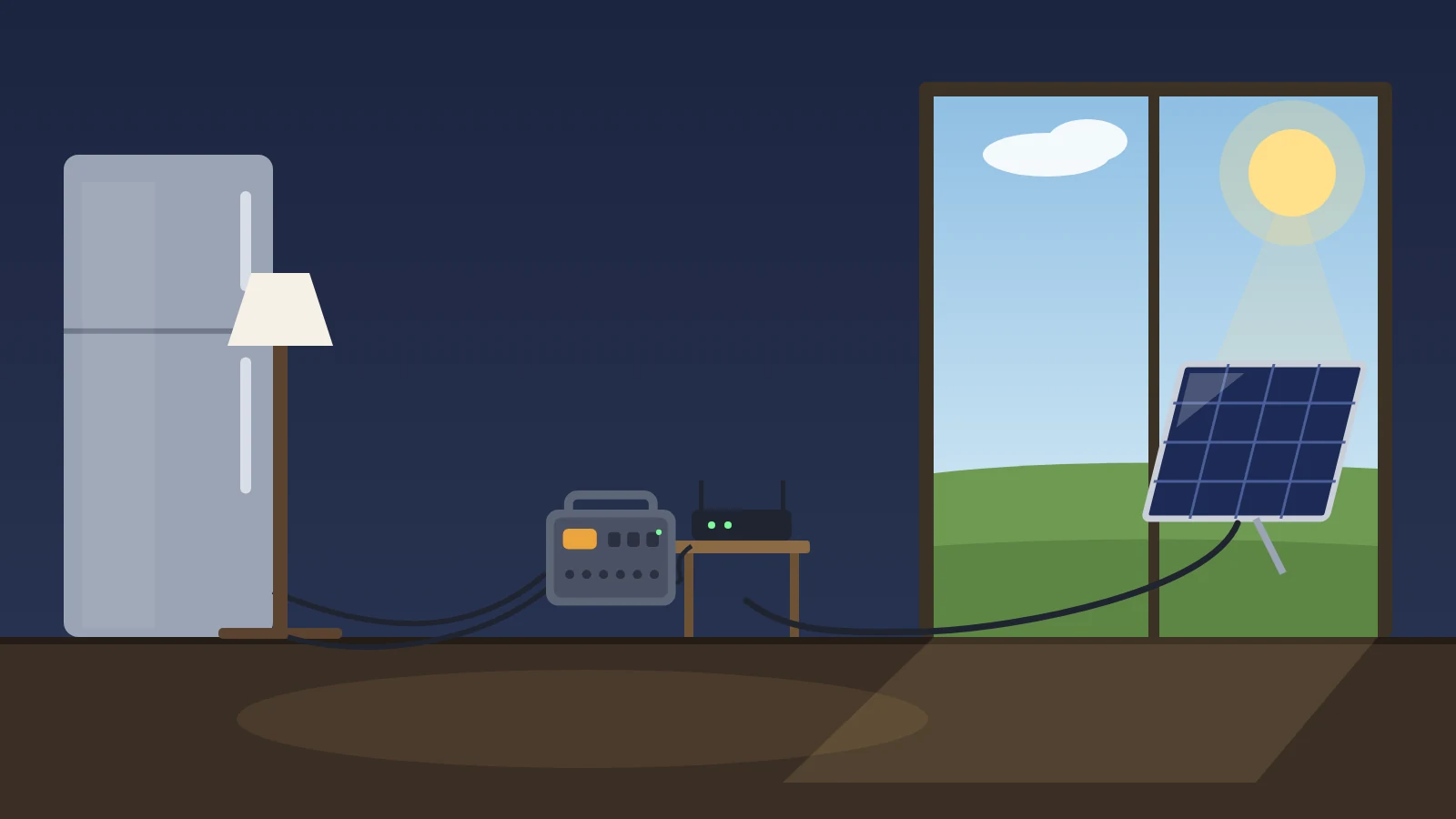
Bottom line: A “solar generator” is a battery power station sold together with a folding solar panel. It makes no fumes, so it can run inside, and the panel refills it on sunny days while the grid is down. For most homes we’d pick the EcoFlow DELTA 3 Plus kit. Its station takes the most solar of the four, so you can add panels later.
Our pick
EcoFlow DELTA 3 Plus + 220 W bifacial panel: a 1,024 Wh station with 1,800 W of AC output and a switchover under 10 ms, plus one 220 W folding panel. The station takes up to 1,000 W of solar, so there’s room for up to three more of the same panel.
Want the lightest ~1 kWh kit? The Jackery Explorer 1000 v2 kit. Only need phones, Wi-Fi and lights? The small RIVER 3 Plus kit.
What’s in a solar generator kit
Every kit is two things you could buy apart: a power station and a panel from the same maker, with the right plug. Two numbers matter most:
- Battery size (Wh): how long it runs your essentials. Our sizing guide does the math.
- The station’s solar limit (W): the most panel power it can use. The panel in the box is the start. The limit is how far you can grow.

How fast does the panel in the box refill it?
Slower than the box suggests. Panel ratings are lab numbers in full sun, and a real day delivers only a few “peak sun hours.” By our math, one panel refills about a quarter to most of a ~1 kWh battery a day:

The makers’ own figures assume ideal sun. Jackery’s kit listing says the 200 W panel charges the Explorer 1000 v2 to 80% in 6 hours, and its site says about 7.5 hours to full (Jackery). BLUETTI’s kit listing says 4.8–9.6 hours to full for the AC180. EcoFlow’s says 7.3 hours for the RIVER 3 Plus with its 45 W panel. EcoFlow’s “80% in 1 hour” solar figure for the DELTA 3 Plus needs the station’s full 1,000 W of solar, not the one panel in the box.
Our four picks
Best for most homes: EcoFlow DELTA 3 Plus + 220 W bifacial panel
The station is 1,024 Wh with 1,800 W of AC output (3,600 W surge) and a UPS switchover under 10 ms. It weighs about 27.6 lb. It has two solar ports, each good for 500 W (11–60 V, 15 A), for 1,000 W total (EcoFlow manual). EcoFlow says you can expand it to 5 kWh with extra batteries (EcoFlow).
The 220 W panel is two-sided. The back adds a little from light reflected off the ground. It weighs about 15.4 lb and has a 30–60° stand with an angle guide. EcoFlow lists a 5-year warranty on the station and 12 months on the panel.
The catch: one 220 W panel uses about a fifth of what the station can take, so plan on a second panel for long outages. And the panel’s warranty is only 12 months.
Lightest ~1 kWh kit: Jackery Explorer 1000 v2 + SolarSaga 200 W
The station is 1,070 Wh, 1,500 W (3,000 W surge), and around 23.8 lb. Jackery says it switches over in under 20 ms. Its two solar ports take 400 W together, so two 200 W panels max it out. The SolarSaga 200 W panel weighs 14.33 lb and is rated IP68 (Jackery).
The catch: Jackery doesn’t recommend its stations for medical devices, so look elsewhere for a CPAP. It also has the least room to add solar.
Most battery: BLUETTI AC180 + 200 W panel
The AC180 is 1,152 Wh with 1,800 W output (2,700 W surge) and 500 W of solar input (12–60 V, 10 A) (BLUETTI). The kit listing says it switches over to battery in 20 ms. On our check, this one was sold by Amazon itself.
The catch: at 35.3 lb, it’s the heaviest station here. BLUETTI says not to recharge it below freezing (it charges at 32–104°F), and its FAQ says it doesn’t take expansion batteries.
Small kit for phones, Wi-Fi and lights: EcoFlow RIVER 3 Plus + 45 W panel
The 286 Wh RIVER 3 Plus weighs 10.4 lb, has 600 W of AC output and a UPS switchover under 10 ms, and expands to 858 Wh with an extra battery (EcoFlow). The 45 W panel folds to 8.74 × 12.17 in and weighs 3.09 lb (EcoFlow). On a typical day it makes about 118 Wh by our math, enough for 4 to 5 phone charges (see our phone charging guide).
The catch: it won’t run a fridge for long. The station takes up to 220 W of solar, so you can add a bigger panel later.
Setup during an outage

Do one full solar charge on a normal sunny day before you need it, so you know what your yard really delivers. For winter, clouds and wildfire smoke, see our solar recharge guide.
Growing your kit
A second matching panel is the best upgrade. On a typical 3.5-sun-hour day, it brings the three ~1 kWh kits to about 90–100% a day by our math. Stick to the same maker’s panel, and check the voltage and amp limits before wiring panels together. Jackery and BLUETTI both advise against mixing panel models. Our solar recharge guide covers the wiring math for these stations.
Why portable first: a solar kit costs far less upfront than a standby generator or a home battery install, needs no electrician, and goes with you. See how the three approaches compare → Renting? See our apartment power station picks. More gear is on our Gear page.
FAQ
Is a solar generator the same as a gas generator?
No. It’s a battery with a built-in inverter, and the panel refills it. There’s no fuel and no exhaust, so it can run indoors. A gas generator must run outside, at least 20 feet from the home (Ready.gov). For the full comparison, see power station vs. generator.
Can a solar generator kit run your whole house?
No. These ~1 kWh kits cover essentials: a fridge for about half a day, Wi-Fi, lights, phones, fans, or a CPAP night. Whole-home backup takes a standby generator or a home battery, and big 120/240 V stations sit in between (our big station picks). Our comparison of the three approaches shows what each one covers.
Does solar charging work in winter or on cloudy days?
Yes, but slowly. In December, the northern cities we checked get about 1.5 to 2.6 peak sun hours a day (PVWatts). At 2 hours, one panel refills roughly a quarter to a third of a ~1 kWh battery, by our math. Keep a backup plan: wall power before the storm, the car, or a generator outdoors only.
Specs last checked Oct 19, 2026, from EcoFlow, Jackery and BLUETTI product pages and the Amazon kit listings. If a maker updates a spec, their page wins. Tell us and we’ll fix ours.