
Heads up: Some links on this page are affiliate links. If you buy through them, we may earn a commission at no extra cost to you. As an Amazon Associate, we earn from qualifying purchases. Full disclosure
Testing note: We haven’t hands-on tested these roof rakes. Specs come from the Avalanche! product listings, checked Oct 26, 2026.
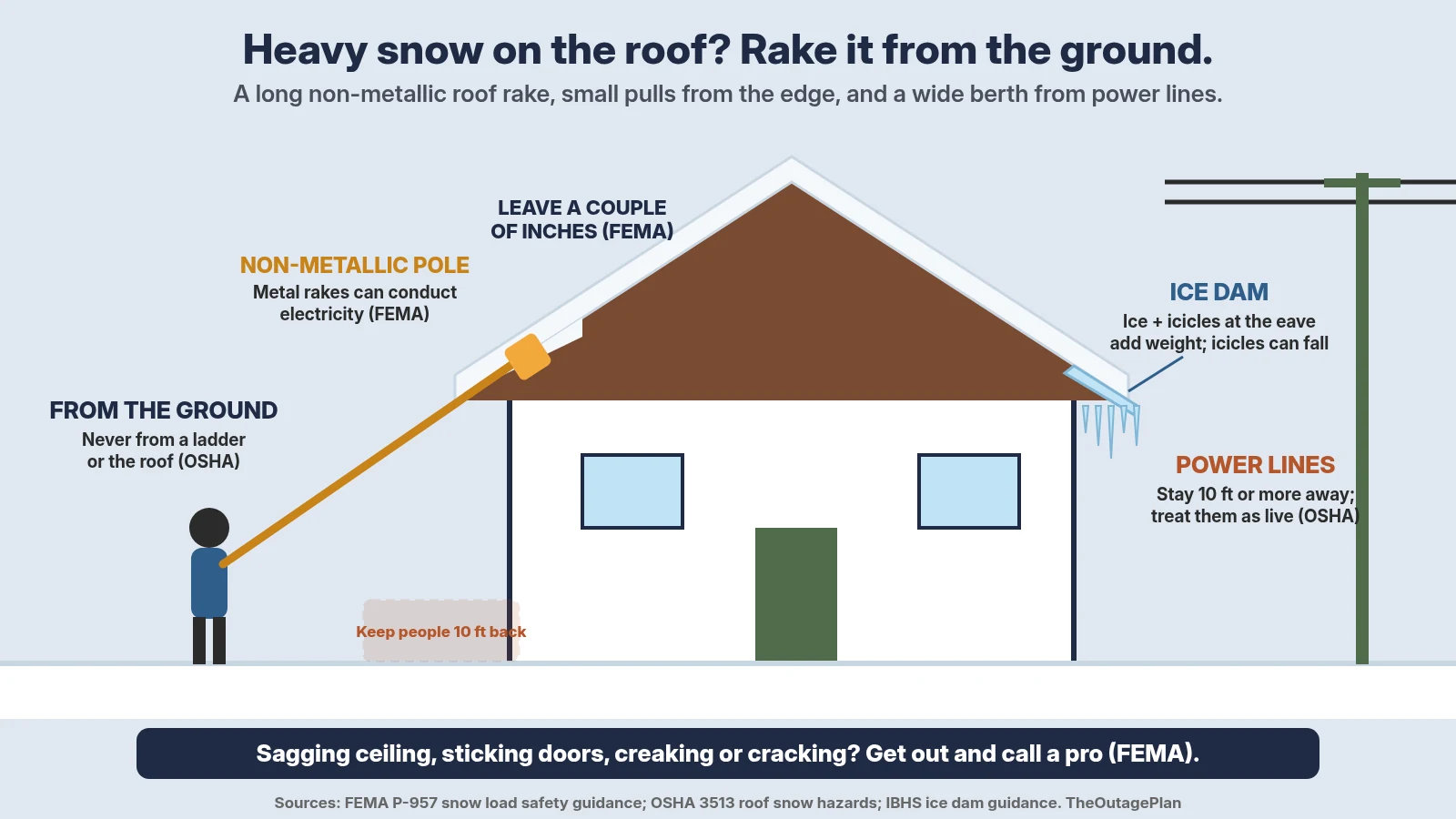
Bottom line: Most roofs don’t need clearing. But after a big or wet snowfall, or when ice builds at the eaves, a long roof rake lets you pull snow down from the ground. FEMA says to choose a non-metallic rake, since metal can damage roofing and conduct electricity. Leave a couple of inches of snow, stay well away from power lines, and call a pro if the house shows warning signs.
Our pick
Avalanche! 750: four snap-together fiberglass handle sections make a 15.5 ft pole. A 17 in wide, 12 ft long plastic slide carries snow off the roof, and 3 in wheels keep it off tile, cedar shake, metal and solar panel roofs, per the listing.
Why roof snow matters in a winter storm
- Snow gets heavy fast. A foot of light, dry snow weighs about 3 lb per sq ft, but a foot of heavy, wet snow can weigh 21 lb per sq ft. Ice is about 5 lb per sq ft for each inch (DOE Building America Solution Center, citing FEMA).
- Ice dams add weight where it hurts. FEMA says ice dams put a concentrated load at the eaves, and rain on top of snow adds even more (FEMA).
- Most roofs are fine. The DOE guide says clearing usually isn’t needed unless the house is older, its construction is in doubt, or the buildup is extraordinary (BASC).
- In an outage, help is slow. Roofers and snow removal crews are busy after a big storm. Our winter storm checklist covers the rest of the house.
How ice dams form

IBHS says heat escaping into the attic melts snow on the roof. The water runs down and refreezes at the cold eave, and the ridge of ice backs more water up under the shingles (IBHS). Removing roof snow takes away one ingredient of an ice dam (UMN Extension).
- Leaking now? UMN says running tap water from a hose over the dam on a warm day can cut a channel for water to drain. It’s a temporary fix, and you should work from the ground (UMN Extension).
- Long term, air-seal the attic floor, then add insulation and ventilation so the roof stays cold (UMN Extension, IBHS).
- Heat cables can make channels for water to drain but won’t remove a dam. IBHS says to use cables listed by UL, FM or CSA and have them installed by a pro (IBHS).
How to rake a roof safely
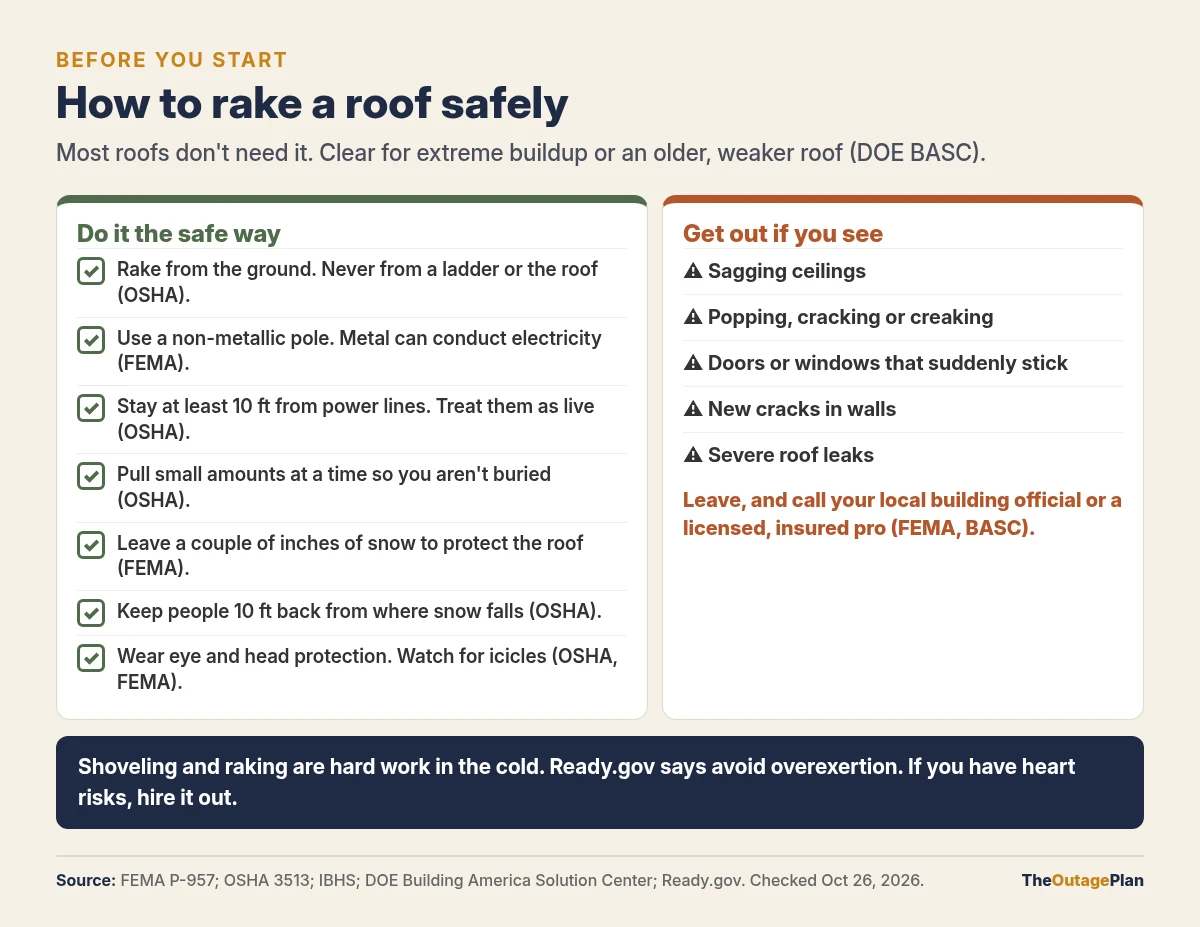
- Stay on the ground. OSHA says to use a snow rake from the ground when you can, and never to use a rake or shovel while standing on a ladder (OSHA).
- Mind the power lines. OSHA says to stay at least 10 ft from power lines, treat every line as energized, and use extendable nonconductive poles (OSHA). IBHS adds: avoid areas where power lines enter the house (IBHS).
- Go slow. Remove small amounts at a time so you don’t strain yourself or get buried by falling snow (OSHA). Ready.gov warns against overexertion in the cold (Ready.gov).
- Leave some snow. FEMA says leave at least a couple of inches on the roof, and don’t use picks or sharp tools that can damage it (FEMA).
- Watch the drop zone. Roof snow can slide at any moment, and icicles can come down with it. FEMA suggests a helper on the ground to keep people away (FEMA). OSHA says keep people 10 ft back and wear eye and head protection (OSHA).
- Know when to leave. FEMA lists sagging ceilings, popping or creaking, sticking doors and windows, new wall cracks and severe leaks as warning signs. Get out and call your local building official or a qualified pro (FEMA).
When in doubt, IBHS and the DOE guide both suggest hiring a licensed, insured snow removal pro (IBHS, BASC).
Our roof rake picks

We only picked rakes with fiberglass poles, because FEMA says metal snow rakes can damage roofing and pose an electrocution risk (FEMA). Most roof rakes on Amazon have aluminum poles. No roof rake we found on Oct 26, 2026, was sold by Amazon.com itself, so these come from other sellers (noted below). Check the seller before you buy, since it can change.
Our pick: Avalanche! 750
Four snap-together fiberglass handle sections make a 15.5 ft pole, so you can work from the ground. The 17 in wide, 12 ft long slide is vinyl-coated polyester that resists cuts and tears, and snow slides down it off the roof. Its 3 in wheels keep the slide above tile, cedar shake, metal and solar panel roofs, per the listing (Amazon listing). Ships from Amazon and sold by The GENERAL Store on Oct 26. Stock was limited.
Full maker specs: Avalanche! 750
- Pole: 15.5 ft, four snap-together fiberglass sections
- Slide: 17 in wide, 12 ft long, vinyl-coated polyester
- Wheels: 3 in
- Roof types: Tile, cedar shake, metal, solar panels
- Weight: 10 lb (listing)
- Made: Assembled in the USA
For asphalt shingles: Avalanche! 500
The same 15.5 ft four-section fiberglass pole and 17 in by 12 ft plastic slide, with smaller 1.5 in wheels sized for asphalt shingle roofs, per the listing (Amazon listing). Sold by The GENERAL Store on Oct 26. Only a few were left, so check stock.
Full maker specs: Avalanche! 500
- Pole: 15.5 ft, four snap-together fiberglass sections
- Slide: 17 in wide, 12 ft long, plastic
- Wheels: 1.5 in
- Roof types: Asphalt shingles
- Weight: 9.2 lb (listing)
- Made: Made in the USA
More reach: Avalanche! Handle Extension Kit
Two 4 ft fiberglass poles add up to 8 ft of length to the Avalanche! 500, 750 and 1000. It isn’t compatible with the SRD20 Deluxe (Amazon listing). The couplers are aluminum, and a longer pole is harder to control, so the 10 ft power line rule matters even more. Ships from Amazon and sold by MARSHALLTOWN on Oct 26.
Full maker specs: Avalanche! extension kit
- Adds: Up to 8 ft
- Parts: Two 4 ft fiberglass poles, two aluminum couplers
- Fits: AVA500, AVA750, AVA1000 (not SRD20)
- Made: Made in the USA with global materials
More for a winter storm: our snow shovel and pet-safe ice melt picks, ice cleat picks, frozen pipes guide and winter storm checklist.
FAQ
Should you rake snow off your roof?
Usually not. The DOE’s Building America guide says clearing is mostly needed for older homes, doubtful construction or extraordinary snow. Rake when snow is deep or wet, or ice is building at the eaves, and leave a couple of inches on the roof, as FEMA advises.
Are metal roof rakes dangerous?
FEMA says metal snow rakes can damage roofing and pose an electrocution risk and should be avoided. OSHA says to stay at least 10 ft from power lines and use nonconductive poles. Even with fiberglass, keep well clear of any line.
Does a roof rake prevent ice dams?
It helps. University of Minnesota Extension says removing roof snow removes one ingredient of an ice dam. The lasting fix is air sealing and insulating the attic so heat doesn’t melt the snow, per IBHS and UMN.
What are the signs a roof may collapse from snow?
FEMA lists sagging ceilings, popping, cracking or creaking sounds, doors or windows that stick, new cracks in walls and severe leaks. If you see them, get out and call your local building official or a qualified pro.
Specs checked Oct 26, 2026, from the Avalanche! product listings. Guidance from FEMA, OSHA, IBHS, University of Minnesota Extension, the DOE Building America Solution Center and Ready.gov. We haven’t hands-on tested these roof rakes.