
Heads up: Some links on this page are affiliate links. If you buy through them, we may earn a commission at no extra cost to you. As an Amazon Associate, we earn from qualifying purchases. Full disclosure
Testing note: We haven’t tested these bulbs or lights ourselves yet. Specs come from each maker’s product page or manual, checked Oct 18, 2026.

Bottom line: A rechargeable emergency bulb is a normal LED bulb with a small battery inside. When the power cuts out, it keeps shining for a few hours, but only if its switch was already on (or you flip it on). That makes it great for a stairway, hallway, or kid’s room light that’s on in the evening anyway. It doesn’t replace flashlights. Think of it as the light that keeps you from tripping in the first minute of an outage.
- Our bulb pick: the GE LED+ Battery Backup A21. GE lists up to 5 hours at 650 lumens on battery (GE Lighting).
- For outlets instead of fixtures: Energizer Weatheready Auto-On lights sit in a wall outlet and turn on by themselves when the power fails (Energizer).
- Still keep a flashlight per person, as Ready.gov recommends (Ready.gov).
How emergency bulbs work
A battery backup bulb screws into a standard E26 socket like any other bulb. While the power is on, it lights normally and tops up its internal battery. When the power drops, it switches to the battery.
The catch is the switch: the bulb charges, and knows to stay lit, only through the fixture’s switch (GE setup guide, GE Lighting):

How long they last (per the makers)
Maker figures for both lights, next to the flashlight we pair them with (GE Lighting, Energizer, Olight):
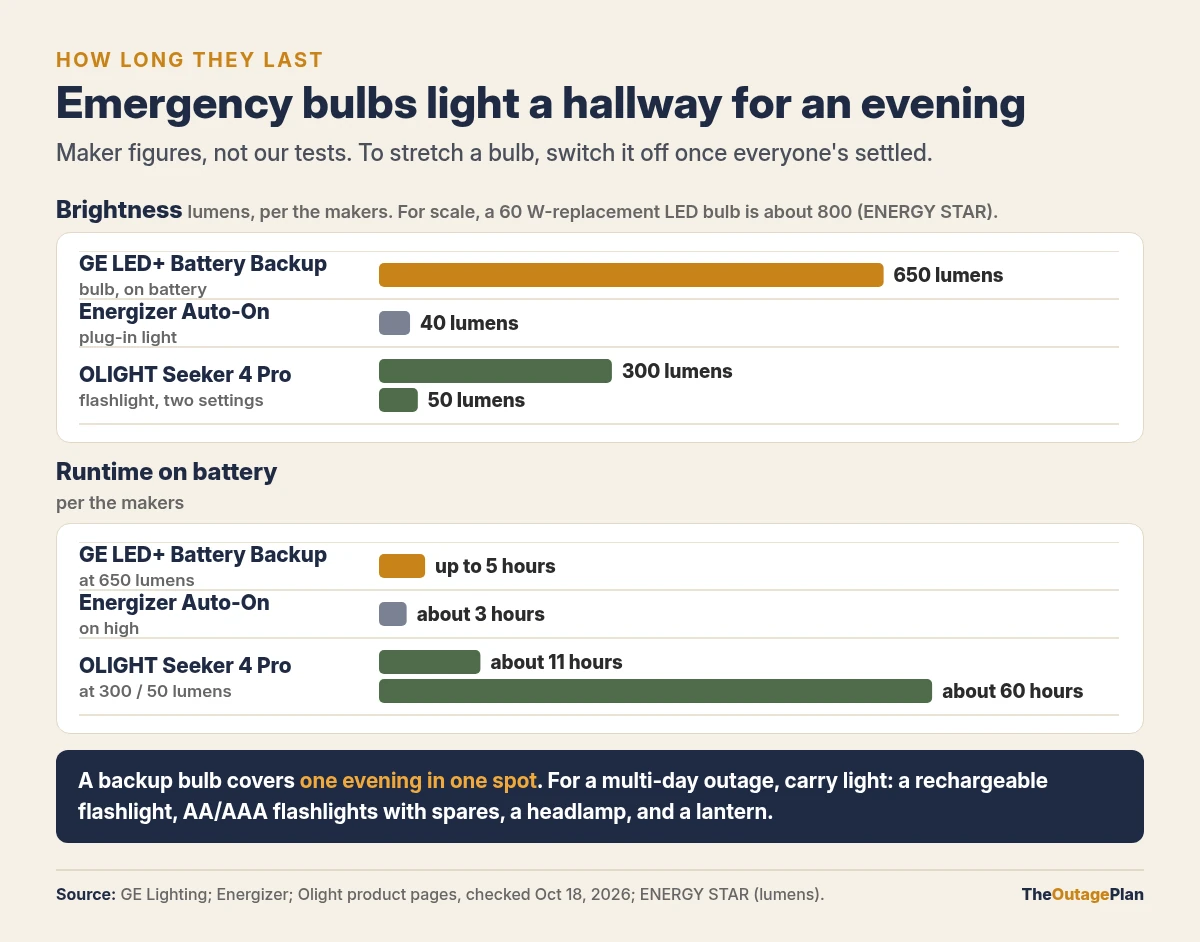
Both are on our Gear page: the GE LED+ Battery Backup A21 and the Energizer Weatheready Auto-On. A bulb that replaces a 60 W incandescent puts out about 800 lumens (ENERGY STAR), so 650 is plenty for a hallway or stairs. Five hours covers most of an evening, not a multi-day outage. To make it last, turn the bulb off with its switch once everyone’s settled.
Where they make sense

Stairs and hallways come first: the first few minutes of a nighttime outage are when people trip.
Pair them with flashlights and headlamps
An emergency bulb covers one spot for a few hours. For the rest of an outage, you need light you can carry:
- A rechargeable flashlight like the OLIGHT Seeker 4 Pro. Olight lists 300 lumens for about 11 hours and 50 lumens for about 60 hours, with USB-C charging (Olight). You can top it up from a power station or a power bank.
- Flashlights that take standard batteries like the GearLight S1000 2-pack. Each takes 3 AAA batteries, so with a stash of spares it keeps working after everything rechargeable has run down.
- Headlamps for cooking, first aid, and resetting breakers hands-free. Our pick is on the Gear page.
- A lantern for shared room light. See the LED lantern.
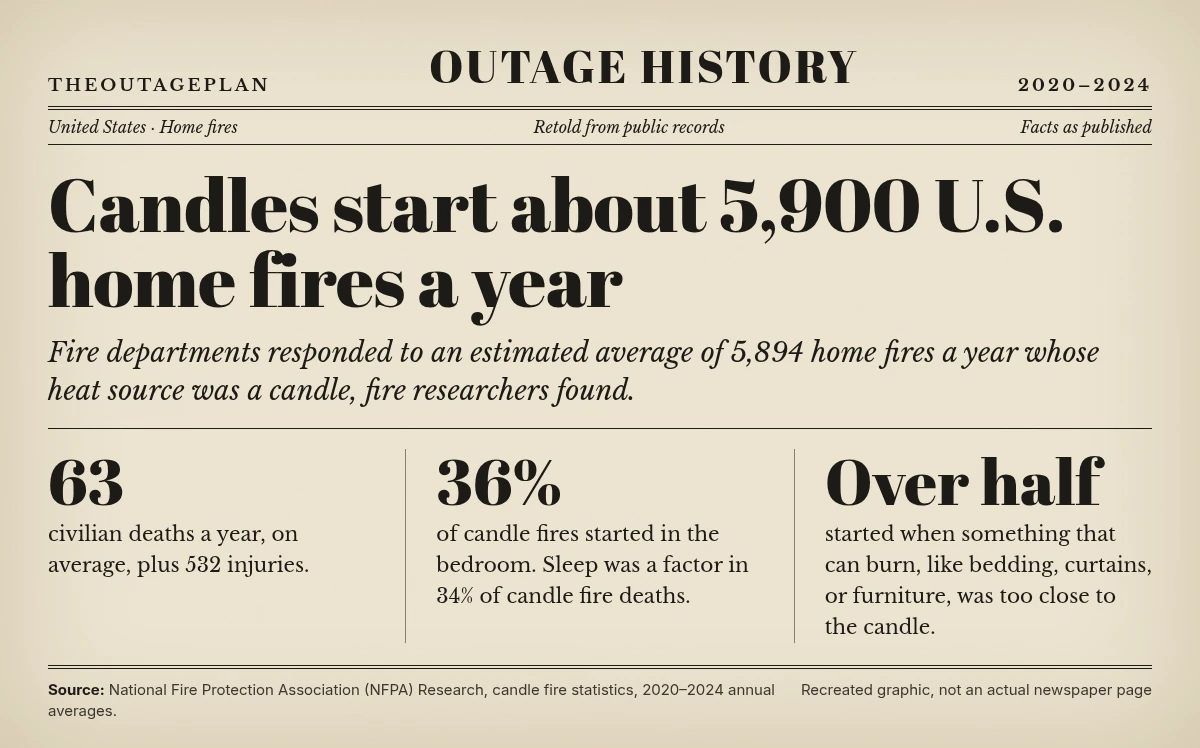
Ready.gov’s power outage advice is to use flashlights in the dark, not candles (Ready.gov).
Candle fires are common enough that fire researchers track them every year:
Are they worth it?
For most homes, a couple of emergency bulbs are a simple upgrade in the right spots, as long as you still keep flashlights and headlamps for everything else.
If your outages tend to last days, put your money toward rechargeable and AA/AAA flashlights, a lantern, and a way to recharge them first. Then add a few bulbs.
Quick checklist
- ☐ Emergency bulbs in the stairway, a hallway, and kids’ rooms, on switches that are on in the evening
- ☐ Each new bulb left on for its full first charge (10 hours for the GE)
- ☐ An auto-on plug-in light near the bedrooms or on the stairs
- ☐ One flashlight per person, plus spare batteries (Ready.gov)
- ☐ A headlamp and a lantern
- ☐ A way to recharge: a power bank or a power station
All of these are on our Gear page. For radios and the rest of your lighting, see our NOAA weather radio and outage lighting guide, and build the full kit with the 72-hour outage kit checklist.
Specs checked Oct 18, 2026, from GE Lighting, Energizer, Olight, and GearLight. If a maker updates a spec, their page wins. This is general information, not electrical advice.