
Heads up: Some links on this page are affiliate links. If you buy through them, we may earn a commission at no extra cost to you. As an Amazon Associate, we earn from qualifying purchases. Full disclosure
Testing note: We haven’t hands-on tested these blankets. Specs come from Ignik’s owner’s manual and product pages, BougeRV’s user manual and product page, and the Amazon listings, checked Oct 19, 2026. Safety guidance comes from the makers’ manuals and the CDC.

Bottom line: A space heater empties a power station in under an hour. A 12 V heated blanket draws 48 W at most and plugs into the station’s car outlet, so it needs no inverter. Both makers we picked say a full night takes about 250 to 300 Wh of battery.
Our pick
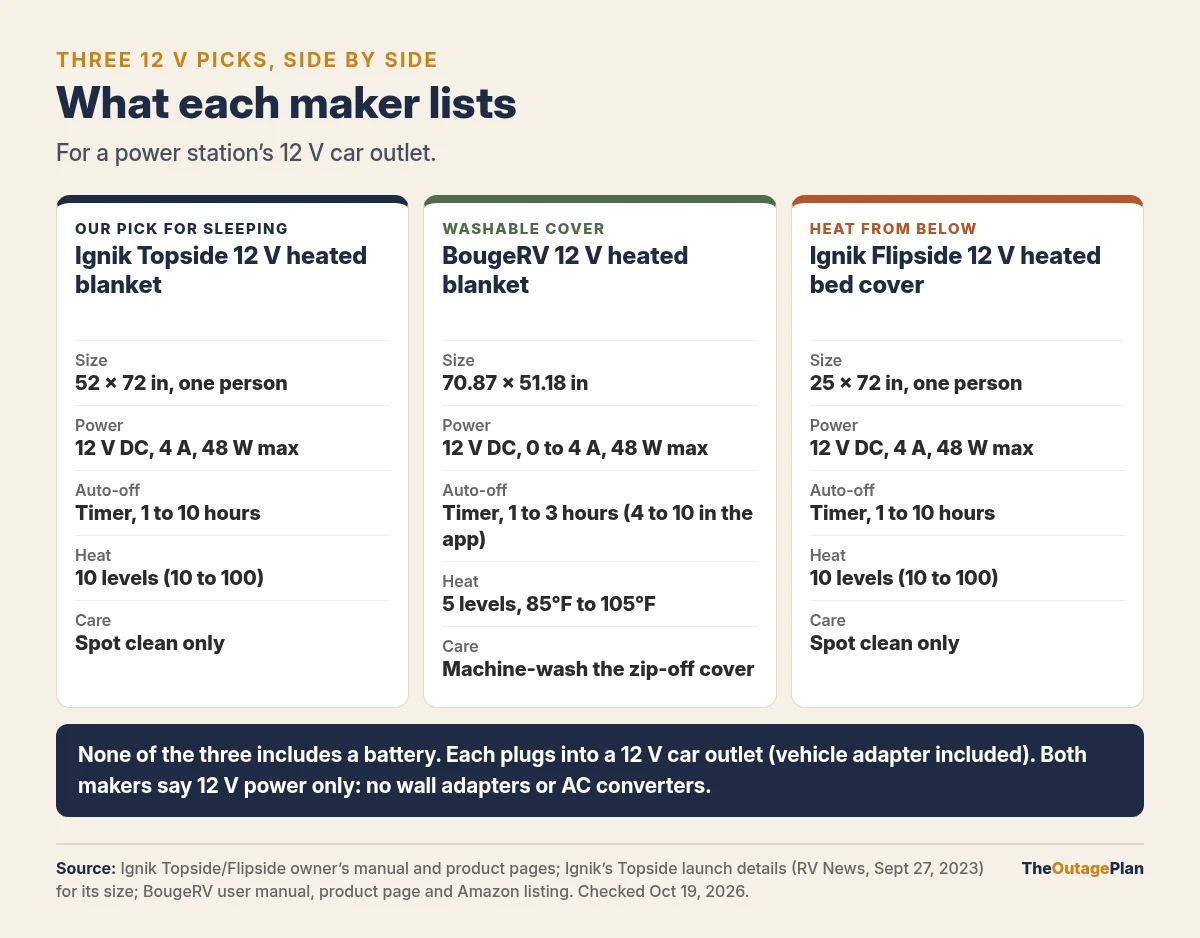
Ignik Topside 12 V heated blanket: 52 x 72 inches, 48 W max, and an auto-off timer you can set from 1 to 10 hours, so it can shut itself off after you fall asleep.
Our guide to running a space heater on a power station has the winter battery math. This page is about which heated blanket to buy for it.
Why 12 V and not your regular electric blanket?
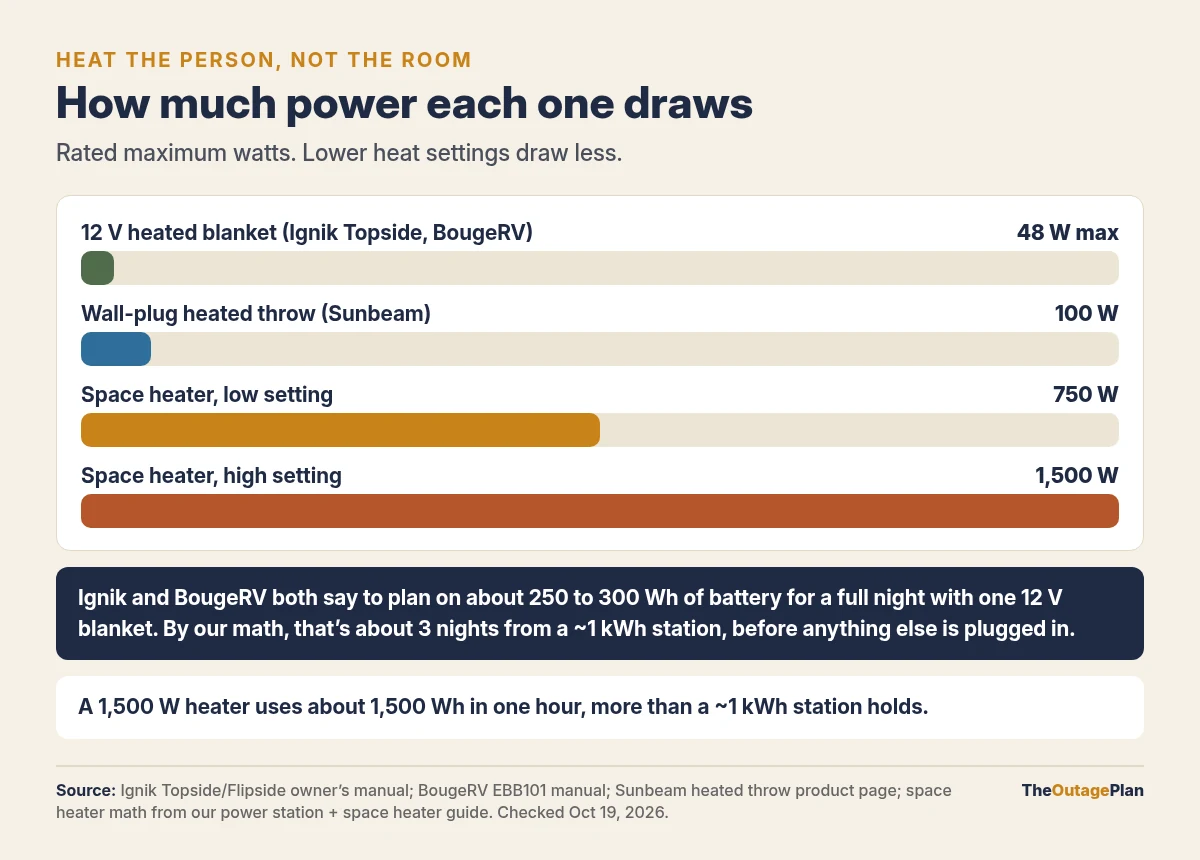
A regular heated throw is a good fit on watts: Sunbeam lists 100 W for its 50″ x 60″ throw (Sunbeam). The catch is the plug. Sunbeam’s heated bedding manual says not to use its products with generators, power converters or inverters (Sunbeam manual), and a station’s AC outlets run through an inverter.
A 12 V blanket skips that. It plugs into the 12 V car outlet, the same socket you’d use in a vehicle. The three stations in our DELTA 3 Plus vs. AC180 vs. Explorer 1000 v2 comparison all have one rated for 10 A, more than the 4 A these blankets need.
How long it lasts. Ignik and BougeRV each say one full night of use takes about 250 to 300 Wh (Ignik manual, BougeRV manual). By our math, a station of about 1 kWh covers roughly 3 nights for one blanket, before the fridge, phones and lights take their share. Our sizing guide shows how to add it all up.
Battery-pack throws are another route. The ones we looked at on Amazon, including Bedsure’s, didn’t list their watts, and the Sunbeam On-the-Go throw from our space heater guide didn’t turn up on Amazon when we checked, so none made this list.
Our picks
Our pick: Ignik Topside 12 V heated blanket
A one-person blanket, 52 x 72 inches (RV News), with a handheld controller that sets heat from 10 to 100 and an auto-off timer from 1 to 10 hours. It needs 12 V at 4 A and puts out 48 W max. Ignik says the pad surface reaches up to about 95°F (Ignik manual). It comes with a 12 V vehicle adapter, and the battery is sold separately (Ignik).
The catch: it’s spot clean only, with no machine washing. Ignik recommends a station of at least 500 Wh with a 4 A output, and says the Topside isn’t compatible with the Anker SOLIX C1000 (Ignik). Check yours before the storm.
Washable cover: BougeRV 12 V heated blanket
Bigger, at 70.87 x 51.18 inches, with 5 heat levels (85°F to 105°F, per its Amazon listing). It runs on 12 V DC, 0 to 4 A, 48 W max, and the wired controller has a 1, 2 or 3-hour auto-off, or 4 to 10 hours through BougeRV’s app (BougeRV manual). The outer cover zips off for the washing machine (BougeRV).
The catch: the longest timers need the app on your phone. BougeRV says not to put this blanket under your body, so it goes over you, not under you. Its Amazon listing says to wipe the heated inner layer clean rather than wash it.
Heat from below: Ignik Flipside 12 V heated bed cover
Heat rises, so this one goes on top of the mattress, under you. It’s 25 x 72 inches (Ignik) with the same controller as the Topside: 12 V, 4 A, 48 W max, heat from 10 to 100 and a 1 to 10-hour timer (Ignik manual). Snaps on the side join two Flipsides for a shared bed.
The catch: it’s spot clean only, and running it with a Topside doubles the draw, so plan on two nights’ worth of battery for one night (Ignik manual). Amazon showed only 16 left when we checked.
Use it safely

- 12 V DC only. Both makers say not to use a wall adapter, transformer or converter (Ignik manual, BougeRV manual). Ignik says that voids its warranty.
- Not for everyone. Both makers say not to use one with infants, children, anyone who can’t feel heat or anyone who can’t adjust the control.
- Set the timer every time, and keep the blanket flat. Ignik says not to fold or roll it up while it’s on.
- Running it from a car? BougeRV recommends doing that with the engine running so it doesn’t drain the car battery. Never run a car or truck in an attached garage, even with the door open (CDC).
- If your blanket’s maker says not to sleep under it, don’t. Follow your own manual.
Make the battery last
- Warm one room. The CDC says to close off rooms you don’t need and stuff towels under doors (CDC).
- Layer first. A sleeping bag and wool socks do the heavy lifting; the blanket adds to them.
- Preheat, then turn it down. Ignik suggests starting at 60 and adjusting after 5 minutes (Ignik manual).
- Recharge in daylight if you have panels (solar recharge guide).
If you’re burning fuel for heat, read our indoor-safe propane heater picks first, and have a battery CO alarm. For the rest of the winter plan, see our winter storm checklist and winter storm outage lessons.
FAQ
Can you run a heated blanket on a power station?
Yes, if it’s a 12 V blanket and your station has a 12 V car outlet. Some household heated blankets, including Sunbeam’s, say not to use an inverter, and a station’s AC outlets use one, so check your manual first (Sunbeam manual).
How long will a 12 V heated blanket run on a power station?
Ignik and BougeRV each say about 250 to 300 Wh for one full night. By our math, a station of about 1 kWh covers roughly 3 nights for one blanket, with nothing else plugged in.
Is it safe to sleep under a 12 V heated blanket?
Ignik and BougeRV both describe overnight use, and both have auto-off timers. Set the timer, keep the blanket flat, and follow your manual. If your maker says not to sleep under it, don’t.
Can you plug a 12 V blanket into a wall outlet?
Not with an adapter. Both makers say 12 V power only, with no wall adapters or converters, and Ignik says that use voids its warranty.
Specs checked Oct 19, 2026, from Ignik’s owner’s manual and product pages, Ignik’s Topside launch details, BougeRV’s user manual and product page, and the Amazon listings. Safety guidance is from the makers’ manuals and the CDC. We haven’t hands-on tested these blankets.