
Heads up: Some links on this page are affiliate links. If you buy through them, we may earn a commission at no extra cost to you. As an Amazon Associate, we earn from qualifying purchases. Full disclosure
Testing note: We haven’t hands-on tested these alarms. Specs come from Kidde’s and First Alert’s user guides and product pages and the Amazon listings, checked Oct 20, 2026. Placement guidance comes from the CPSC and the makers’ manuals.

Bottom line: Power outages are when carbon monoxide risk goes up: generators, propane heaters and grills all come out. They’re also when a plug-in CO alarm without a battery goes silent. The CPSC says to put battery-operated or battery-backup CO alarms on each level of the home and outside separate sleeping areas, and to test them monthly (CPSC).
Our pick
Kidde 30CUD10-V: a smoke + CO combo alarm with a sealed 10-year battery and voice alerts, so one alarm covers the hallway outside the bedrooms and never depends on the outlet.
Why outages raise the CO risk
CO is colorless and odorless, and the CPSC says CO poisoning from portable generators “can kill in minutes.” An average of nearly 100 people die in the U.S. each year from CO from portable generators, according to the CPSC (CPSC). The CDC says never to run a generator inside a home or garage, or a car in an attached garage, even with the door open (CDC).
An alarm is the backstop when something goes wrong: a generator too close to a window, a blocked furnace vent under snow, or a heater in a closed room. It only helps if it still has power.
Where to put them
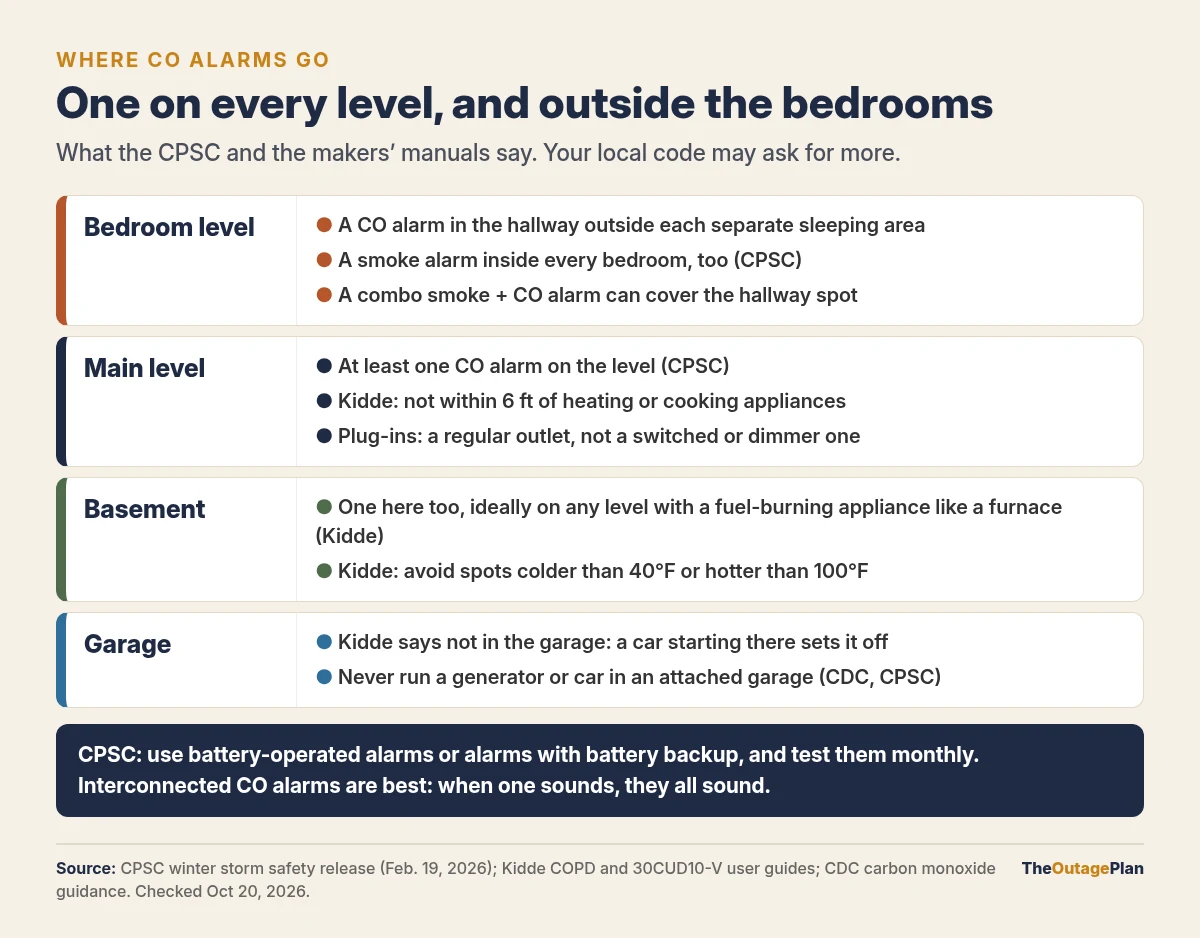
- Every level, including the basement. Kidde’s manuals say ideally on any level with a fuel-burning appliance, and outside sleeping areas (Kidde).
- Outside each separate sleeping area. A combo smoke + CO alarm can cover this spot, but the CPSC also wants a smoke alarm inside every bedroom (CPSC).
- Not in the garage, and not within 6 feet of heating or cooking appliances, per Kidde’s COPD guide.
- Interconnected is best, the CPSC says: when one sounds, they all sound. That usually means hardwired or wireless-linked alarms. None of our three picks interconnect, so put one close enough to every bedroom to be heard.
Which alarms keep working in an outage
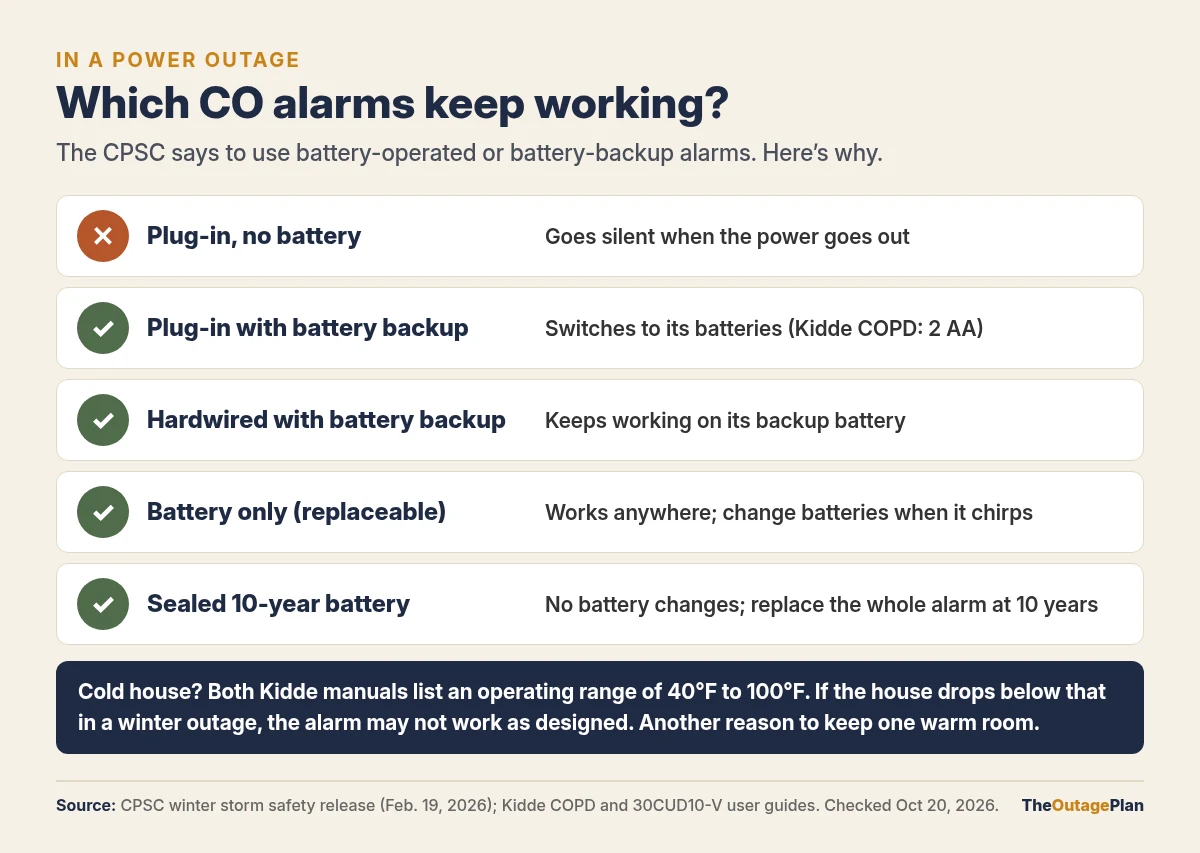
Check the alarms you already have. If one plugs in and has no battery door, it stops working the moment the power does. Battery-only, sealed 10-year, and plug-in or hardwired alarms with battery backup keep watching.
One more outage detail: both Kidde manuals list an operating range of 40°F to 100°F. If the house gets colder than that in a winter outage, the alarm may not work as designed. That’s another reason to keep one warm room, as in our winter heat guide.
Our picks
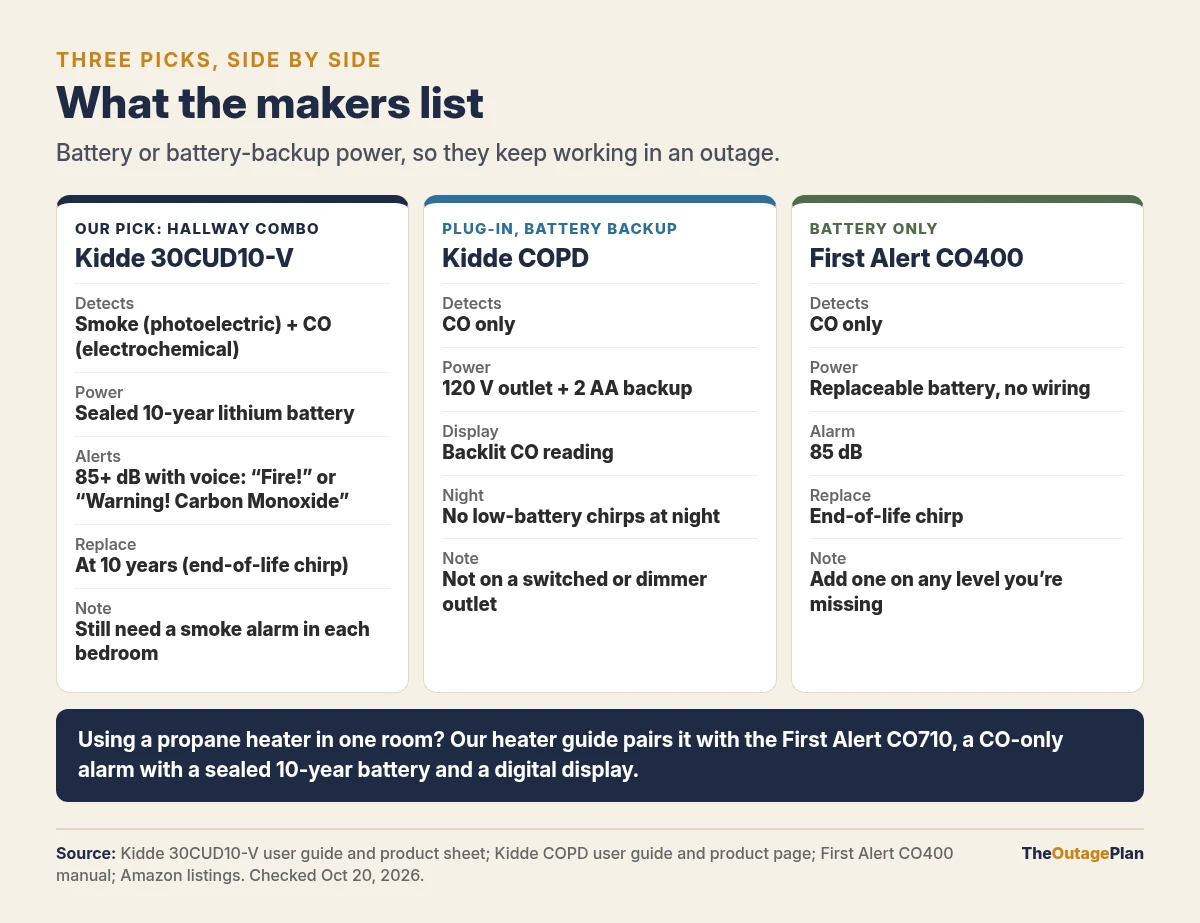
Our pick: Kidde 30CUD10-V (smoke + CO, 10-year battery)
A combination alarm with a photoelectric smoke sensor and an electrochemical CO sensor, powered by a sealed lithium battery (Kidde user guide). It sounds an 85+ dB alarm with voice messages, “Fire!” or “Warning! Carbon Monoxide,” so you know which problem you have. Kidde says it self-tests, should still get a button test weekly, and chirps when it’s time to replace it, 10 years after it’s powered up (Kidde).
The catch: the battery can’t be replaced, so the whole alarm goes at 10 years. And a hallway combo doesn’t replace the smoke alarm the CPSC wants in each bedroom.
Plug-in with battery backup: Kidde COPD
A CO-only alarm that plugs into a standard 120 V outlet and switches to 2 AA backup batteries when the power goes out (Kidde). It has a backlit display that shows the CO reading at the push of a button, and Kidde says it skips low-battery chirps at night. Its user guide lists an 85+ dB alarm and a 10-year replace-by date (Kidde user guide). The Amazon listing says it’s tested to UL 2034, the CO alarm standard.
The catch: use a regular outlet, not one on a switch or dimmer, and swap the AA batteries when it asks. Kidde lists which alkaline brands to use and says not to use lithium.
Battery only: First Alert CO400
The simple fix for a level with no CO alarm at all. It runs on a replaceable battery with no wiring or outlet, sounds an 85 dB alarm, and chirps at end of life, per its Amazon listing. First Alert’s manual says to put one near or inside each separate sleeping area and, for more protection, one on every level (First Alert manual).
The catch: First Alert’s current manual calls for one 9-volt battery, and it warns the CO alarm doesn’t work without a working one. Change it when it chirps.
Running a propane heater? Our indoor propane heater guide pairs it with the First Alert CO710, a CO-only alarm with a sealed 10-year battery, for the room you’re heating.
Skip the no-name combo alarms
The CPSC has recalled or warned about several off-brand smoke + CO combos sold on Amazon that can fail to alert, including Treatlife in 2026 (CPSC), CHZHVAN in 2024 (CPSC) and BQQZHZ in 2023 (CPSC). Stick with established brands, and look for UL 2034 (CO) and UL 217 (smoke) on the box. We checked the CPSC recall database on Oct 20, 2026, and found no recalls for our three picks.
Before the next outage
- Test monthly, as the CPSC says. Kidde and First Alert say weekly.
- Write the replace-by date on each alarm. Kidde says 10 years for the 30CUD10-V and COPD.
- Clear snow from the outside vents of your furnace and other fuel-burning appliances, per the CPSC.
- Keep generators outside, at least 20 feet from the house (CPSC). Our generator vs. power station guide covers the trade-offs, and our gas furnace guide covers keeping the heat on safely.
- Put it on the list. Our winter storm checklist has the rest.
FAQ
How many carbon monoxide alarms do you need?
The CPSC says to put CO alarms on each level of the home and outside separate sleeping areas. A two-story house with a basement and one bedroom hallway needs at least three.
Do CO alarms work when the power is out?
Battery-operated alarms and plug-in or hardwired alarms with battery backup keep working. A plug-in alarm with no battery stops when the power does, which is why the CPSC says to use battery or battery-backup alarms.
Is a combination smoke and CO alarm enough?
A combo can cover the spot outside the bedrooms, but the CPSC also says to put smoke alarms inside each bedroom and CO alarms on every level. Most homes need a mix.
How long do carbon monoxide alarms last?
Kidde says to replace its 30CUD10-V and COPD 10 years after they’re powered up, and its alarms chirp at end of life. Write the replace-by date on each one when you install it.
Specs and placement checked Oct 20, 2026, from the CPSC, CDC, Kidde’s and First Alert’s user guides and product pages, and the Amazon listings. We haven’t hands-on tested these alarms.