
Heads up: Some links on this page are affiliate links. If you buy through them, we may earn a commission at no extra cost to you. As an Amazon Associate, we earn from qualifying purchases. Full disclosure
Testing note: We haven’t hands-on tested these coolers. Specs and ice-life claims come from Coleman, Igloo and EcoFlow and the Amazon listings, checked Oct 23, 2026.
Bottom line: The USDA says a closed fridge keeps food safe for up to 4 hours without power. After that, perishables need a cooler with ice at 40°F or below. Our pick is the Coleman 50-Quart Xtreme 5-Day wheeled cooler, rated by Coleman to keep ice up to 5 days at up to 90°F.
Our pick
Coleman 50-Quart Xtreme 5-Day wheeled cooler: holds 84 cans, rolls on wheels, and Coleman claims ice for up to 5 days at up to 90°F.
Biggest: the Igloo MaxCold Latitude 90 Roller. No ice at all: the EcoFlow GLACIER Classic 35L.
This page is about the cooler. For which foods to keep or toss, see our food safety guide. For insulin, see our insulin cooler guide, since insulin shouldn’t sit on ice.
When to move food into the cooler
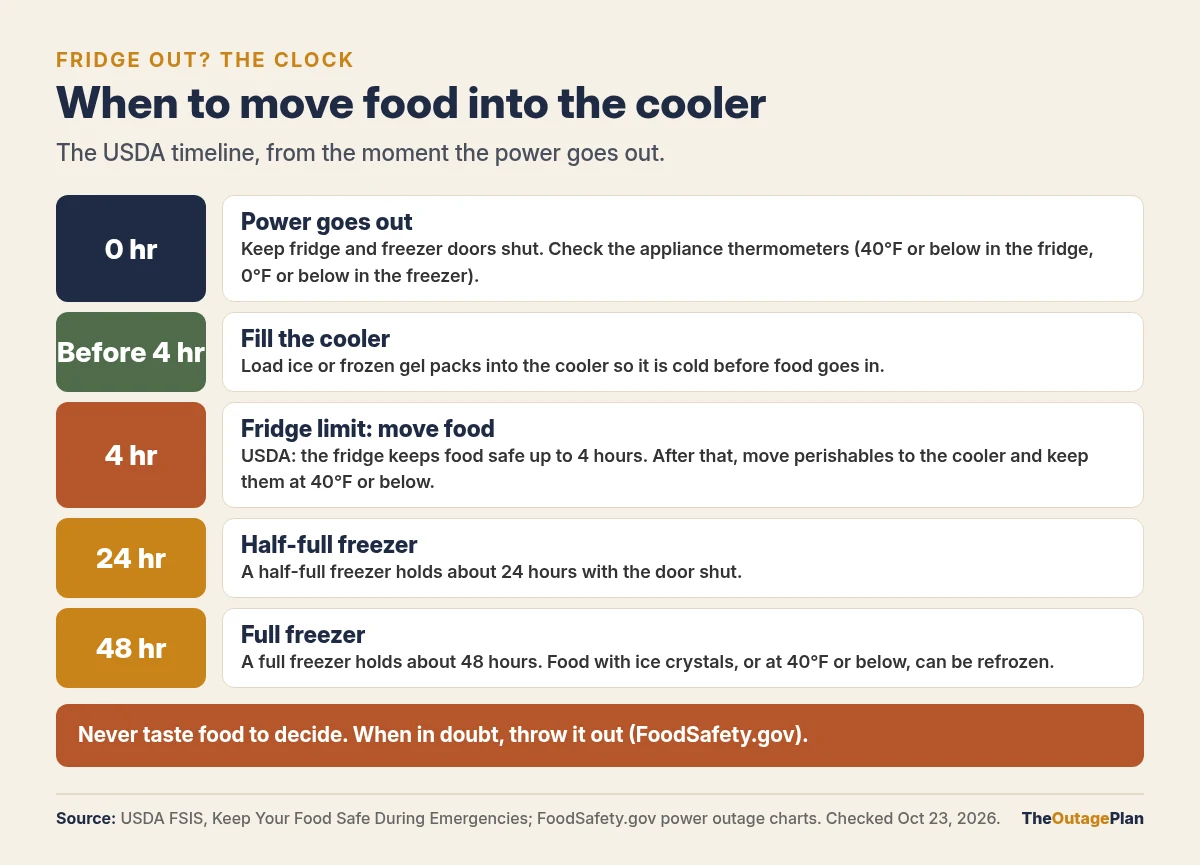
- Keep the doors shut. The USDA says the fridge keeps food safe up to 4 hours. A full freezer holds about 48 hours, or 24 if half full (USDA).
- Past 4 hours, move it. Put meat, dairy, eggs and leftovers in a cooler with ice or frozen gel packs, and keep them at 40°F or below. Add ice as it melts (USDA).
- Check temperatures, never taste. FoodSafety.gov says to discard perishables held above 40°F for more than 2 hours (FoodSafety.gov). An appliance thermometer in the cooler answers the question. See our thermometer picks.
How long does ice last in a cooler?
Those “5-day” claims are lab numbers. Igloo explains its test: a cooler filled 90% with ice chilled to 10°F sits, lid shut, in a 90°F oven at 70% humidity. The claim is the time until the inside reaches 40°F (Igloo). Some makers cool the oven at night, which stretches their claims. In an outage you’ll open the lid often, so expect less.
Block ice vs. cubed ice
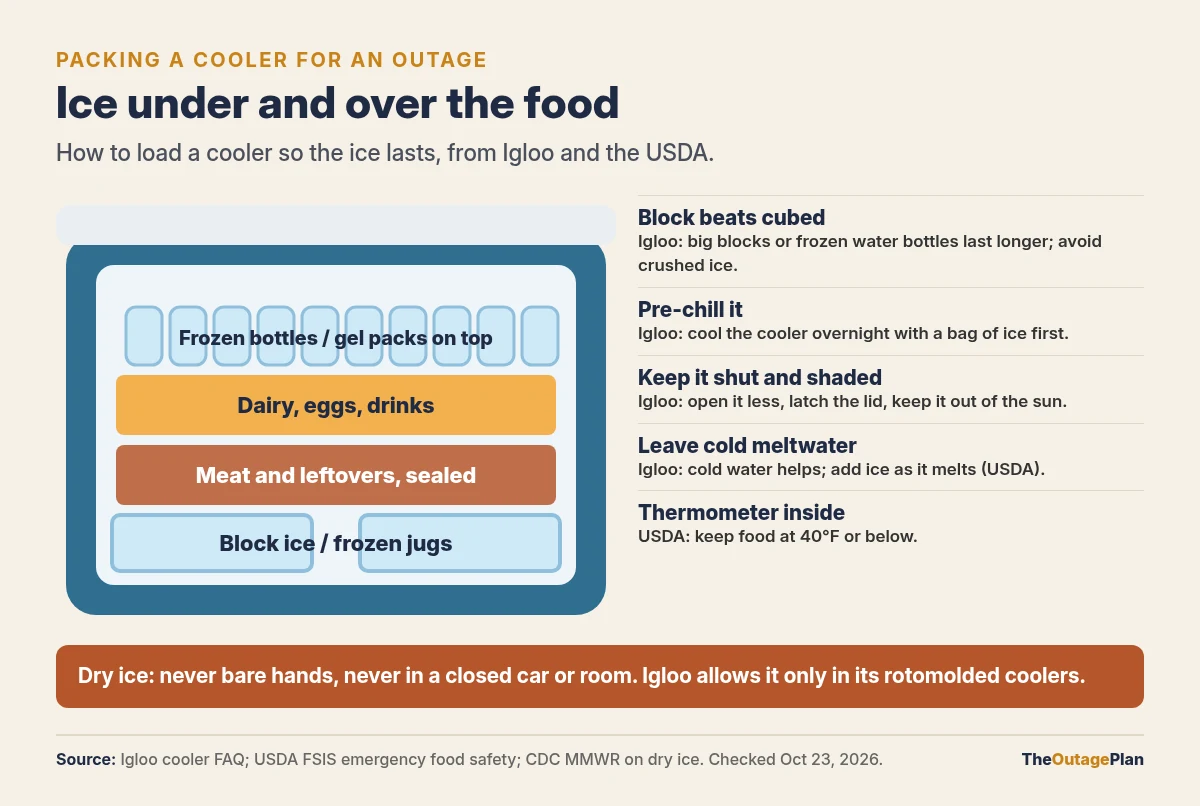
Igloo’s tips (Igloo FAQ):
- Block beats cubed. Large blocks or frozen water bottles last longer. Use large, solid cubes and skip crushed or dripping ice.
- Pre-chill. Cool the cooler overnight with a bag of ice, and put in food that’s already cold.
- Keep it shut, latched and shaded.
- Leave the cold meltwater in; it keeps things cold. Drain it once it warms.
No ice in the store? The USDA suggests freezing water in buckets or milk jugs outside in winter, rather than putting food in the snow (USDA).
Dry ice: useful, with cautions
The USDA says 50 lb of dry ice should hold an 18-cubic-foot full freezer for 2 days. Don’t touch it with bare hands, and don’t let it touch food (USDA).
- Air. Dry ice turns into carbon dioxide gas, which you can’t see or smell. The CDC describes a man who passed out driving 100 lb of it in a closed truck cab. Carry it in the truck bed or with windows open, and store it in an open, well-ventilated space (CDC).
- Your cooler. Igloo allows dry ice only in its rotomolded Sportsman and Yukon lines, with gloves and ventilation (Igloo FAQ). Neither of our ice coolers is rotomolded, so check your cooler’s manual first.
Our picks

Our pick: Coleman 50-Quart Xtreme 5-Day Wheeled
A plain ice chest on wheels. Coleman says it keeps ice up to 5 days at up to 90°F, holds 84 cans, weighs 12.7 lb empty, and has a telescoping handle, a lid that seats up to 250 lb and a leak-resistant drain (Coleman).
The catch: 50 quarts won’t hold a full fridge. Move the perishables first.
Full maker specs: Coleman 50-Qt Xtreme 5-Day Wheeled
- Ice claim: Up to 5 days at temperatures up to 90°F
- Capacity: 50 qt, 84 cans
- Moving: Wheels, telescoping locking handle
- Lid: Have-A-Seat lid supports up to 250 lb
- Drain: Leak-resistant drain
- Size and weight: 22.6 x 17.6 x 17.5 in, 12.7 lb empty
- Warranty: 1 year
Biggest: Igloo MaxCold Latitude 90 Roller
For a big household or a full fridge. Igloo lists up to 5 days of ice retention, tested at 90°F, 90 quarts (137 cans), oversized wheels and a flip-up tow handle (Igloo 2026 catalog).
The catch: it’s large and heavy once loaded. Fill it where it will stay.
Full maker specs: Igloo MaxCold Latitude 90 Roller
- Ice claim: Up to 5 days, tested at 90°F in controlled conditions
- Capacity: 90 qt / 85 L, 137 cans
- Moving: Oversized wheels, flip-up tow handle, swing-up rear handle
- Lid: Hybrid latches with stainless steel hinge
- Drain: Threaded, garden-hose-compatible drain plug
- Other: Cool Riser elevated base, THERMECOOL foam
No ice at all: EcoFlow GLACIER Classic 35L
A 12-volt compressor fridge-freezer for wall, car, solar or battery power. EcoFlow lists 165 Wh a day holding 39°F in a 77°F room (Eco mode), or 520 Wh a day as a 0°F freezer, with a range of -4°F to 68°F (EcoFlow).
Our rough math: a 1,000 Wh power station has maybe 850 Wh to give after losses, or about 5 days at 39°F. Warm rooms and opening it cut that. See our fridge runtime math and power station picks.
The catch: 35 liters (about 37 qt) and 45 lb, and the 298 Wh battery is sold separately.
Full maker specs: EcoFlow GLACIER Classic 35L
- Capacity: 35 L (about 37 qt), 58 cans
- Range: -4°F to 68°F
- Energy: 165 Wh/24 hr at 39°F; 520 Wh/24 hr at 0°F (77°F room, Eco mode)
- Rated power: 55 W
- Inputs: AC up to 95 W; 12/24V car up to 100 W; solar up to 110 W
- Battery: Optional 298 Wh plug-in battery, up to 43 hr at 39°F per EcoFlow
- Weight: 45 lb
Before the next outage
- Freeze water jugs now. The USDA says a full freezer stays cold longer, and the jugs become block ice later.
- Keep the cooler handy, with gel packs and a thermometer.
FAQ
How long will food stay safe in a cooler?
As long as it stays at 40°F or below, per the USDA. Add ice as it melts.
Is block ice better than cubed ice?
Yes. Igloo says big blocks or frozen water bottles last longer than cubes, and to skip crushed ice.
Can you put dry ice in any cooler?
No. Check the manual; Igloo allows it only in its rotomolded coolers. Never handle it bare-handed or keep it in a closed car or room.
When should you move food from the fridge to a cooler?
After about 4 hours without power, per the USDA. A full freezer can wait about 48 hours if the door stays shut.
Specs checked Oct 23, 2026, from Coleman, Igloo and EcoFlow and the Amazon listings. Food safety guidance from the USDA and FoodSafety.gov; dry ice cautions from the USDA, the CDC and Igloo. We haven’t hands-on tested these coolers.