Heads up: Some links on this page are affiliate links. If you buy through them, we may earn a commission at no extra cost to you. As an Amazon Associate, we earn from qualifying purchases. Full disclosure
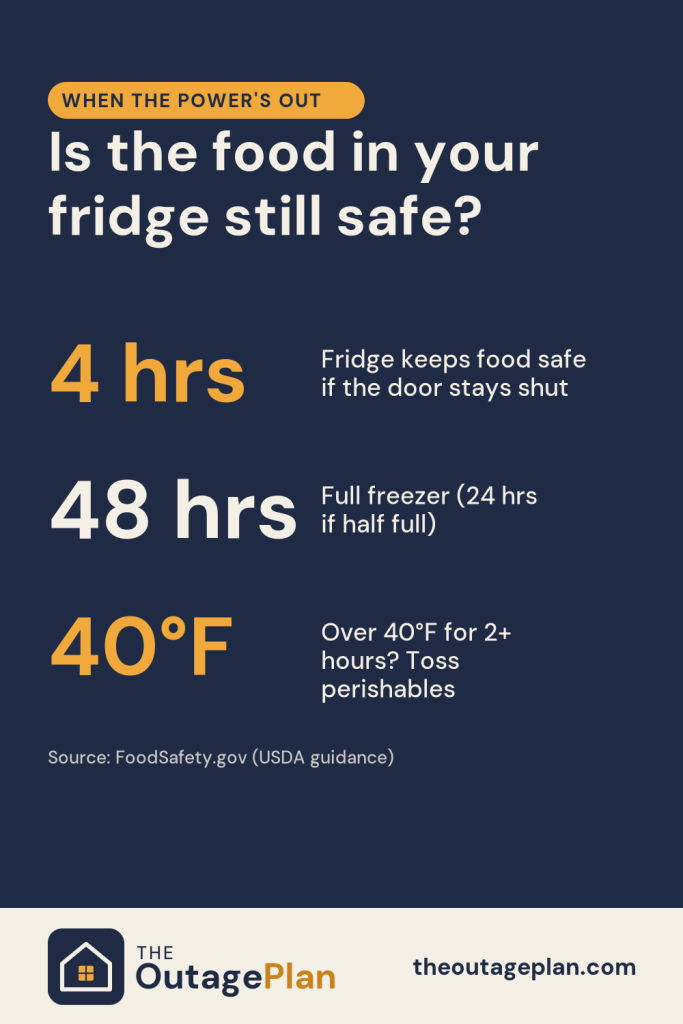
Bottom line: Keep the doors shut. A refrigerator keeps food safe for up to 4 hours without power. A full freezer holds a safe temperature for about 48 hours, or 24 hours if half full (FoodSafety.gov). Never taste food to check it. When in doubt, throw it out.

Before the outage
- ☐ Put appliance thermometers in the fridge and freezer. You can’t judge 40°F by feel.
- ☐ Keep the freezer full. A full freezer holds its temperature twice as long as a half-full one (48 vs. 24 hours, per FoodSafety.gov). Jugs of water work as filler, and they double as ice.
- ☐ Know where you can get ice or coolers. Ready.gov suggests coolers with ice if needed (Ready.gov).
During the outage
- Keep the doors closed as much as possible.
- After 4 hours without power, perishable fridge food (meat, poultry, fish, eggs, leftovers) should be discarded (FoodSafety.gov).
Big storms can leave millions of homes without power at once. One example:

After: keep or toss? (selected items)
Fridge food exposed to 40°F or above for more than 2 hours, per FoodSafety.gov:
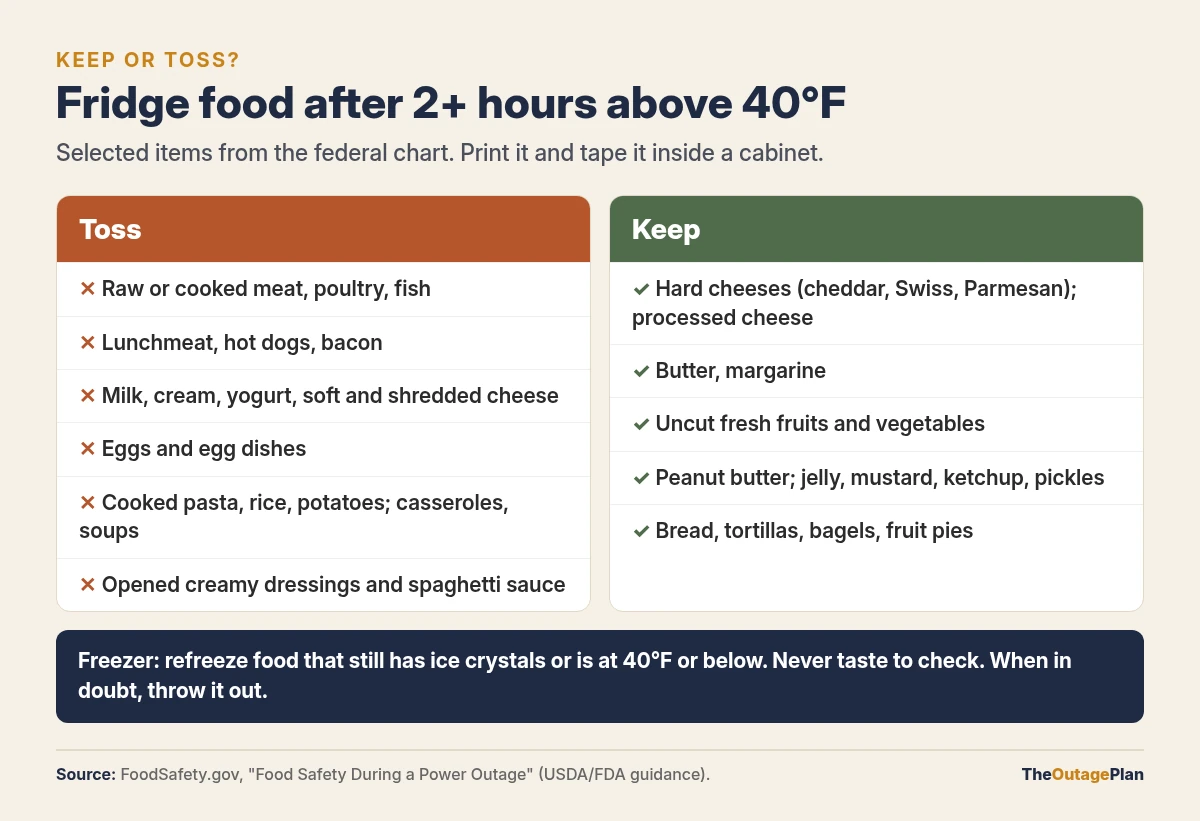
Freezer: food can be refrozen if it still has ice crystals or is at 40°F or below, though quality may suffer (FoodSafety.gov).
The full chart covers dozens more items. Print it and tape it inside a cabinet.
Can a power station keep the fridge running?
Yes, for a while. The math:
- Find your fridge’s yellow EnergyGuide label (kWh per year). The DOE has a search tool if the label is gone.
- kWh/year ÷ 365 = kWh per day. Example: 600 kWh/yr ≈ 1,644 Wh/day, or about 68.5 W on average.
- Run time ≈ capacity (Wh) × 0.85 ÷ average watts. The 0.85 is Jackery’s planning factor for losses (Jackery).
For that example fridge, a ~1,000 Wh station gives roughly 12–14 hours (DELTA 3 Plus ~12.7 hr, AC180 ~14.3 hr, Explorer 1000 v2 ~13.3 hr; our estimates from manufacturer capacities). Also check the station’s surge rating. Virginia Tech notes a motor draws about 3× its running current for a moment at startup (VCE).
Full walkthrough: How to size a power station.
Which thermometer to buy? See our fridge and freezer thermometer picks: an alarm model, a no-battery dial and an instant-read probe.
Fridge and freezer thermometers are on our Gear page.
Food safety rules from FoodSafety.gov (USDA guidance) and Ready.gov; run times are our estimates from manufacturer specs. We haven’t hands-on tested these setups. Checked Oct 18, 2026.
Save this for later