
Heads up: Some links on this page are affiliate links. If you buy through them, we may earn a commission at no extra cost to you. As an Amazon Associate, we earn from qualifying purchases. Full disclosure
Testing note: We haven’t hands-on tested these thermometers. Specs come from AcuRite’s manual and product page, Taylor’s product page and package card, TempPro’s product page and the Amazon listings, checked Oct 19, 2026. Food safety guidance comes from USDA FSIS, the FDA, FoodSafety.gov and the CDC.
Bottom line: When the power comes back, a thermometer answers the question you can’t answer by feel: did the fridge stay at 40°F or below and the freezer at 0°F or below? The FDA says to buy one for the fridge and one for the freezer (FDA). Our pick also remembers the warmest each box got while the power was out.
Our pick
AcuRite 00986M wireless fridge and freezer thermometer: two battery sensors and a display outside the door, with high and low records and an alarm. It keeps working with the power out.
Our food safety guide has the 4-hour and 48-hour rules and the keep-or-toss chart. This page is about which thermometer to buy.
Which kind do you need?

Few fridge controls show the actual temperature, which is why the FDA recommends a freestanding appliance thermometer (FDA). A newer fridge’s built-in display also goes dark when the power does.
Why an alarm model is our pick. The federal rule turns on time as well as temperature: perishable fridge food that sat at 40°F or above for more than 2 hours should go (FoodSafety.gov). A dial shows only the temperature right now. If the alarm model’s high record never passed 40°F, you have your answer without guessing. If it did and you can’t say for how long, the FDA’s advice is to throw the food out (FDA).
Wi-Fi models can alert your phone, but only while your router and internet are up (keeping Wi-Fi on in an outage). We picked a model that keeps its own record.
Our picks
Our pick: AcuRite 00986M wireless fridge and freezer thermometer
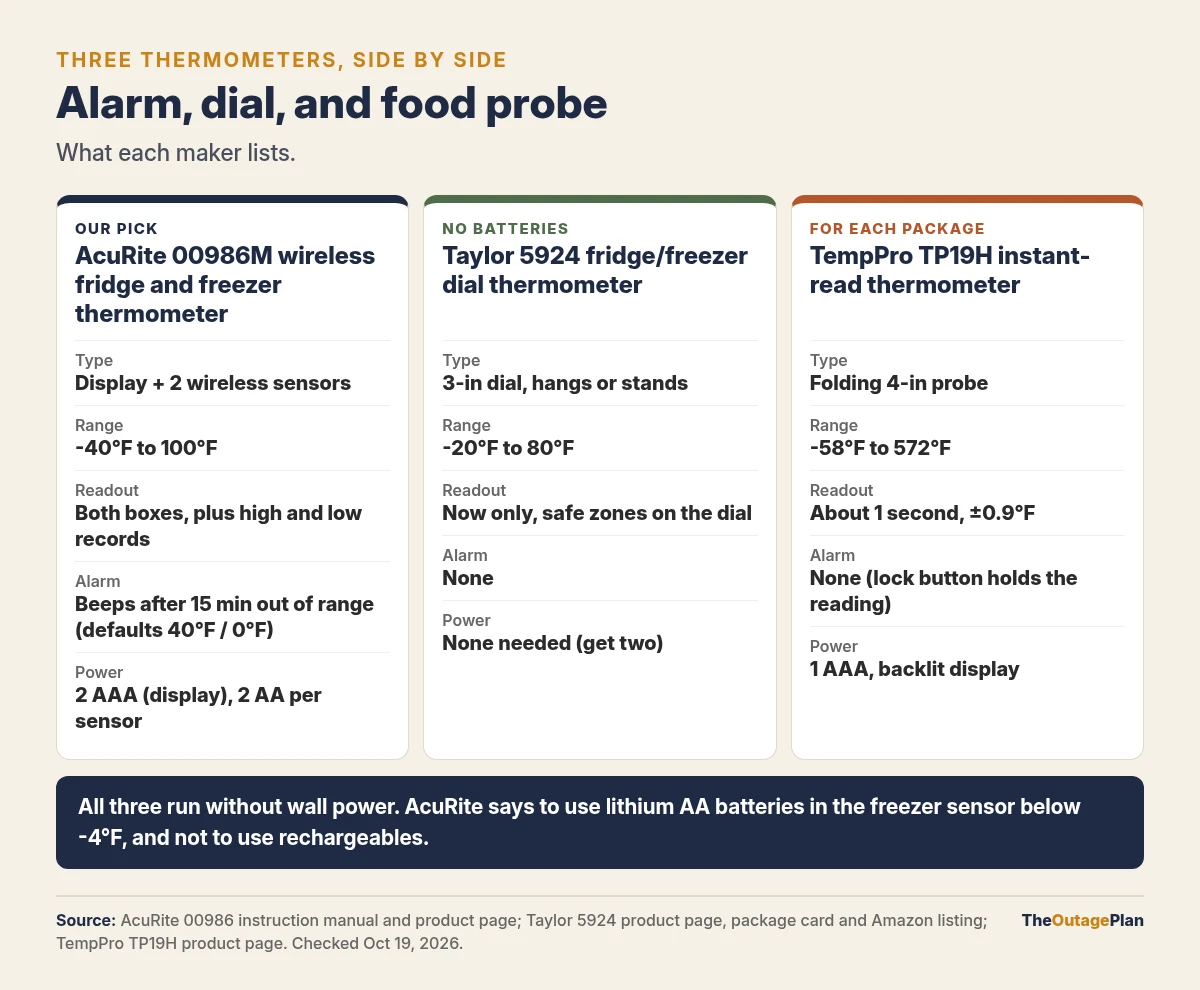
A display plus two wireless sensors, one for the fridge and one for the freezer, each with a shelf clip and a suction cup. The display sticks to the fridge with a magnet or hangs on a wall within 75 ft. It reads -40°F to 100°F, updates every 90 seconds and keeps a high and low record for each sensor. The alarm defaults to 33–40°F for the fridge and -22–0°F for the freezer, and it sounds after 15 minutes out of range, so loading groceries won’t set it off (AcuRite manual). It runs on 2 AAA batteries in the display and 2 AA in each sensor (AcuRite).
The catch: batteries. AcuRite says to use alkalines, lithium AAs in the freezer sensor below -4°F, and no rechargeables. Suction cups don’t hold well on freezing surfaces, so use the clip in the freezer (AcuRite manual).
No batteries: Taylor 5924 dial thermometer (get two)
A 3-inch dial that hangs from a rack or stands on a shelf, with freezer, fridge and danger zones printed on the face. Taylor’s package marks the safe zones as 32–40°F for the fridge and -20–0°F for the freezer, and its Amazon listing gives a range of -20°F to 80°F. Stainless steel, NSF certified, hand wash only (Taylor).
The catch: it shows only the temperature right now, and you have to open the door to read it. It makes a good second thermometer, and it’s the one we’d put in a cooler.
For each package: TempPro TP19H instant-read thermometer
When you’re not sure about a package, check the food itself: if it still has ice crystals or is at 40°F or below, it can be refrozen or cooked (FoodSafety.gov). The CDC also says to check food kept in coolers and throw out anything above 40°F (CDC). The TP19H (formerly ThermoPro) has a 4-inch folding probe and reads -58°F to 572°F in about 1 second, within ±0.9°F. It has a backlit display, a lock button and a calibration setting, and runs on 1 AAA battery. It’s rated IP65, so rinse it but don’t submerge it (TempPro).
The catch: it’s for spot checks, not for living in the fridge. TempPro says boxes may arrive with either the ThermoPro or TempPro name. When the power’s back, it’s also a regular cooking thermometer.
Set them up before the outage
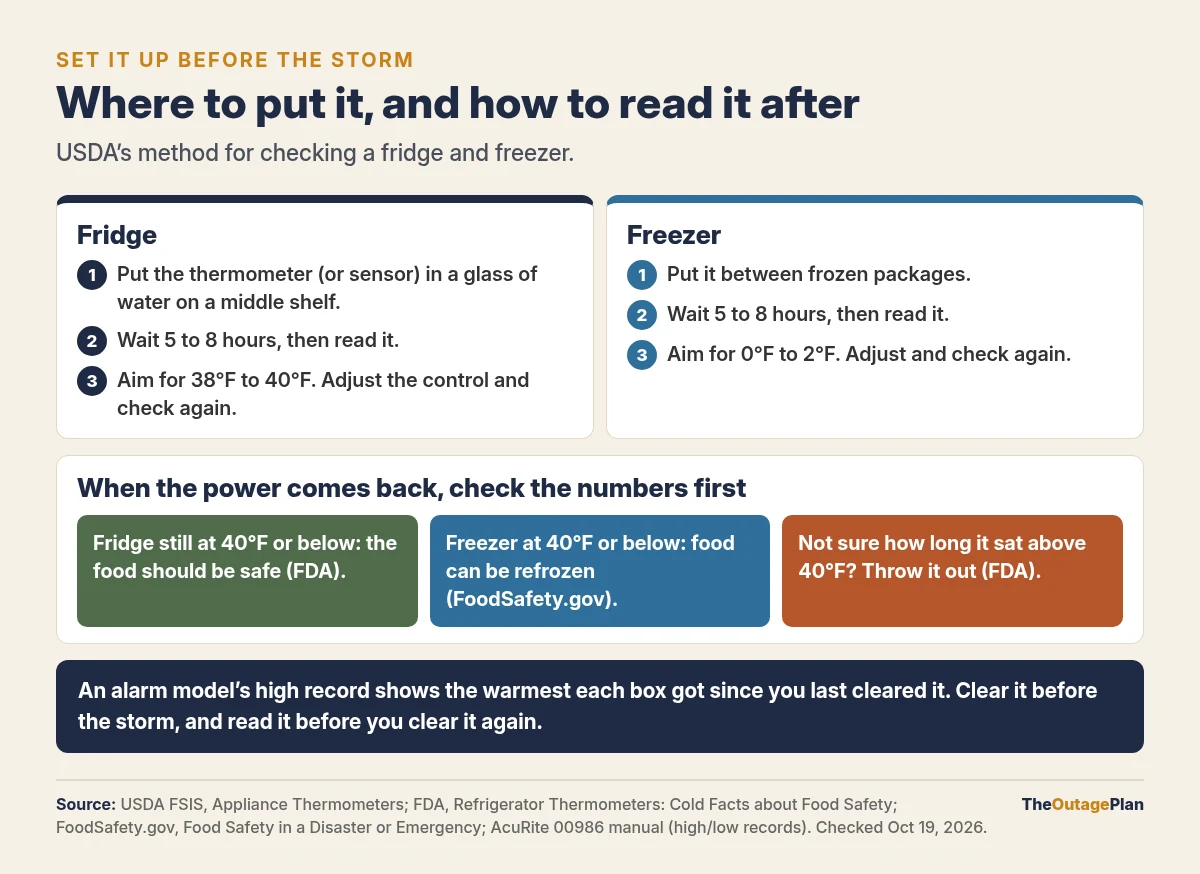
- Test the fridge and freezer now, not during the storm. USDA’s method: a thermometer in a glass of water on a middle shelf of the fridge, or between frozen packages in the freezer, read after 5 to 8 hours (USDA FSIS).
- Put the display where you can read it without opening a door. AcuRite’s sensors and display have to stay within 75 ft of each other (AcuRite manual).
- Clear the high and low record before a storm, so it covers only the outage.
- Keep spare batteries for the display, both sensors and the probe.
- Check the probe in ice water. USDA says a food thermometer’s stem, at least 2 inches into a glass of ice water, should read 32°F after 30 seconds (USDA FSIS).
When the power comes back, check the numbers before you open anything. Then use the keep-or-toss chart in our food safety guide.
What about a cooler?
USDA FSIS says to have a large insulated cooler and frozen gel packs ready. If the outage runs past 4 hours, move fridge food into it with enough ice to keep it at 40°F or below (USDA FSIS). Any cooler you already own works, so we don’t pick one here. Put the dial thermometer inside. To keep the fridge running instead, see our power station picks for a fridge and freezer and how long a station runs a fridge.
For the rest of your kit, see our 72-hour outage kit checklist and our Gear page.
FAQ
What temperature should a fridge and freezer be?
40°F or below for the fridge and 0°F or below for the freezer (USDA FSIS, FDA).
Where should you put a fridge thermometer?
USDA’s method: in a glass of water in the middle of the fridge, and between frozen packages in the freezer (USDA FSIS).
Do you need one if your fridge has a digital display?
Yes. Few fridge controls show the actual temperature (FDA), and a built-in display goes dark when the power does.
Can a food thermometer replace a fridge thermometer?
Not really. A probe checks one package at a time. A fridge thermometer watches the whole box, and an alarm model remembers how warm it got.
Specs checked Oct 19, 2026, from AcuRite’s 00986 manual and product page, Taylor’s product page and package card, TempPro’s TP19H product page and the Amazon listings. Food safety guidance is from USDA FSIS, the FDA, FoodSafety.gov and the CDC. We haven’t hands-on tested these thermometers.