
Heads up: Some links on this page are affiliate links. If you buy through them, we may earn a commission at no extra cost to you. As an Amazon Associate, we earn from qualifying purchases. Full disclosure
Testing note: We haven’t taste-tested or long-term stored these kits ourselves. Figures come from Mountain House, My Patriot Supply (Ready Hour’s parent company), and their Amazon listings, checked Oct 18, 2026.

Our picks
Most food per bucket: Ready Hour 120-Serving Emergency Entrée Bucket. 30,000+ calories per the brand’s label, about 3.75 days for a family of four. Some entrées cook in a pot.
Easiest to eat: Mountain House Essential Meal Assortment Bucket. Add water to the pouch; Mountain House says cold water works in 20 to 30 minutes. About 5,400 calories, under a day for four.
Bottom line: Start with a few days of pantry food your family already eats (Ready.gov). For a long-shelf-life backup:
- Easiest to eat in an outage: the Mountain House Essential Meal Assortment Bucket. You add water to the pouch and eat from it, and Mountain House says cold water works if you give it 20 to 30 minutes. But one bucket is only about 5,400 calories, well under a day for a family of four.
- The most food per bucket: the Ready Hour 120-Serving Emergency Entrée Bucket, at 30,000+ calories per the brand’s label. That’s closer to four days for a family of four at 2,000 calories each. The catch: some entrées are cooked in a pot, so you need a way to boil and simmer.
Many families end up with both: Ready Hour for bulk calories, Mountain House for the no-cook nights.
The family-of-4 math: count calories, not “servings”
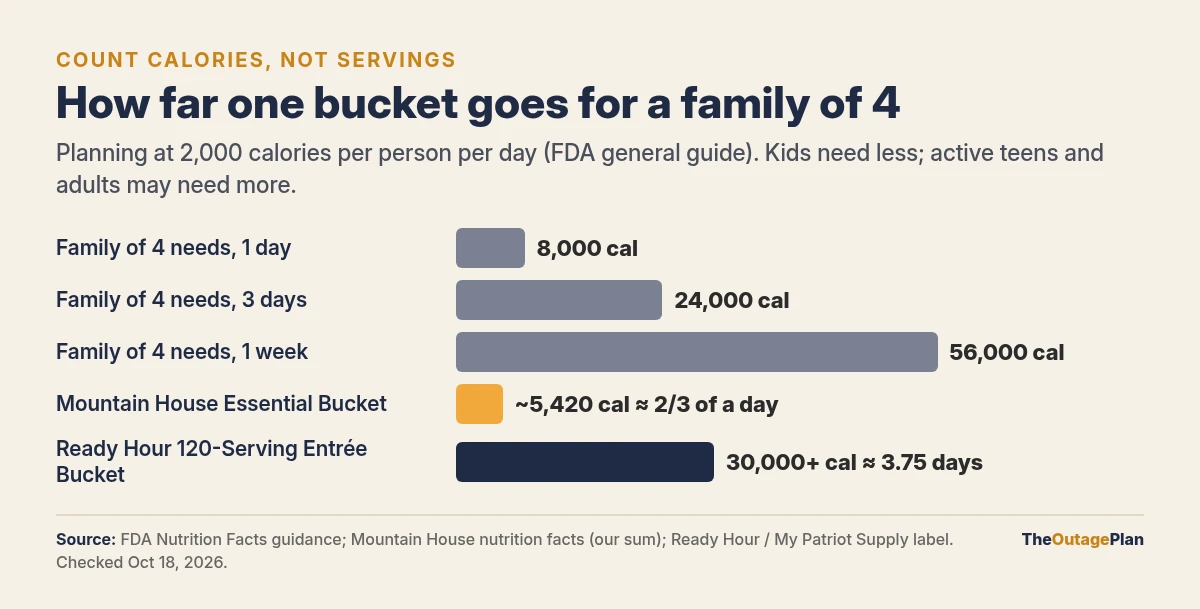
“Servings” on survival food vary a lot from brand to brand, so compare calories. The FDA uses 2,000 calories a day as a general guide for nutrition advice, and notes that real needs vary by age, sex, size, and activity (FDA). Young kids need less, and active adults or teens may need more. Using 2,000 as a planning number:
| Family of 4 | Calories needed |
|---|---|
| 1 day | 8,000 |
| 3 days | 24,000 |
| 1 week | 56,000 |
Mountain House vs. Ready Hour, side by side
| Mountain House Essential Bucket | Ready Hour 120-Serving Entrée Bucket | |
|---|---|---|
| Pouches | 12 (22 servings) | 22 resealable pouches, 10 entrée varieties |
| Total calories | ~5,420 (our sum of Mountain House’s nutrition facts) | 30,000+ (brand label) |
| Family of 4 at 2,000 cal/day | about 2/3 of a day | about 3.75 days |
| Prep | Add water to the pouch; eat in under 10 minutes with hot water | Varies by pouch; the Mac & Cheese is boiled and simmered 15–20 minutes in a pot |
| Water to make everything | 17 cups (about 1 gallon) | Not listed for the bucket; the Mac & Cheese alone takes 4½ cups per pouch |
| Shelf life (maker’s claim) | 30-Year Taste Guarantee | Up to 25 years; resealed pouches up to 1 year |
| Storage temperature | Unopened; avoid prolonged exposure above 75°F | Cool, dry, dark; ideally 55–70°F |
| Diet notes | Gluten-free meals | Mac & Cheese contains milk and wheat |
| Weight | 5.04 lb | Listed at 20 lb on Amazon |
Sources: Mountain House Essential Bucket, Mountain House shelf life, My Patriot Supply: Ready Hour Mac & Cheese, My Patriot Supply FAQ, and each kit’s Amazon listing.
How we got 5,420 calories: Mountain House lists 4 Beef Stew (420 per pouch), 2 Breakfast Skillet (520), 2 Scrambled Eggs with Bacon (350), and 4 Rice & Chicken (500). That adds up to 5,420.
Mountain House: best when cooking is hard
The Essential bucket holds 12 pouches: 4 Beef Stew, 4 Rice & Chicken, 2 Breakfast Skillet, and 2 Scrambled Eggs with Bacon. All 12 are gluten-free. It weighs 5.04 lb and measures 12 × 10 × 12.3 inches, and making everything takes 17 cups of water (Mountain House).
Why it fits an outage:
- No pot, no dishes. Add water to the pouch and eat in under 10 minutes with hot water.
- Cold water works too, per Mountain House, if you allow 20 to 30 minutes (Mountain House). That matters with an electric stove and no power.
- The shelf life is long. Mountain House backs it with a 30-Year Taste Guarantee, as long as it’s kept unopened and not exposed to prolonged heat above 75°F (Mountain House).
The tradeoff: at about 5,420 calories, one bucket feeds a family of four for less than a day. Think of it as a few easy dinners on the worst nights, not the whole plan.
Check Mountain House on Amazon
Ready Hour: best calories per bucket
Ready Hour is My Patriot Supply’s food brand (My Patriot Supply). The Entrée bucket holds 22 resealable pouches across 10 varieties, 120 servings in all. It’s rated for up to 25 years in a cool, dry place, and resealed pouches last up to a year (per Ready Hour’s Amazon listing). My Patriot Supply recommends storing its food at 55–70°F (My Patriot Supply FAQ).
Why it’s worth it:
- Bulk calories. At 30,000+ calories, one bucket covers most of a 3-day plan for four people.
- Resealable pouches, so you can open one, use part of it, and save the rest.
The tradeoff: plan for a stove. My Patriot Supply’s directions for Ready Hour Mac & Cheese, one of the entrées, are to whisk the pouch into 4½ cups of water, bring it to a boil, and simmer 15–20 minutes (My Patriot Supply). If your stove is electric, you’ll need another heat source. And a camp stove goes outdoors only. The CDC says never use a portable gas camp stove indoors because of carbon monoxide (CDC).
A one-week plan for a family of 4
Why plan for a full week: after a major hurricane, some households wait weeks for power.

A practical mix:
- Days 1–3: your pantry. Canned meats, beans, soups, fruit, peanut butter, crackers, and cereal, plus a manual can opener. Eat the fridge food first, within the limits on keeping food safe in an outage.
- Days 4–7: one Ready Hour Entrée bucket, about 3.75 days at 2,000 calories each, cooked on a camp stove outside.
- For the hardest nights: one Mountain House Essential bucket, for when you can’t or don’t want to cook.
Need more? Add a second Ready Hour bucket, or stretch the pantry tier. Our Food Storage Kit has the checklist.
Don’t forget water and where you store it
- Water: store 1 gallon per person per day for drinking and sanitation (Ready.gov). That’s 28 gallons for a family of four for a week, plus whatever your meals take. A couple of Reliance Aqua-Tainer 7-gallon containers make a good start. See how much water to store.
- Storage spot: both brands’ temperature guidance rules out a hot garage or attic in most of the country in summer. Keep the buckets inside the climate-controlled part of the house, off the floor in case of flooding.
- Rotate: write the purchase date on each bucket, and check it each year when you check your smoke and CO detectors.
FAQ
How many buckets does a family of 4 need for 2 weeks?
At 2,000 calories each, two weeks for four people is 112,000 calories. That’s about four Ready Hour Entrée buckets (30,000+ calories each), or a smaller number plus a deep pantry. Kids eat less, so your real number may be lower.
Is freeze-dried food worth it if you already have a pantry?
For short outages, a well-stocked pantry is enough. Long-shelf-life kits earn their space for longer disasters, and for families who won’t rotate canned food. They can sit for years.
Can you keep the fridge going instead?
For a while. A ~1 kWh power station runs a typical fridge for roughly half a day (see our power station sizing guide and fridge and freezer picks). Shelf-stable food is the backup for when the battery runs out.
Everything mentioned here is on our Gear page.
Figures checked Oct 18, 2026, from Mountain House, My Patriot Supply, the FDA, the CDC, Ready.gov, and the products’ Amazon listings. Shelf-life numbers are manufacturer claims and depend on storage. Check labels for allergens. This is general information, not dietary or medical advice.