
Heads up: Some links on this page are affiliate links. If you buy through them, we may earn a commission at no extra cost to you. As an Amazon Associate, we earn from qualifying purchases. Full disclosure
Testing note: We haven’t hands-on tested these radios yet. Specs come from Midland’s product pages and user guides, checked Oct 18, 2026.
Our picks
By the bed: Midland WR120. A NOAA weather alert radio with SAME, so it wakes you for warnings in your county, with a 3 × AA backup (up to 2 days of standby, per Midland).
In the outage kit: Midland ER310. AM/FM and NOAA with a hand crank, solar, and a 6 × AA backup option.
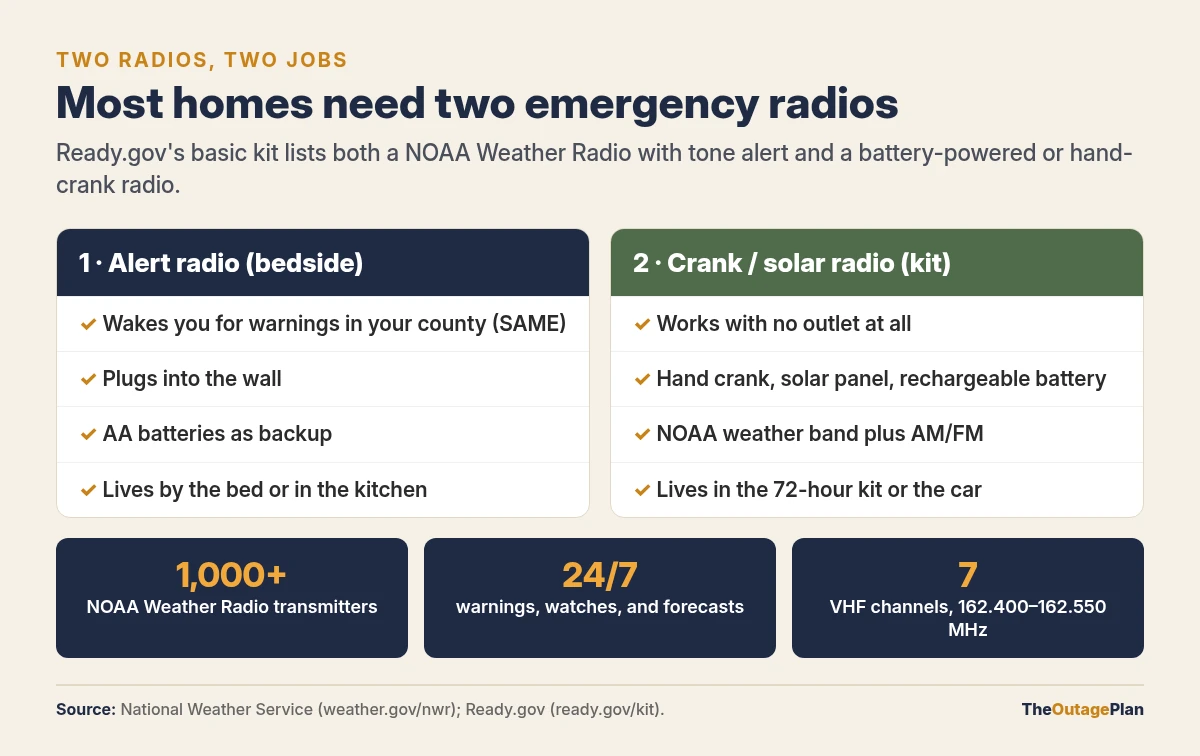
Bottom line: Most homes need two radios with two different jobs:
- A plugged-in NOAA weather alert radio with SAME by the bed, so a tornado or flash flood warning for your county wakes you up at 2 a.m. Our pick: the Midland WR120. Step up to the Midland WR400 if you want voice and light alerts.
- A hand-crank or solar radio for when the power, the internet, and the cell network are all down. Our pick: the Midland ER310, or the smaller Midland ER40 for the car.
Ready.gov’s basic emergency kit lists both: “a battery-powered or hand crank radio and a NOAA Weather Radio with tone alert” (Ready.gov).
Why every home needs a real weather radio
Wherever you live, there’s a warning you can’t afford to sleep through: tornadoes across the Plains, Midwest, and South, flash floods in hill country and cities alike, hurricanes on the Gulf and Atlantic coasts, and ice storms and blizzards in winter. Many of the worst warnings come at night, and phones get silenced, run down, or lose signal.
NOAA Weather Radio All Hazards is a network of more than 1,000 transmitters broadcasting National Weather Service warnings, watches, and forecasts 24 hours a day, plus non-weather emergency alerts. To hear it, you need a radio that receives its seven VHF frequencies (162.400–162.550 MHz) (National Weather Service).
Outages can also be long. In 2024, Hurricane Helene left 5.9 million customers without power across 10 states (EIA), and Winter Storm Uri left some households without power for up to four days in 2021 (U.S. House committee document). A radio that runs on AA batteries, a crank, or the sun keeps working after everything else quits.

The two kinds of emergency radio
SAME (Specific Area Message Encoding) lets you program the radio for your county, so you’re not woken up for a warning two counties away. Midland explains that SAME codes are how the National Weather Service targets alerts to specific areas (Midland WR400 FAQ). The NWS publishes a county-by-county list of SAME codes and transmitters.
Best bedside alert radio: Midland WR120
Midland WR120 NOAA weather alert radio
- SAME alerts: set it for one county, up to 25 counties, or all alerts
- Receives all 7 NOAA weather channels
- Runs on 120V AC with 3 AA batteries as outage backup
- Battery-only runtime: up to 2 days on standby, or about 12 hours of continuous full-volume broadcast with basic alkalines, per Midland
Sources: Midland WR120 user guide, Midland runtime note.
Why it’s our pick: it does the one job that matters most, waking you for warnings in your county, and it keeps doing it on AA batteries when the power drops. That 2-day standby figure is a good reason to keep fresh AAs in your kit and swap them in on day two of a long outage.
Step-up alert radio: Midland WR400
Midland WR400 deluxe NOAA weather alert radio
- Public Alert certified, per Midland
- SAME for up to 25 counties
- Choose siren, voice, or visual LED alerts, with color-coded alert-level lights
- AM/FM radio, alarm clock, and a USB charging port
- 4 AA batteries for emergency power backup (not included)
Source: Midland WR400.
Who it’s for: households that want more control over how alerts sound, or that have someone hard of hearing who’d benefit from visual alert lights. The USB port is handy for topping off a phone while the radio is on wall power.
Best crank radio: Midland ER310
Midland ER310 emergency crank radio
- AM/FM plus 7 NOAA channels with weather alert
- Built-in rechargeable battery, about 2,600–3,500 mAh depending on version
- 6 × AA backup option
- Solar panel and hand crank
- Midland notes that solar and crank are for topping up in an emergency, not reliable ways to fully charge it
Source: Midland ER310 user guide.
Why it’s our pick: the AA backup is the key. Crank and solar are great for a top-up, but a few fresh AAs are the dependable fallback on day three of an outage.
Compact crank radio for the car: Midland ER40
Midland ER40 emergency crank radio
- AM/FM plus NOAA weather band with weather alerts
- 2,600 mAh rechargeable lithium-ion battery
- Hand crank and solar charging
- Backlit LCD display for reading channels in the dark
- LED flashlight with an SOS strobe
- USB port for an emergency phone charge
Sources: Midland ER40 and Midland’s Amazon listing.
Why the ER40 and not the ER210: we used to list Midland’s ER210 here. Midland still sells it on its own site, but we couldn’t find a current Amazon listing, so the ER40 is our compact pick for now.
One honest caveat: a small crank radio’s battery is a few thousand mAh, far less than a phone power bank. Midland’s FAQ for its ER radios says a 2,600 mAh battery charging a newer phone (4,000 to 8,000 mAh) while also running itself “will likely not even move the needle” (Midland). Treat the ER40 as a radio and flashlight, and use a phone power bank for your phone.
Which radio should you buy?
- Most homes: a WR120 by the bed plus an ER310 in the outage kit.
- Hard of hearing in the house, or want more alert options: the WR400 instead of the WR120.
- Second kit for the car or a commute: add an ER40.
- Apartment with limited space: start with the WR120. It works as your outage radio too, as long as you keep spare AAs.
All four are on our Gear page, with key specs and price-check links.
How to set up your radio (10 minutes)
- Look up your county’s SAME code on the NWS county list. Also note which transmitter serves you; if you live near a county line, consider programming both counties.
- Program the code following your radio’s manual.
- Install fresh batteries in the alert radio, even though it’s plugged in. Midland’s FAQ says to install AA batteries so the radio keeps working in an outage.
- Check the weekly test. Midland says desktop radios default to a silent weekly test: the advisory light comes on and the display shows “Required Weekly Test” instead of a siren. That’s how you know it’s working (Midland WR400 FAQ).
- Charge the crank radio fully over USB, then store it in your 72-hour kit. Midland says solar is meant to extend the charge, not fill it from empty.
- Put it on the calendar. Test both radios when you change your clocks or smoke-alarm batteries.
What to do when the alert goes off
- Tornado warning: go to the lowest floor, in a small interior room away from windows. Follow Ready.gov’s tornado guidance.
- Flash flood warning: move to higher ground, and never drive through flooded roads. The National Weather Service’s message is “Turn Around, Don’t Drown” (NWS).
- Winter storm warning: charge everything and stay off the roads. See our winter storm outage prep lessons.
- Hurricane watch or warning: follow local evacuation orders. See our hurricane outage power plan.
Pair your radio with light and power
A radio is one part of the outage shelf. Add a flashlight for every person (Ready.gov), headlamps, a lantern, and charged power banks. Our NOAA radio and outage lighting guide covers the lighting side, and our guide to emergency light bulbs covers lights that stay on when the power cuts out. If you want to keep a fridge or CPAP running too, start with the power station sizing guide.
Specs checked Oct 18, 2026, from Midland’s product pages, user guides, and FAQs, plus the National Weather Service and Ready.gov. We haven’t hands-on tested these radios yet. If Midland updates a spec, their page wins.