
Heads up: Some links on this page are affiliate links. If you buy through them, we may earn a commission at no extra cost to you. As an Amazon Associate, we earn from qualifying purchases. Full disclosure
Testing note: We haven’t hands-on tested these panels. Specs come from Anker’s, BigBlue’s and Goal Zero’s product pages and the Amazon listings, checked Oct 21, 2026.
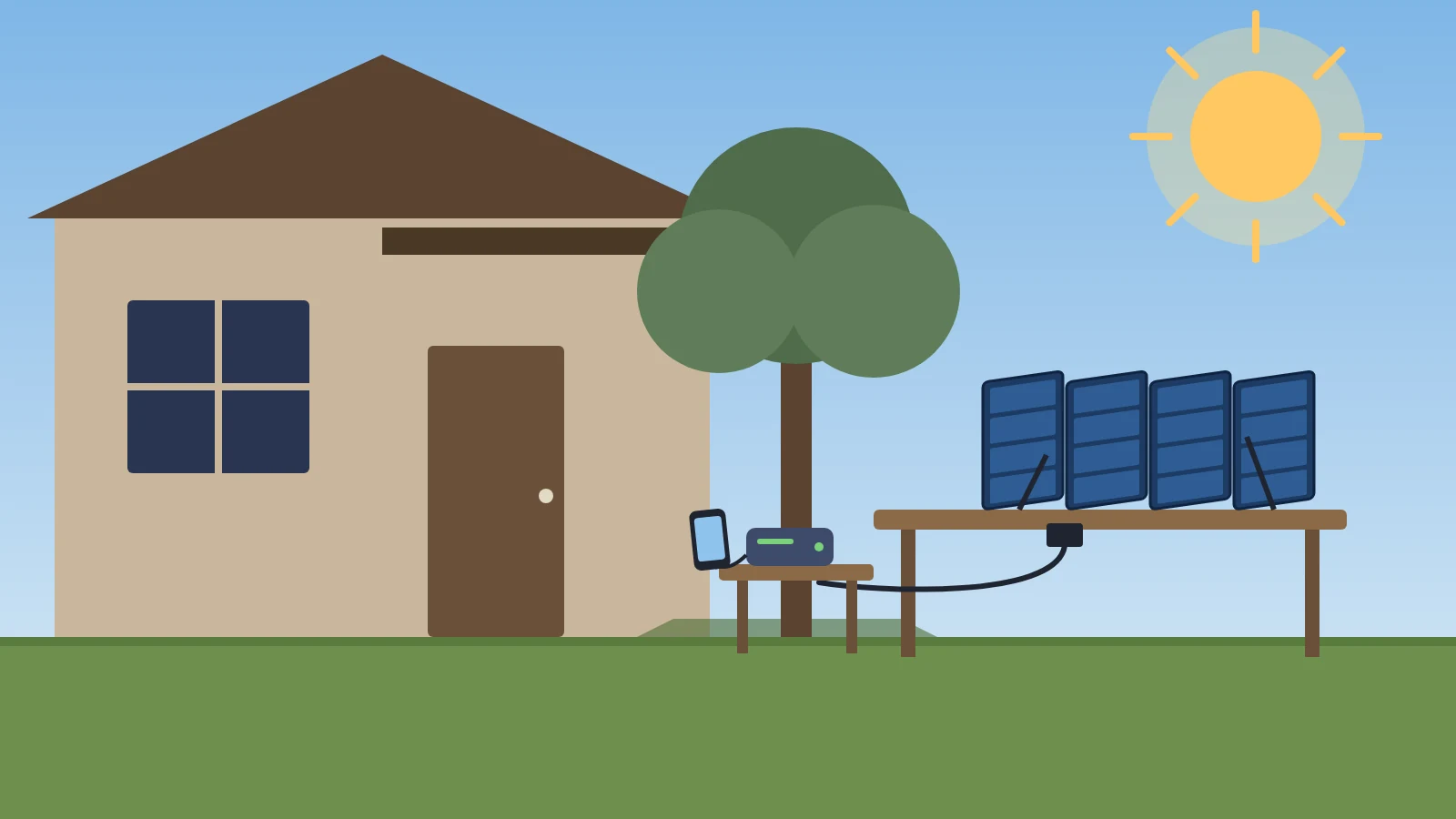
Bottom line: Charged power banks get you through the first days. When an outage runs longer, a small folding solar panel can keep refilling them on sunny days. Our pick is the Anker SOLIX PS30: 30 W rated, a USB-C and a USB-A port, and IP65 weather resistance. None of these panels has a battery, so plan to charge a power bank by day and your phone from the bank at night.
Our pick
Anker SOLIX PS30 (30W): a folding USB panel with USB-C and USB-A ports, IP65 weather resistance and two carabiners for hanging.
Want the lightest panel with three ports? The BigBlue SolarPowa 28. Want something small for a go-bag? The Goal Zero Nomad 5.
How a small solar charger fits an outage
Ready.gov says to plan for batteries and other power sources, such as a portable charger or power bank, for the things you need that run on electricity (Ready.gov). A solar charger is how you refill those once the grid is down for days.
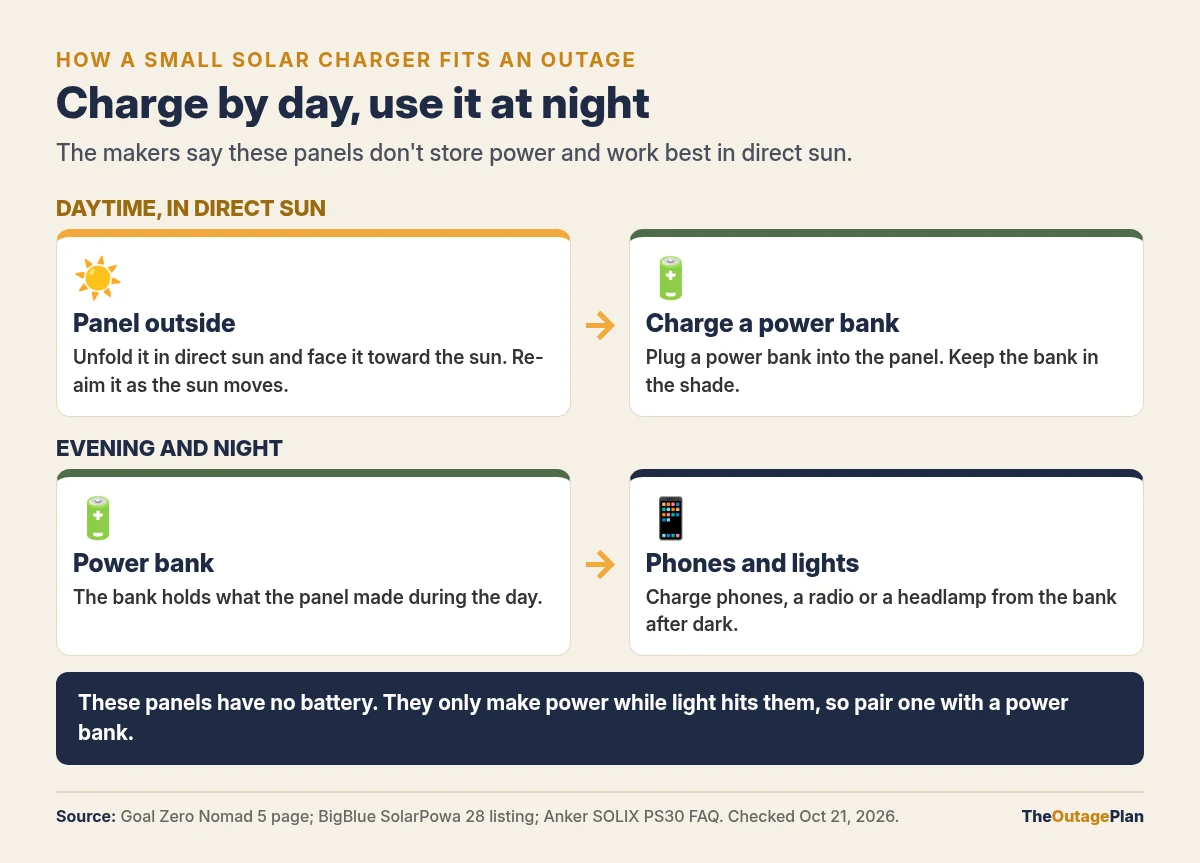
The rating is a lab number. BigBlue explains that rated power is measured under standard test conditions, and that real output is lower and changes with the weather, the season and the panel’s angle (BigBlue). So we treat these panels as a way to top up, not a way to replace stored power.
Our picks
Our pick: Anker SOLIX PS30 (30W)
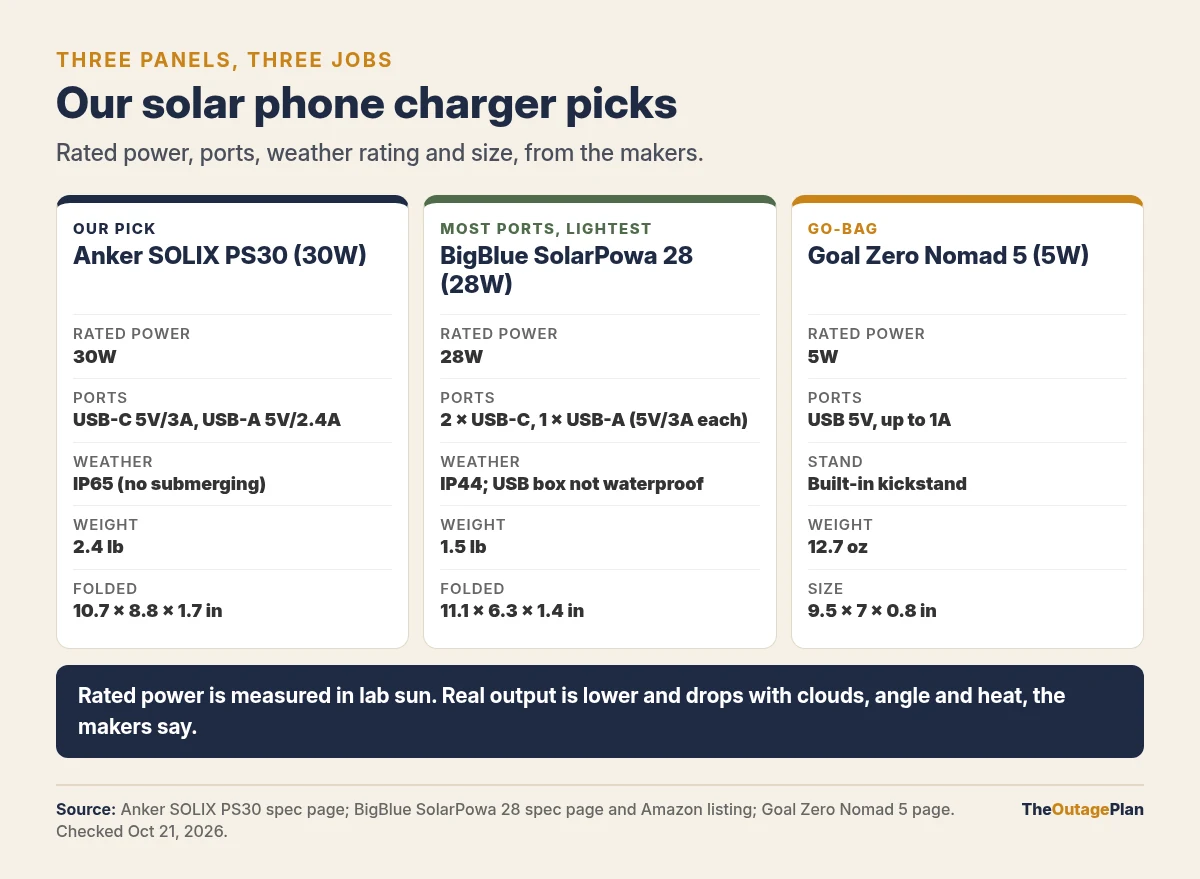
A folding panel rated at 30 W, with a USB-C port (5 V, 3 A) and a USB-A port (5 V, 2.4 A), so two devices can charge at once. It weighs 2.4 lb and folds to 10.7 × 8.8 × 1.7 in (Anker). In the FAQ on its Amazon listing, Anker rates it IP65 against rain and spray, but says not to submerge it. The box includes two carabiners and an 18-month warranty, per the Amazon listing.
The catch: both ports are 5 V, so phones charge at standard USB speed, not fast-charge speed. Anker’s FAQ says it’s meant for low-power devices like phones and tablets.
Full maker specs: Anker SOLIX PS30
- Rated power: 30W
- Outputs: USB-C 5V/3A; USB-A 5V/2.4A
- Weather: IP65 (rain and spray); do not immerse, per Anker’s FAQ on the Amazon listing
- Weight: 2.4 lb
- Size: 10.7 × 8.8 × 1.7 in folded; 35.6 × 10.7 × 0.7 in unfolded
- Battery: None; it only makes power in sunlight
- In the box: Panel, 2 carabiners, user manual; 18-month warranty, per the Amazon listing
Most ports, lightest: BigBlue SolarPowa 28
A 28 W rated panel that BigBlue lists at 24 W working power in total, with two USB-C ports and one USB-A port. Each port gives up to 5 V, 3 A, shared up to 5 V, 4.8 A total. It weighs 1.5 lb and folds to 11.1 × 6.3 × 1.4 in (BigBlue). The Amazon listing adds a USB-C cable and carabiners, and says an LED glows blue when it’s charging.
The catch: the Amazon listing rates it IP44 and says the USB junction box isn’t waterproof, so bring it in when it rains.
Full maker specs: BigBlue SolarPowa 28 (dual USB-C, no ammeter)
- Rated power: 28W rated; 24W working power in total, per BigBlue
- Outputs: 2 × USB-C, 1 × USB-A; 5V/3A per port, 5V/4.8A total (shared)
- Weather: IP44; USB junction box not waterproof, per the Amazon listing
- Weight: 1.5 lb
- Size: 11.1 × 6.3 × 1.4 in folded; 32.9 × 11.1 × 0.2 in unfolded
- Battery: None; it must be in direct sunlight to charge
- In the box: Panel, USB-C to USB-C cable, carabiners, user manual, per the Amazon listing
For the go-bag: Goal Zero Nomad 5
A small 5 W panel with a USB port (5 V, up to 1 A) and a built-in kickstand that clicks into place at several angles. It weighs 12.7 oz and measures 9.5 × 7 × 0.8 in, with a 2-year warranty (Goal Zero). Goal Zero pitches it for phones, headlamps and power banks, and suggests pairing it with a power bank to charge devices after dark.
The catch: at 5 W, it’s the slowest of the three by a wide margin. It’s a go-bag top-up, not the main recharge plan for a household.
Full maker specs: Goal Zero Nomad 5
- Rated power: 5W, monocrystalline
- Output: USB 5V, up to 1A (5W max)
- Weight: 12.7 oz
- Size: 9.5 × 7 × 0.8 in
- Stand: Built-in kickstand, up to 180 degrees
- Battery: None; Goal Zero says solar panels do not hold a charge
- Warranty: 2 years, per Goal Zero
Setup tips from the makers
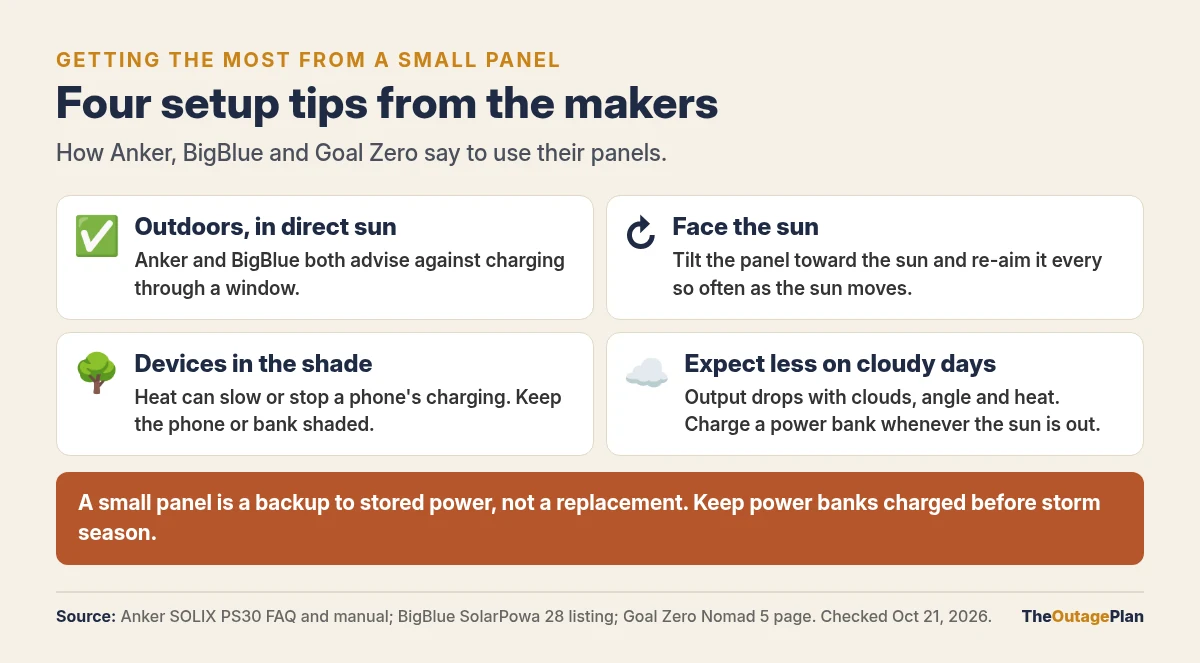
- Put it outside in direct sun. In the FAQ on its Amazon listing, Anker says a panel behind a window can work but the output may be low, and doesn’t recommend it. BigBlue doesn’t suggest using its panel inside a window or windshield.
- Aim it at the sun and adjust it as the day goes on, per Anker’s manual.
- Keep the phone or power bank in the shade. Anker and BigBlue both warn that heat can damage a phone or slow its charging.
- Charge a power bank first. It stores what the panel makes, so you can charge phones at night or when clouds roll in.
Before the next outage
- Keep power banks charged. Our power bank picks cover sizes and charges per phone.
- Have a bigger backup for a long outage. A folding panel feeding a power station does far more; see our solar recharge guide.
- Learn the phone-saving tricks. Our guide to charging your phone in an outage covers battery-saving settings and safe car charging.
- Unfold and test it now on a sunny day, not during a storm.
FAQ
Can a solar charger charge a phone directly?
Yes. All three of our picks have USB ports for a phone. The makers say to keep the phone in the shade, and output drops when the sun is weak, so charging a power bank first and the phone from the bank is steadier.
Do solar phone chargers work on cloudy days?
They still make some power, but less. BigBlue says real output is lower than the rated wattage and changes with the weather, the season and the panel’s angle. Charge whenever the sun is out.
Can you use a solar charger through a window?
Anker says it can work but the output may be low, and recommends keeping the panel outdoors. BigBlue doesn’t suggest using its panel inside a window.
Do solar phone chargers have a battery?
These three don’t. Goal Zero says solar panels don’t hold a charge and only make power in sunlight, so pair one with a power bank to store power for the night.
Specs checked Oct 21, 2026, from Anker’s, BigBlue’s and Goal Zero’s product pages and the Amazon listings. Prep guidance from Ready.gov. We haven’t hands-on tested these panels.