
Heads up: Some links on this page are affiliate links. If you buy through them, we may earn a commission at no extra cost to you. As an Amazon Associate, we earn from qualifying purchases. Full disclosure
Testing note: We haven’t hands-on tested these power banks. Specs come from Anker’s product pages, spec sheets and user guides and the Amazon listings, checked Oct 19, 2026. Airline rules come from the FAA. Charge counts are our estimates.
Bottom line: A power bank is the simplest outage backup: silent, safe indoors, and ready the moment the lights go out. Get one 20,000 mAh bank per adult, a 10,000 mAh one for each kid’s bag, and charge them all before every storm. Anything over 100 Wh isn’t a power bank anymore. That’s a power station.
Our pick
Anker Power Bank 20K, 87W (A1383): 20,000 mAh with a built-in USB-C cable and up to 65 W from one port, enough for a phone, a radio or a laptop. It’s under the airline limit, too.
Our phone charging guide covers battery-saving settings and the charge math. This page is about which power bank to buy.
Which size do you need?
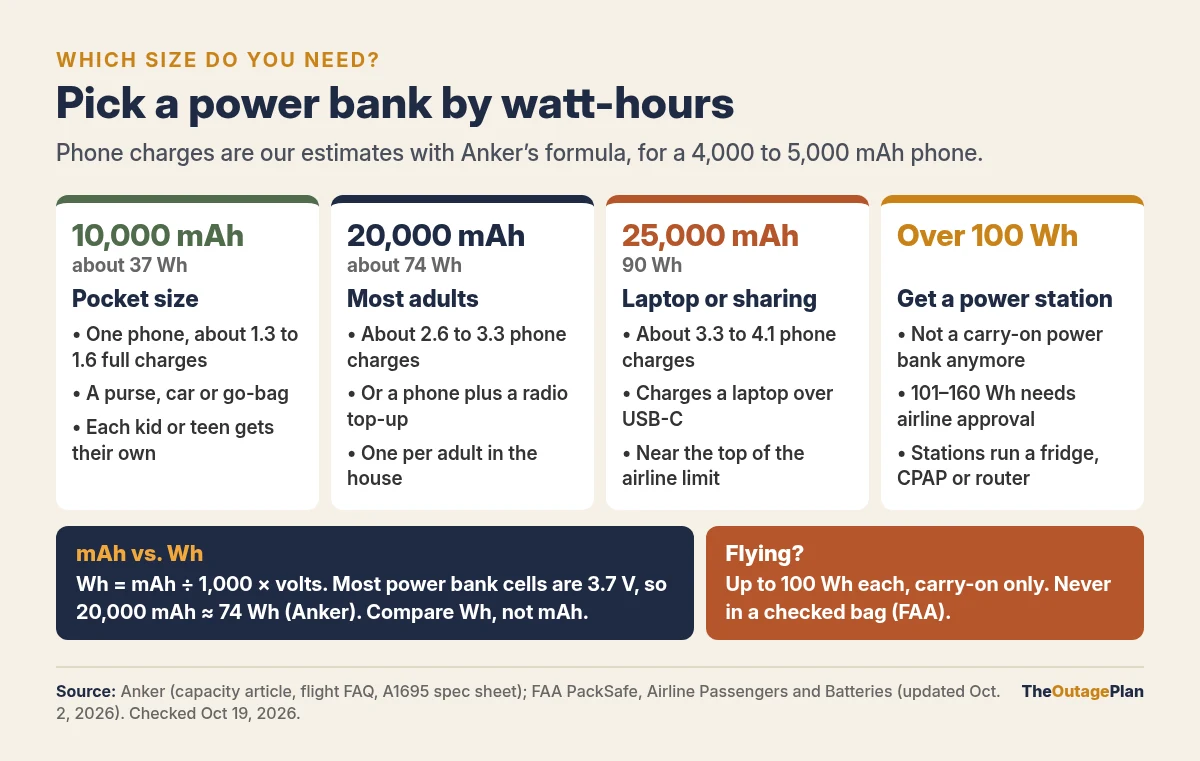
mAh vs. Wh. The mAh number is charge, not energy. Anker’s formula for energy is Wh = mAh ÷ 1,000 × cell voltage, and most power bank cells run at 3.7 V, so a 20,000 mAh bank holds about 74 Wh. Converting that up to USB voltage loses some, which is why packaging often lists a lower “rated capacity” (about 12,140 mAh at 5 V for a 20,000 mAh bank, by Anker’s example). Anker’s advice: compare Wh, not mAh (Anker).
Flying with it. The FAA allows power banks up to 100 Wh each in carry-on bags, and never in checked bags. From 101 to 160 Wh you need the airline’s approval, and airlines can set stricter limits (FAA). All three of our picks are under 100 Wh.
Our picks

Our pick: Anker Power Bank 20K, 87W (A1383)
20,000 mAh, a built-in USB-C cable plus a USB-C port and a USB-A port. Anker lists up to 65 W from the cable or USB-C port, 87 W total, and a 65 W input (Anker). That’s enough for many USB-C laptops as well as phones. Its trickle-charging mode handles earbuds and other low-power gear, per its user guide. It weighs about 15.2 oz. Anker’s Amazon listing says it refills in about 1.5 hours on a 65 W charger.
The catch: sharing splits the power. Its user guide lists 24 W combined when the USB-C and USB-A ports run together.
Pocket pick: Anker Zolo Power Bank 10K (A1688)
10,000 mAh, a built-in USB-C cable plus USB-C and USB-A ports, and up to 30 W from USB-C (Anker). Anker says it refills in about 2.5 hours on a 20 W charger and gives an iPhone 15 up to 2 full charges (Anker). About 4.3 × 2.6 × 1.0 in, so it fits a pocket, a car or a go-bag. Double-tap the button for its low-current mode. When two ports run at once, its listing says total output drops to 15 W.
The catch: about 1.3 to 1.6 full charges of a current Android phone by Anker’s formula. That’s one phone for a day or two, not a family.
Most power: Anker Laptop Power Bank 25K, 165W (A1695)
25,000 mAh, 90 Wh, the most Wh of our picks while still under the airline limit. Two built-in USB-C cables (one retractable, 27.6 in), a USB-C port and a USB-A port, up to 100 W per USB-C and 165 W total, a display, and pass-through charging. Anker lists about a 2-hour refill at 100 W (Anker) and about 63 to 70 Wh of usable output (Anker).
The catch: at about 21 oz, it’s a brick. Pick it if you’ll charge a laptop or share one bank across the house.
None of our picks is among the recalled models below. Prefer one big battery for the whole house? See our power station for an apartment picks.
How many charges each one gives
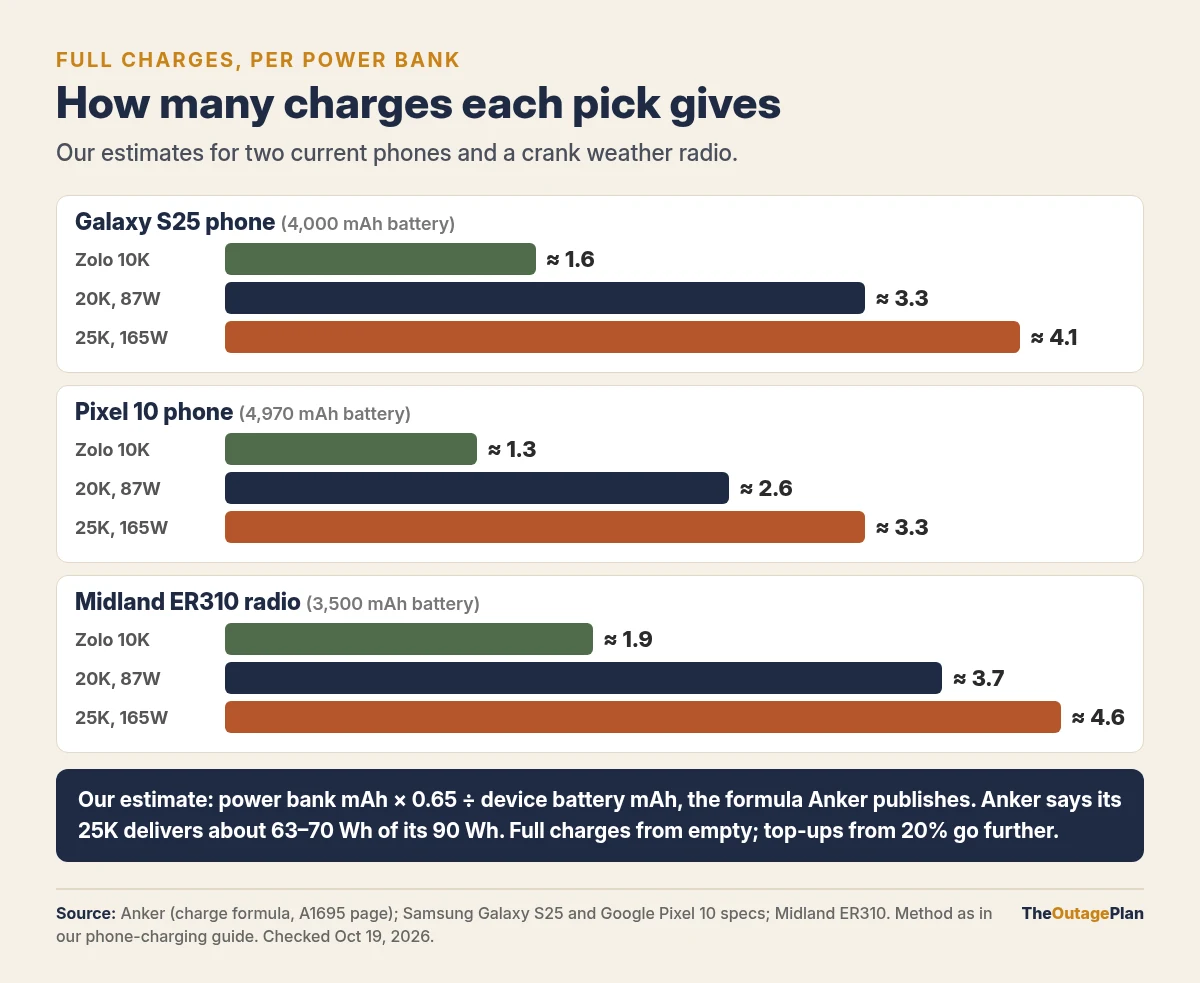
We use the same method as our phone charging guide, which shows the math step by step. Top-ups stretch further than full charges: a phone at 20% needs well under a full charge to get back to 80%. A crank radio’s own battery tops up a phone only in an emergency, so let the power bank feed the radio, not the other way around (our radio picks).
Solar or hand-crank power banks?
We didn’t find a solar or crank power bank with maker-published charge rates we’d plan around, so none is a pick. For sun power in a long outage, a folding panel feeding a power station works better: see our solar generator kits. Then refill the power banks from the station’s USB ports.
Keep it ready
- Charge it before every storm. For long storage, Anker suggests keeping it at about 60% and recharging every 3 months. Store it between 32°F and 95°F, and not in a parked car (Anker).
- Don’t charge it on a bed or sofa for long, and unplug it before you sleep (Anker).
- Retire it if the case swells, cracks, smells or rattles, or it gets unusually hot. Anker rates its banks for about 300 to 500 full cycles (Anker).
- Check older Anker banks for the recall. In 2025 the CPSC announced a recall of Anker models A1647, A1652, A1257, A1681 and A1689 (including the Zolo 20K) sold from August 2023 through June 2025, for fire and burn hazards. Find the model number on the back or side, then check the serial on Anker’s recall page (CPSC). The FAA doesn’t allow recalled batteries on planes (FAA).
For the rest of your kit, see our 72-hour outage kit checklist and our Gear page.
FAQ
What size power bank do you need for a power outage?
For most adults, 20,000 mAh (about 74 Wh). By Anker’s formula that’s about 2.6 to 3.3 full charges of a current Android phone. Add a 10,000 mAh bank for each kid or go-bag.
Can you take a 25,000 mAh power bank on a plane?
Usually, if it’s 100 Wh or less and in your carry-on. Our 25K pick is 90 Wh by Anker’s spec. Power banks can’t go in checked bags, and some airlines set stricter limits (FAA).
Can a power bank run a Wi-Fi router?
Usually not. Most home routers take a 12 V barrel plug, not USB. Our Wi-Fi guide covers what works.
Do power banks lose charge sitting in a drawer?
Plan on topping them off. Anker suggests recharging every 3 months in storage (Anker), and we’d charge every bank to full when a storm is in the forecast.
Specs checked Oct 19, 2026, from Anker’s product pages, spec sheets and user guides (A1688, A1383, A1695) and the Amazon listings. Airline rules are from the FAA, recall details from the CPSC and Anker, and storage guidance from Anker. Phone batteries are from Samsung and Google, and the radio battery from Midland. Charge counts are our estimates, not manufacturer claims.