
Heads up: Some links on this page are affiliate links. If you buy through them, we may earn a commission at no extra cost to you. As an Amazon Associate, we earn from qualifying purchases. Full disclosure
Testing note: We haven’t hands-on tested this gear. Specs come from NOCO’s product page and the Amazon listings, checked Oct 24, 2026.

Bottom line: A winter storm that knocks out power can also strand you on the road. Ready.gov’s car kit is short: jumper cables, sand, a flashlight, warm clothes, blankets, bottled water and snacks, plus a full tank of gas (Ready.gov). NHTSA adds a shovel, an ice scraper, warning devices, a first aid kit and a phone charger (NHTSA). Most of it is already in your house. The three things worth buying are below.
Our pick
NOCO Boost GB40 jump starter: NOCO rates it at 1,000 amps for gas engines up to 6.0 liters and diesels up to 3.0 liters, with up to 20 jump starts per charge. No second car needed.
What goes in the kit
NHTSA’s list, grouped by job (NHTSA):
- Clear the car: a snow shovel, a broom or snow brush and an ice scraper. For the driveway at home, see our snow shovel and ice melt picks.
- Get unstuck: sand or kitty litter to sprinkle under the tires.
- Get moving or get help: jumper cables, a flashlight and warning devices like flares or reflective triangles.
- Stay alive: blankets, a first aid kit, a phone and charger, water, food and any medicine you need.
Ready.gov adds warm clothes (Ready.gov). The CDC says to always carry extra warm clothing and blankets, and not to count on the car for heat, since it could break down (CDC). Keep the warmth and food in the cabin. If you get stuck, the CDC says to move what you need from the trunk into the passenger area (CDC).
If you get stranded

- Stay with the car. The National Weather Service warns that you’ll get disoriented quickly in wind-driven snow if you leave (NWS). NHTSA adds: don’t overexert yourself (NHTSA).
- Watch for carbon monoxide. Run the motor and heater about 10 minutes per hour, open one window slightly, and keep snow off the exhaust pipe (CDC). NHTSA says never run the car for long periods with the windows up or in an enclosed space (NHTSA).
- Be seen. Tie a bright cloth to the antenna, turn on the dome light at night, and raise the hood once the snow stops (NWS).
- Stay warm. Wrap up head to toe, keep your arms and legs moving, and huddle together. Don’t eat snow; it lowers your body temperature (CDC).
Before you drive
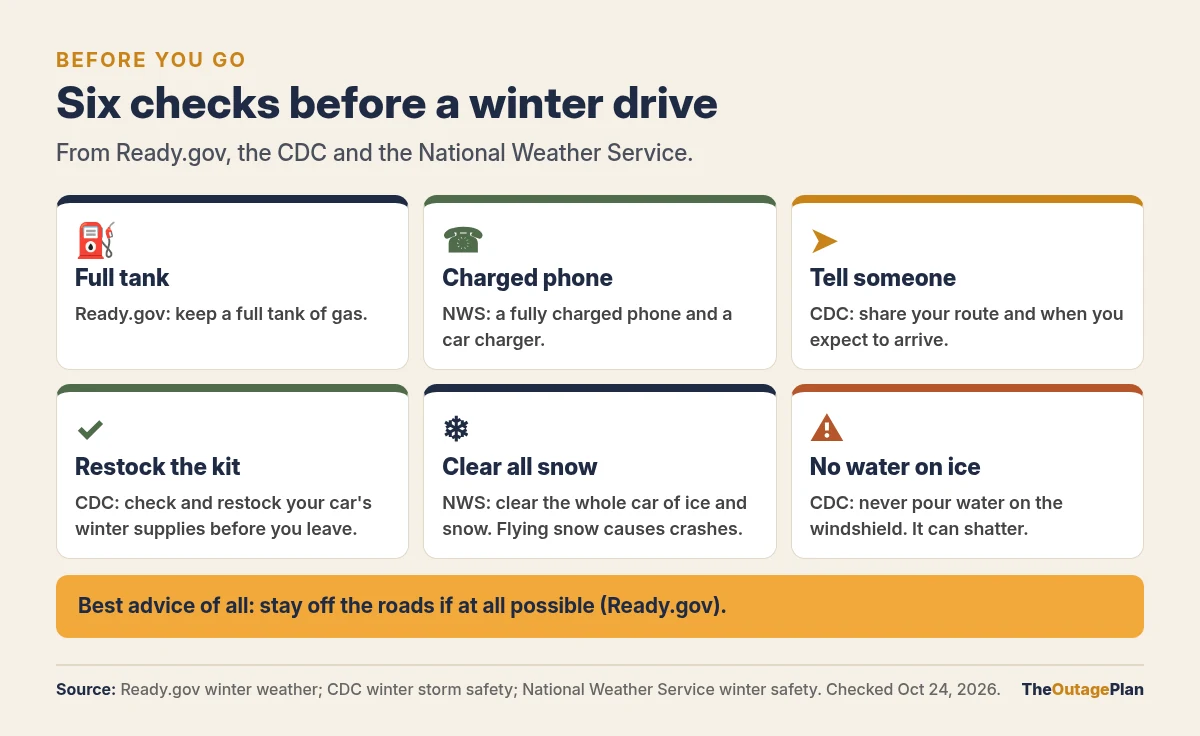
Ready.gov’s advice is to stay off the roads if at all possible (Ready.gov). If you must go, the CDC says to tell someone your route and arrival time, restock the car kit, and never pour water on an icy windshield, because it can shatter (CDC).
Our winter car kit picks
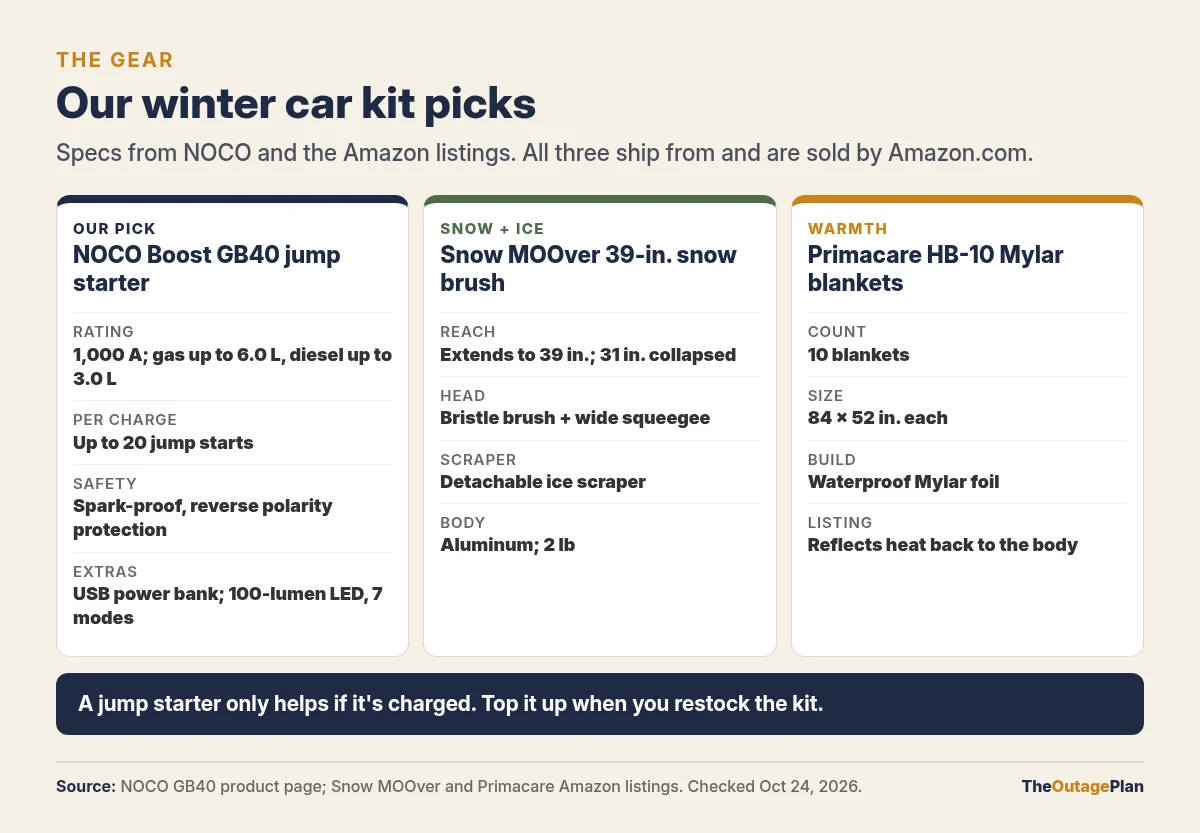
All three ship from and are sold by Amazon.com.
Our pick: NOCO Boost GB40 jump starter
Jumper cables need a second car. NOCO rates the GB40 at 1,000 amps, for gas engines up to 6.0 liters and diesels up to 3.0 liters, with up to 20 jump starts per charge (NOCO). It’s spark-proof with reverse polarity protection, so a wrong clamp connection won’t spark. It doubles as a USB power bank for your phone and has a 100-lumen LED with SOS and strobe modes. It only helps if it’s charged, so top it up when you restock the kit.
Full maker specs: NOCO Boost GB40
- Peak current: 1,000 A
- Engines: Gas up to 6.0 L; diesel up to 3.0 L; 12 V only
- Per charge: Up to 20 jump starts
- Safety: Spark-proof; reverse polarity protection
- Power bank: USB out; up to 4 smartphone recharges (NOCO)
- Recharge: About 3 hours at 2.1 A
- Light: 100-lumen LED, 7 modes incl. SOS and strobe
- Build: IP65 rated; about 2.4 lb
- Warranty: 1-year (listing)
Snow and ice: Snow MOOver 39-inch snow brush
NHTSA lists a broom and an ice scraper (NHTSA). This one does both. It has a bristle head with a wide squeegee and a detachable ice scraper, on an aluminum pole that extends to 39 inches, long enough to reach the middle of windshields and car roofs, per its Amazon listing. It breaks down for storage. Smaller car? The Amazon Basics 26-inch brush and scraper is also sold by Amazon.com.
Full listing specs: Snow MOOver 39-inch
- Length: 39 in. extended; 31 in. collapsed
- Head: 11 in. wide; bristles one side, squeegee the other
- Scraper: Detachable
- Pole: Aluminum
- Weight: 2 lb
Warmth: Primacare HB-10 Mylar blankets
Blankets are on every official list (NHTSA). A pack of thin Mylar blankets adds warmth without taking up trunk space. For the house, see our wool blanket picks. This pack has 10 blankets, each 84 x 52 inches, made of waterproof Mylar foil that reflects heat back toward your body, per the Amazon listing. Pack them in addition to real blankets and warm clothes, not instead of them.
Full listing specs: Primacare HB-10
- Count: 10 blankets
- Size: 84 x 52 in. each
- Material: Mylar foil
- Features: Waterproof; reflects heat
More winter prep: our winter storm checklist, hand warmer picks, power bank picks and cold-rated sleeping bags.
FAQ
What should be in a winter car emergency kit?
NHTSA lists a snow shovel, broom and ice scraper; sand or kitty litter; jumper cables, a flashlight and warning devices; a first aid kit; blankets; and a phone and charger, water, food and medicine. Ready.gov adds warm clothes and a full tank of gas.
Should you stay in your car if you get stranded in snow?
Yes, in most cases. The National Weather Service says to stay in the vehicle because you can get disoriented quickly in wind-driven snow. NHTSA also says to stay with your car and not overexert yourself.
How long can you run your car for heat when stranded?
The CDC says to run the motor and heater about 10 minutes per hour, with one window open slightly. Keep snow off the exhaust pipe to lower the risk of carbon monoxide poisoning.
Is a jump starter better than jumper cables?
A jump starter works without a second car, which matters if you’re stuck alone. Jumper cables never need charging but do need another running vehicle. Carrying both covers either case.
Specs checked Oct 24, 2026, from NOCO’s GB40 page and the Amazon listings. Safety guidance from NHTSA, Ready.gov, the CDC and the National Weather Service. We haven’t hands-on tested this gear.