
Heads up: Some links on this page are affiliate links. If you buy through them, we may earn a commission at no extra cost to you. As an Amazon Associate, we earn from qualifying purchases. Full disclosure
Testing note: We haven’t hands-on tested these sleeping bags. Ratings and specs come from Coleman’s product pages and the Amazon listings, checked Oct 24, 2026.
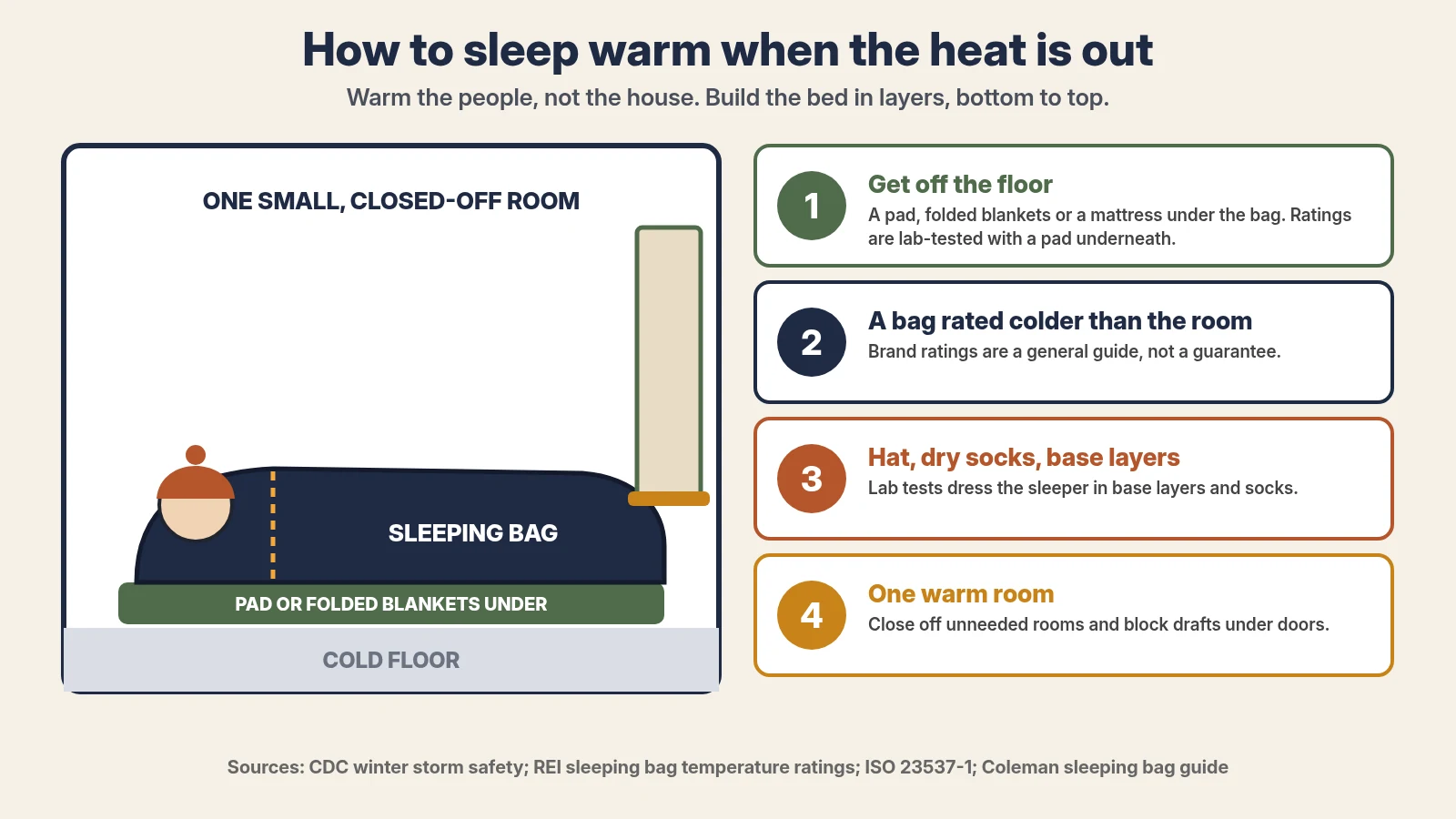
Bottom line: When a winter storm takes out the heat, the CDC puts extra blankets, sleeping bags and warm coats first on its list of backup heat (CDC). It needs no fuel or battery. Get one per person, rated colder than your room could get, with a pad under it.
Our pick
Coleman North Rim 0°F mummy bag: Coleman rates it for temperatures as low as 0°F, with an adjustable hood, a draft tube along the zipper and a machine-washable build.
Need more room? See the Heritage Big & Tall.
What the temperature rating really means
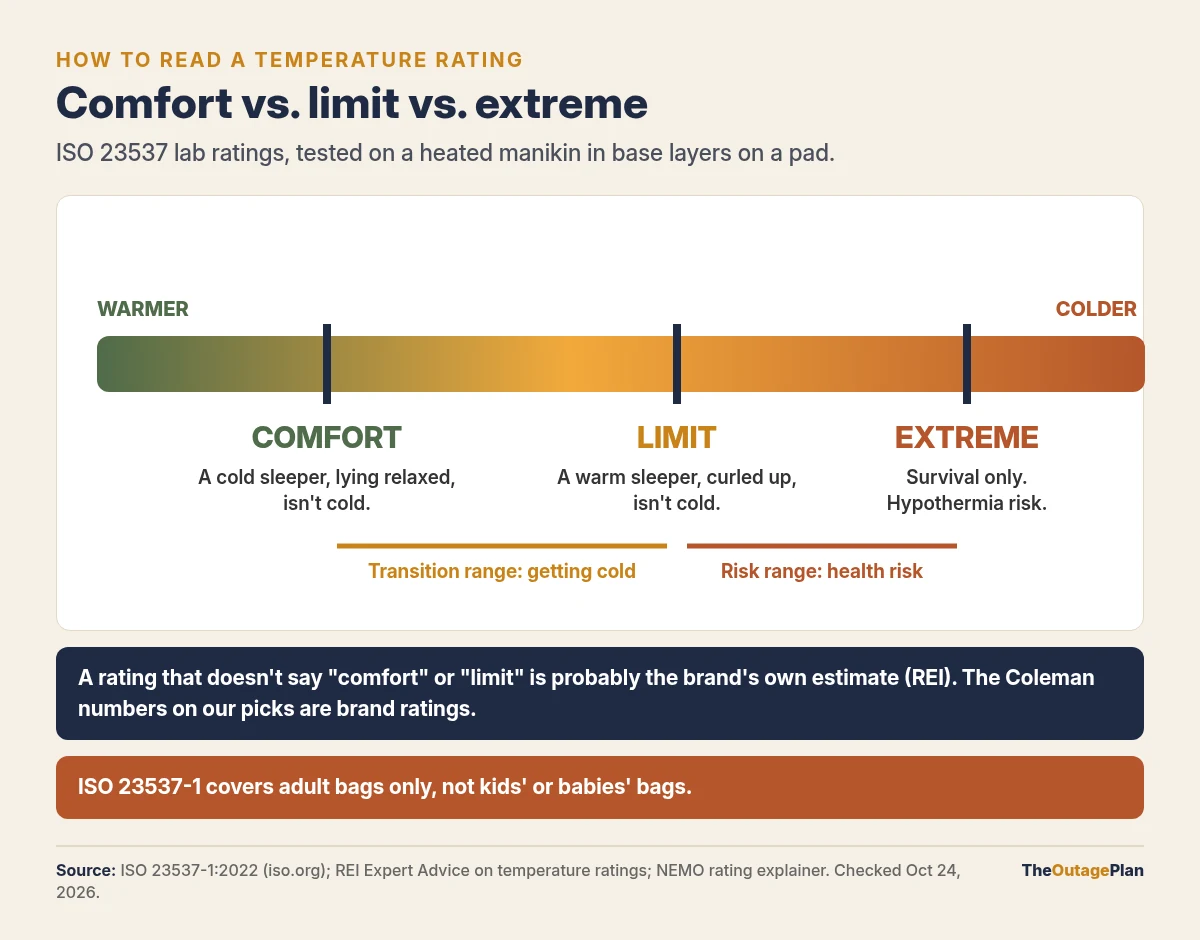
- Comfort vs. limit. Under the ISO 23537 lab standard, the comfort rating is where a cold sleeper stays comfortable lying relaxed. The limit rating is where a warm sleeper stays warm curled up (REI).
- Extreme is a survival number. Hypothermia is a risk there, and NEMO says never to plan around it (NEMO).
- No label? It’s an estimate. REI says a rating that isn’t called “comfort” or “limit” is probably the brand’s own estimate (REI). That’s true of our Coleman picks. Coleman’s own guide calls ratings a general guide, not a guarantee (Coleman).
- Kids are different. The ISO standard covers adult bags only, not bags for children or babies (ISO).
- The pad counts. Lab tests use a pad under the bag and base layers on the manikin (REI).
Set up one warm room

- Shrink the space. The CDC says to close off unneeded rooms, stuff towels in cracks under doors and cover windows with blankets at night (CDC). For a longer-lasting fix, see our window insulation film and thermal curtain picks and door draft stoppers and sweeps.
- Get off the floor. Put a pad, mattress or folded blankets under each bag.
- Dress for bed. Wear a hat and dry socks; the CDC says wool, silk or polypropylene hold more heat than cotton (CDC).
- Babies don’t go in sleeping bags. The CDC says babies under 1 should never sleep in a cold room. Skip soft bedding and use footed pajamas, a wearable blanket or a sleep sack. If you can’t keep the home warm, stay somewhere else (CDC). The AAP adds: no weighted sleep sacks (AAP).
- No fumes inside. Never run a generator, grill or camp stove in the house, and keep a battery CO alarm (CDC). See our CO alarm picks.
Hypothermia is an emergency if body temperature drops below 95°F. Get medical help (CDC).
Our sleeping bag picks

All three are Coleman bags that ship from and are sold by Amazon.com. Coleman’s guide says winter often calls for a bag rated below 15°F (Coleman), so we lead with the 0°F bag.
Our pick: Coleman North Rim 0°F mummy
Coleman says this bag keeps you warm in temperatures as low as 0°F (Coleman). The mummy shape and adjustable hood hold heat around your head, and a draft tube blocks cold air along the zipper. It fits people up to 6 ft 2 in. Mummy bags are snug, so restless sleepers may prefer a rectangle.
Full maker specs: Coleman North Rim
- Rating: As low as 0°F (Coleman rating, not ISO)
- Shape: Mummy, adjustable hood, box foot
- Fits: Up to 6 ft 2 in
- Size: 82 x 32 in
- Insulation: Coletherm hollow polyester
- Extras: Thermolock draft tube; stuff sack
- Care: Machine washable
- Warranty: 5-year limited
Roomy: Coleman Heritage Big & Tall 10°F
A classic rectangular bag rated by Coleman to 10°F, at 84 x 40 in, for people up to 6 ft 7 in (Coleman). You can zip two together to share warmth. The listing gives it a cotton cover and a flannel liner (Amazon listing). It’s machine washable.
Full maker specs: Coleman Heritage Big & Tall
- Rating: 10°F (Coleman rating, not ISO)
- Shape: Rectangle; zips to a second bag
- Fits: Up to 6 ft 7 in
- Size: 84 x 40 in
- Cover/liner: Cotton cover, flannel liner (listing)
- Extras: Thermolock draft tube; no stuff sack
- Care: Machine washable
- Warranty: 5-year limited
Milder rooms: Coleman Brazos 20°F
For mild winters, the Brazos is rated by Coleman to 20°F (Coleman). It’s a rectangle that zips to a second bag and comes with a stuff sack. It fits people up to 5 ft 11 in, so taller adults should look at the Heritage.
Full maker specs: Coleman Brazos 20°F
- Rating: As low as 20°F (Coleman rating, not ISO)
- Shape: Rectangle; zips to a second bag
- Fits: Up to 5 ft 11 in
- Size: 75 x 33 in
- Materials: Polyester shell, brushed polyester tricot liner
- Extras: Thermolock draft tube; Fiberlock; stuff sack
- Care: Machine washable
- Warranty: 5-year limited
Building out the rest of your winter plan? See our hand warmer picks, 12 V heated blanket picks, can a power station run a space heater?, our winter car emergency kit, our base layer and wool sock picks and our winter storm checklist.
FAQ
What temperature sleeping bag do you need for a power outage?
Pick a bag rated colder than your room could get, because ratings are estimates, not guarantees. Coleman’s guide says winter often calls for a bag rated below 15°F, which is why our top pick is a 0°F bag.
What is the difference between comfort and limit ratings?
Under ISO 23537, the comfort rating is where a cold sleeper stays comfortable lying relaxed, and the limit rating is where a warm sleeper stays warm curled up. The extreme rating is a survival number, so never plan around it.
Can babies use sleeping bags in a power outage?
No. The CDC says babies under 1 should never sleep in a cold room and should not have soft bedding. Dress them in footed pajamas, a wearable blanket or a sleep sack, and stay somewhere warmer if you can’t heat the home.
Mummy or rectangular sleeping bag for indoors?
A mummy bag with a hood holds heat best in a very cold room. A rectangular bag gives more room to move, and many zip together so two people can share warmth.
Ratings and specs checked Oct 24, 2026, from Coleman’s North Rim, Heritage Big and Tall and Brazos pages, Coleman’s sleeping bag guide and the Amazon listings. Rating guidance from ISO, REI and NEMO; safety guidance from the CDC and the AAP. We haven’t hands-on tested these sleeping bags.