
Heads up: Some links on this page are affiliate links. If you buy through them, we may earn a commission at no extra cost to you. As an Amazon Associate, we earn from qualifying purchases. Full disclosure
Testing note: We haven’t hands-on tested this gear. Specs come from Gold Eagle (STA-BIL), Eagle Manufacturing, Flame King and the Amazon listings, checked Oct 23, 2026. Safety guidance comes from OSHA, the CPSC and the propane industry’s safety council.

Bottom line: Stale gas is a common reason a generator won’t start when the power goes out. Keep gasoline in approved safety cans, treat it with stabilizer the day you buy it, store it outside living areas, and rotate it into your car or mower. Or skip the routine: propane doesn’t go stale, if your generator runs on it.
Our pick
STA-BIL Storage Fuel Stabilizer, 32 oz: 1 oz treats 2.5 gallons and keeps gas fresh up to 24 months, per Gold Eagle.
For the gas: an Eagle 5-gallon steel safety can. For propane: a Flame King 20 lb cylinder.
Still choosing a generator? See our dual-fuel generator picks.
Where to keep generator fuel
- Never in the house. “Do not store generator fuels in your home,” OSHA says. Keep them away from living areas (OSHA).
- Labeled safety cans, never glass. The CPSC says to keep gasoline, propane and kerosene outside living areas in properly labeled, non-glass safety containers (CPSC).
- Away from flames. Not near a fuel-burning appliance, such as a gas water heater in a garage (CPSC), and not near the generator itself (OSHA).
- Cool and shaded. Honda says to store gas in a clean, sealed, approved container out of the sun (Honda).
- Know your limits. Local fire codes may cap how much fuel you can keep at home. Ask your fire department.
Keep gas fresh: a rotation routine

Gas doesn’t keep long on its own. Generac says fuel begins to deteriorate within about a month and recommends adding stabilizer right from the start (Generac). Honda says to buy only what you’ll use within 3 months, or add stabilizer (Honda).
- Treat fresh gas only. STA-BIL says its stabilizer won’t restore old gas. Dose is 1 oz per 2.5 gallons, so 2 oz per 5-gallon can (Gold Eagle).
- Fill the can almost full. Gold Eagle says to keep the can about 95% full to limit condensation.
- Run it through. After treating the generator’s tank, run the engine about 5 minutes so treated fuel reaches the carburetor (Gold Eagle).
- Date every can. STA-BIL says any gas stored more than 12 months tends to lose volatility, so rotate well before that. Pour older gas into your car or mower, refill and re-treat.
Storing the generator itself? Follow your manual. Generac recommends draining the tank and running the carburetor dry for storage over 30 days (Generac). Champion’s manual allows treated gas in the tank for up to a year if it’s kept cool and dry (Champion).
Refueling: shut the generator off and let it cool first. Gas spilled on hot engine parts can ignite (CPSC). Ready.gov says to run generators outdoors, at least 20 feet from windows, doors and attached garages (Ready.gov).
Gas or propane?
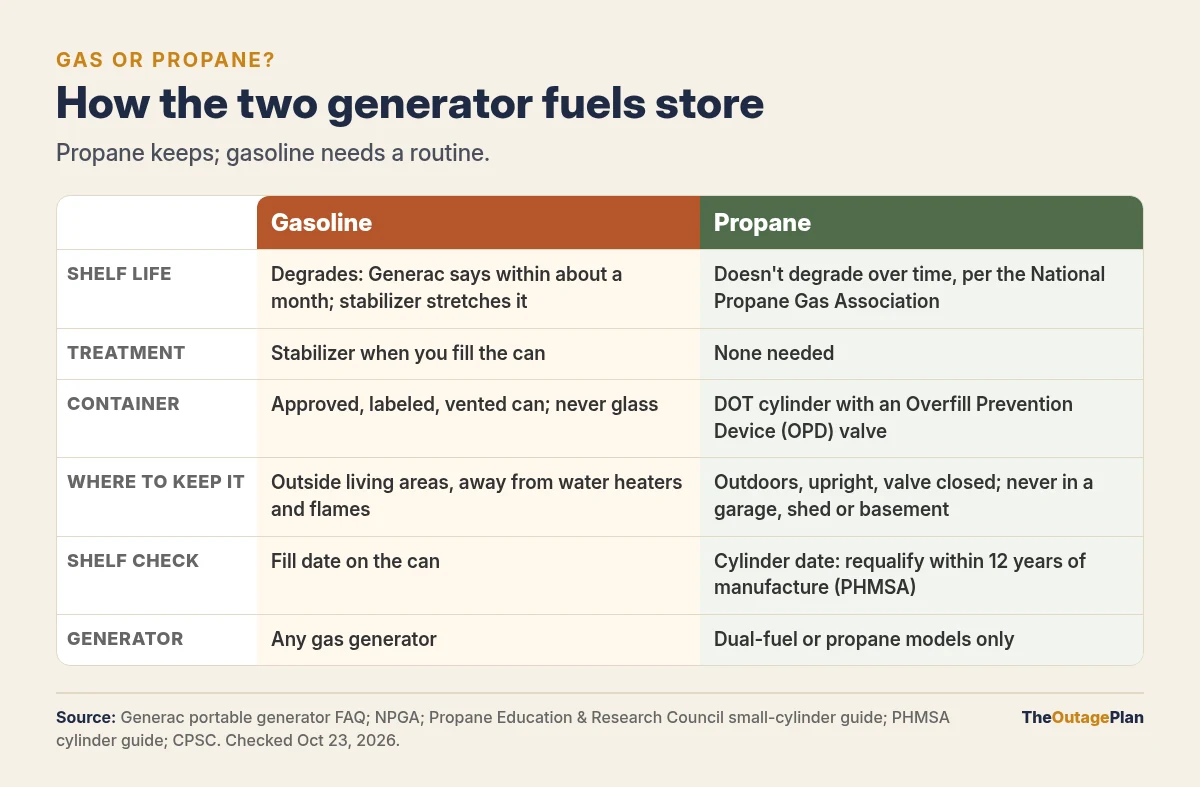
Propane has an indefinite shelf life and doesn’t degrade, says the National Propane Gas Association (NPGA). No stabilizer, no rotation. The trade-offs:
- Your generator has to run on it. Dual-fuel models like the WEN DF480iX in our generator picks take a 20 lb cylinder.
- Store it outdoors. The propane safety council says never to use or store a cylinder in a garage, shed, basement or other enclosed area, even an “empty” one. Keep it upright, outside, away from heat, and don’t leave it in a car (PERC).
- Check the date. A cylinder must be requalified within 12 years of its manufacture date before it can be refilled (PHMSA). Look for the OPD valve, required by law (PERC).
Planning to run house circuits on the generator? See our transfer switch guide.
Our fuel storage picks
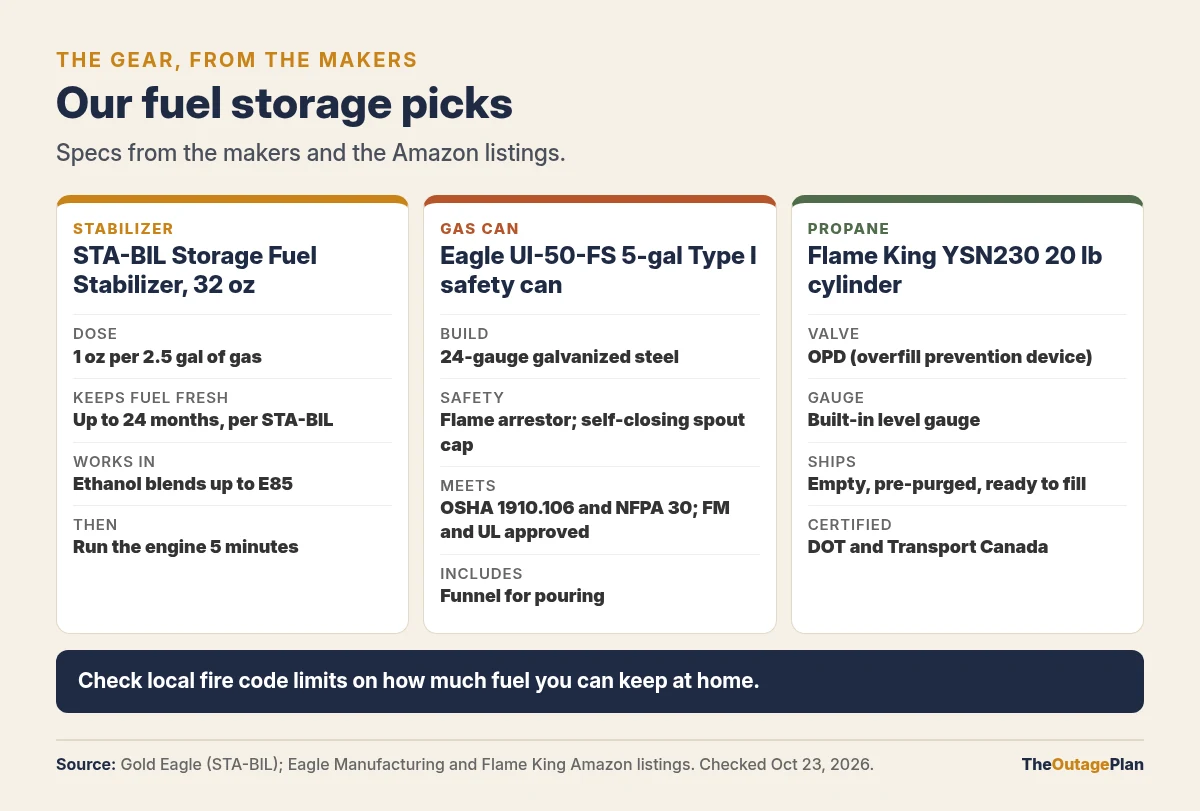
Stabilizer: STA-BIL Storage Fuel Stabilizer, 32 oz
The classic red bottle. Gold Eagle says it keeps gas fresh up to 24 months, works in ethanol blends up to E85, and an opened bottle lasts 2 years (Gold Eagle). The 32 oz size treats up to 80 gallons at the stated dose.
Full maker specs: STA-BIL Storage
- Dose: 1 oz per 2.5 gallons of fresh gas
- Keeps fuel fresh: Up to 24 months
- Fuels: Gasoline, including ethanol blends up to E85
- After treating: Run the engine 5 minutes
- Shelf life: 2 years after opening
- Size: 32 fl oz (model 22214)
Gas can: Eagle UI-50-FS 5-gallon safety can
A steel safety can, not a plastic jug. The listing says it meets OSHA 1910.106 and NFPA 30 and is FM and UL approved, with a flame arrestor and a self-closing, vented spout cap.
The catch: a single opening means you pour with the included funnel.
Full maker specs: Eagle UI-50-FS
- Capacity: 5 gallons
- Build: 24-gauge hot-dipped galvanized steel, made in USA
- Safety: Non-sparking flame arrestor; self-closing gasketed cap that vents
- Approvals: FM, UL, ULC; meets OSHA 1910.106 and NFPA 30
- Size: 12.5 in wide x 13.5 in tall; 5.3 lb empty
- Includes: Funnel
Propane: Flame King YSN230 20 lb cylinder
A standard 20 lb steel cylinder with an OPD valve and a built-in gauge, so you can see how much is left. DOT and Transport Canada certified, per the listing.
The catch: it ships empty. Fill it at a propane dealer before storm season.
FAQ
How long can you store gas for a generator?
Honda says to buy only what you’ll use within 3 months, or add stabilizer. Gold Eagle says STA-BIL keeps fresh gas good up to 24 months, though gas stored over 12 months tends to lose volatility.
Where should you store generator fuel?
Outside living areas, never in the house. The CPSC says to use labeled, non-glass safety containers and keep them away from fuel-burning appliances like a gas water heater in a garage.
Should you drain gas from a generator before storing it?
Follow your manual. Generac recommends draining the tank and running the carburetor dry for storage over 30 days. Champion allows treated gas in the tank for up to a year, kept cool and dry.
Does propane go bad?
No. The National Propane Gas Association says propane has an indefinite shelf life. The cylinder does expire: PHMSA says it must be requalified within 12 years of manufacture.
Specs checked Oct 23, 2026, from Gold Eagle (STA-BIL), Generac, Honda, Champion and the Amazon listings. Safety guidance from OSHA, the CPSC, Ready.gov, NPGA, the Propane Education & Research Council and PHMSA. We haven’t hands-on tested this gear.