
Heads up: Some links on this page are affiliate links. If you buy through them, we may earn a commission at no extra cost to you. As an Amazon Associate, we earn from qualifying purchases. Full disclosure
Testing note: We haven’t hands-on tested this gear. Specs come from Reliance Controls, Eaton, Westinghouse and WEN and the Amazon listings, checked Oct 23, 2026. This is an explainer, not wiring instructions.

Bottom line: To run house circuits (furnace, well pump, lights) from a generator or a big power station, you need transfer equipment: a manual transfer switch, or an interlock kit plus an outdoor inlet box. Either one keeps your house from feeding power back onto the utility lines. A licensed electrician installs it, to local code, before the storm.
Our pick
Reliance Controls 30310A Pro/Tran 10-circuit transfer switch: up to 7,500 running watts, a built-in L14-30 inlet and wattmeters, per Reliance.
For the outside wall: the Reliance PB30 inlet box. The cord: WEN’s 25-foot 30 A cord.
Just running a fridge and a lamp? You don’t need any of this. Cords from the generator to each appliance work; see our extension cord picks.
Never plug a generator into a wall outlet
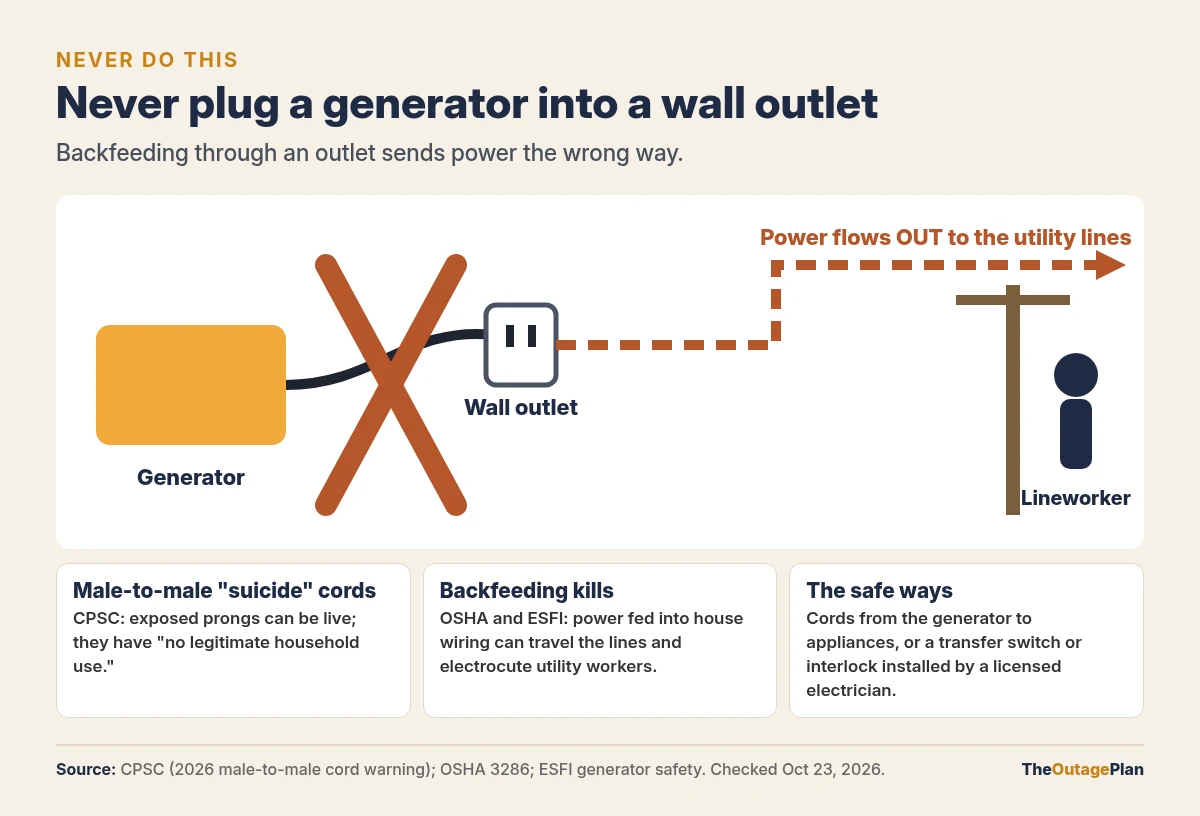
- Backfeeding kills. Power fed into house wiring through an outlet can travel the lines and electrocute utility workers, OSHA warns (OSHA). ESFI calls a transfer switch “the only way to safely power your home’s electrical system” with a generator (ESFI).
- No “suicide cords.” The CPSC says male-to-male cords have exposed prongs that can be live, and have “no legitimate household use” (CPSC).
Three safe ways to connect

1. Manual transfer switch. A small box beside your panel, wired to the circuits you pick ahead of time. Each circuit gets its own switch that picks one source, LINE or GEN. Reliance says its switches are UL 1008 listed (Reliance manual). Simple to run in the dark, but you only get the circuits that were wired in.
2. Interlock kit + inlet box. A metal plate on your main panel that stops the main breaker and the generator breaker from being on at the same time. Eaton says its kits are UL listed and meet NEC Article 702 (Eaton). You choose any circuit at the breakers. The catch: each kit fits only certain panels. Westinghouse says to verify your panel series and have it installed by a qualified electrician (Westinghouse).
3. A power station’s own system. Big stations connect through the maker’s home panel or transfer switch, or from their L14-30 outlet to an inlet box. No fuel, no fumes. See our whole-home station picks.
How it pairs with your generator
- Match the plug. This gear uses a 30 A, 120/240 V L14-30 twist-lock outlet. Reliance says its 30 A switches work with generators up to 7,500 running watts (Reliance manual).
- Dual-fuel generators: in our generator picks, the Westinghouse WGen9500DFc has an L14-30R. The WEN DF480iX is 120 V only, so it can’t feed a 240 V transfer switch.
- Keep fuel ready. Our fuel storage guide covers gas cans, stabilizer and propane.
- Protect the panel too. If an electrician is already working on your panel, ask about a whole-house surge protector.
- Keep it outside. The cord should let the generator sit more than 20 feet from the house (CDC). Our power station vs. generator guide covers the CO rules.
Who installs it
ESFI strongly recommends a licensed electrician so the setup meets local codes (ESFI). Your electrician will know whether your city or county needs a permit and inspection, and which option fits your panel. Hardwired loads like a gas furnace or well pump need this.
Using it in an outage
Eaton’s steps for an interlock (Eaton):
- Turn off all branch breakers.
- Connect the cord to the generator and the inlet box.
- Start the generator.
- Turn off the utility main, then turn on the generator breaker.
- Turn on the circuits you need, one at a time.
With a transfer switch, plug in, start the generator, and flip the chosen circuits from LINE to GEN.
Our gear picks
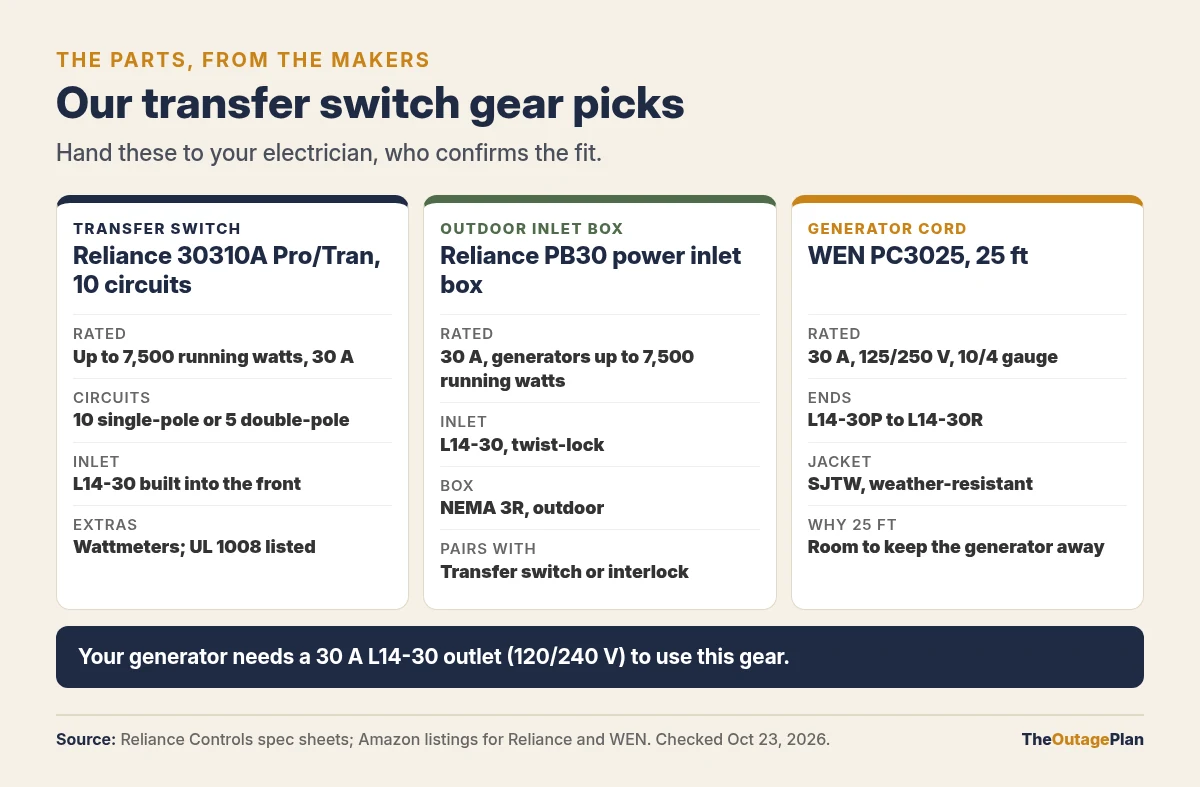
Transfer switch: Reliance Controls 30310A Pro/Tran
Ten circuits, a front L14-30 inlet for the cord, and wattmeters to balance the load. Reliance lists 7,500 running watts, up to 10 single-pole or 5 double-pole circuits (Reliance).
The catch: it mounts indoors, so pair it with an outdoor inlet box and the cord plugs in outside.
Full maker specs: Reliance 30310A
- Rated: 7,500 running watts; 30 A at 250 V
- Circuits: 10 single-pole or 5 double-pole; six 15 A and four 20 A breakers
- Inlet: NEMA L14-30, on the front
- Wattmeters: Yes
- Size: 13.75 x 7 x 4.5 in, indoor surface mount
- Listing: UL 1008
Outdoor inlet box: Reliance Controls PB30
The plug-in point on your outside wall, so no cord runs through a window or door. Rated 30 A for generators up to 7,500 running watts, with an L14-30 inlet in a NEMA 3R box, per the listing and Reliance’s manual (Reliance manual).
Generator cord: WEN PC3025, 25 feet
A 25-foot, 10/4-gauge, 30 A cord with L14-30 ends and a weather-resistant SJTW jacket, per WEN’s listing. The length helps keep the generator away from the house.
FAQ
Do you need a transfer switch for a portable generator?
Only to power house circuits. ESFI calls it the only safe way to power your home’s wiring from a generator. For a few appliances, use outdoor cords straight from the generator.
Is an interlock kit as safe as a transfer switch?
Listed kits that match your panel meet NEC Article 702, per Eaton. Your electrician and local code decide which you can use.
Can you install a transfer switch yourself?
We don’t recommend it. ESFI recommends a licensed electrician, who can tell you if your area needs a permit.
Can a power station use a transfer switch?
Yes, if it has a 120/240 V L14-30 outlet or the maker’s own home panel. See our whole-home station picks.
Specs checked Oct 23, 2026, from Reliance Controls’ manuals and spec sheets, Eaton, Westinghouse and the Amazon listings. Safety guidance from OSHA, the CPSC, the CDC and ESFI. We haven’t hands-on tested this gear.