
Heads up: Some links on this page are affiliate links. If you buy through them, we may earn a commission at no extra cost to you. As an Amazon Associate, we earn from qualifying purchases. Full disclosure
Testing note: We haven’t hands-on tested these generators. Specs come from WEN’s, Champion’s and Westinghouse’s product pages and the Amazon listings, checked Oct 23, 2026.
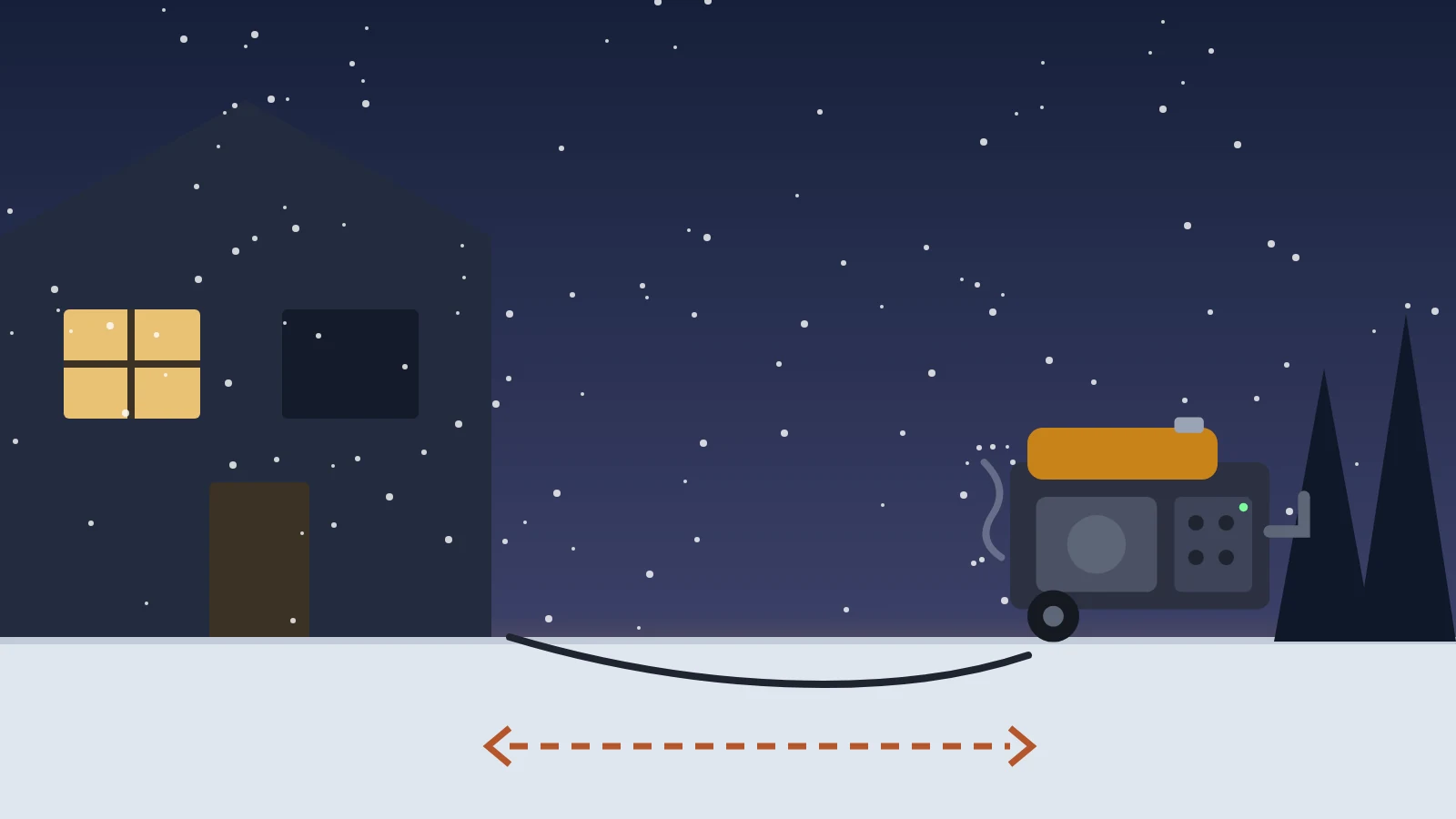
Bottom line: A generator can keep a fridge and lights going for days, if it runs outside, at least 20 feet from the house. Our pick is the WEN DF480iX: an inverter that runs on gasoline or propane, with electric start and a CO shutdown sensor. All three picks have an automatic CO shutoff, which the CPSC says to look for.
Our pick
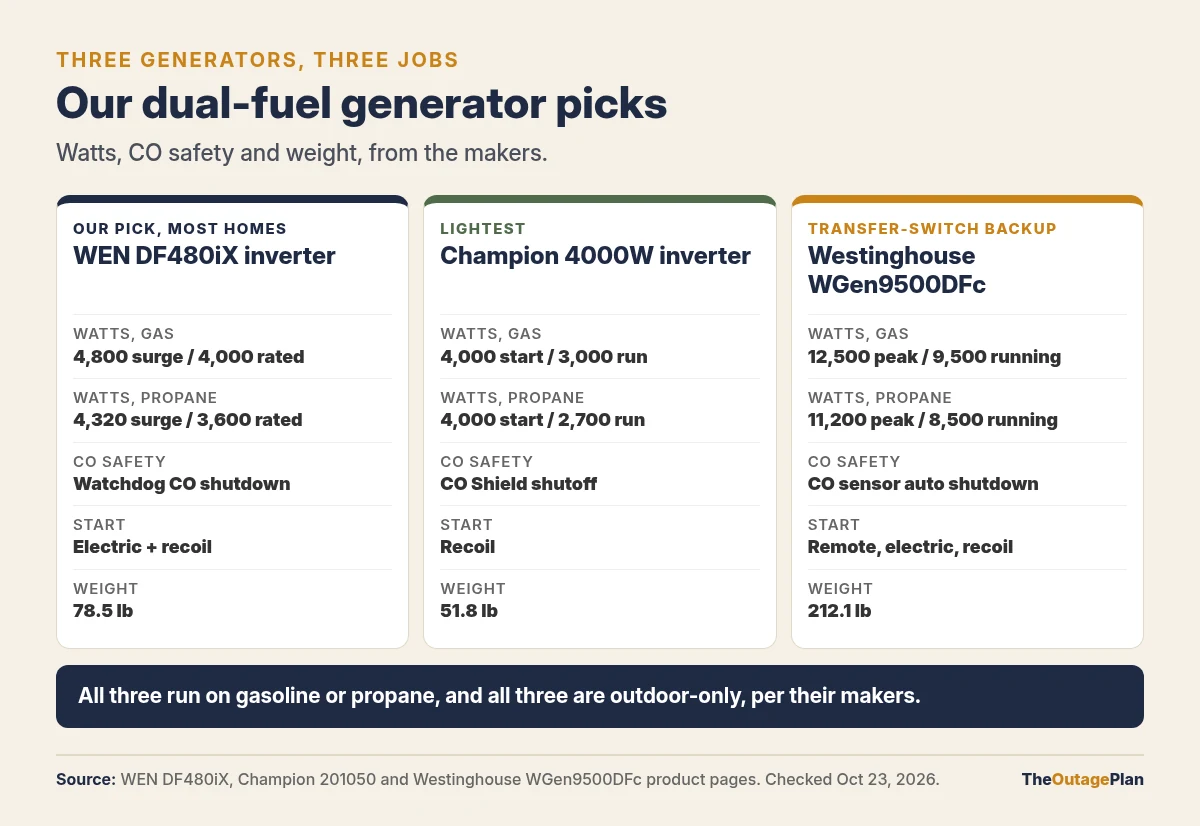
WEN DF480iX dual-fuel inverter generator: 4,800 surge / 4,000 rated watts on gasoline, 4,320 / 3,600 on propane, electric start and WEN’s Watchdog CO shutdown sensor, per WEN.
Lighter: the Champion 4000W inverter. For a transfer switch: the Westinghouse WGen9500DFc.
Not sure you want gas at all? Our power station vs generator guide compares the two.
Outside, 20 feet out: the CO rule
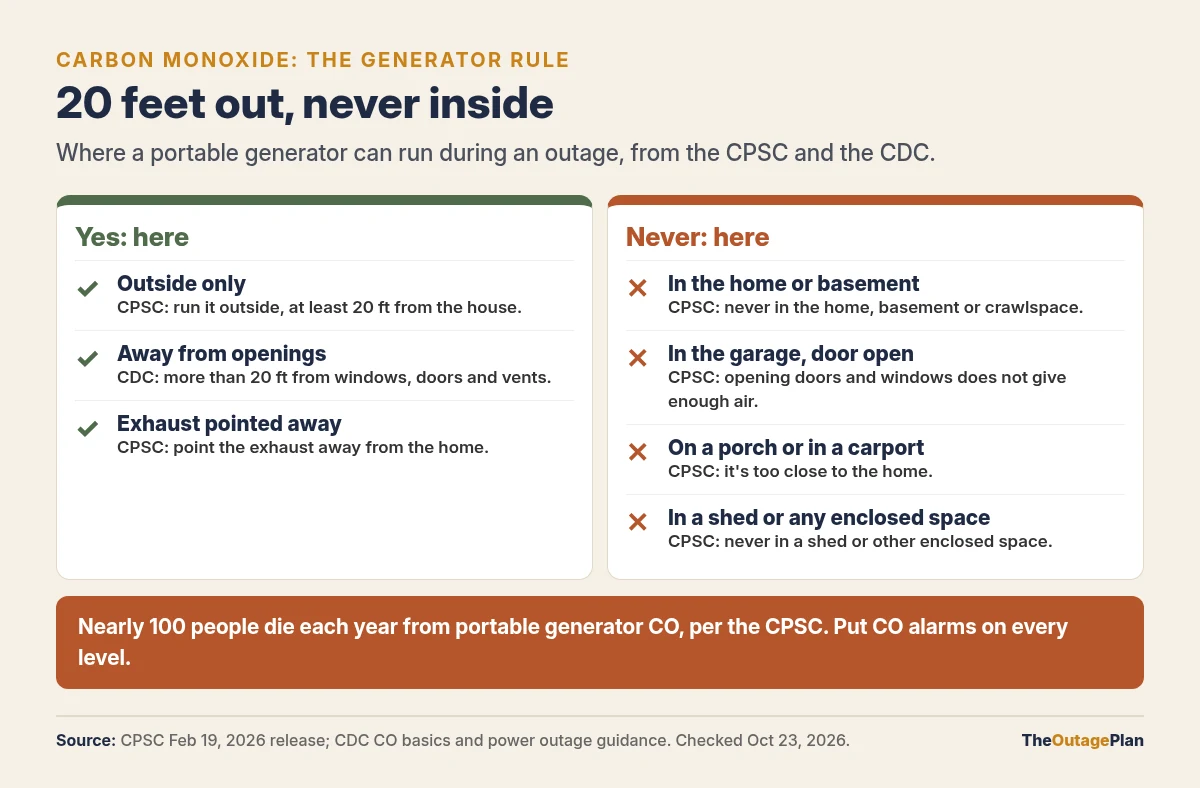
Generator exhaust carries carbon monoxide (CO), which you can’t see or smell. The CPSC says portable generator CO kills nearly 100 people in the U.S. each year, on average (CPSC).
- Outside only, at least 20 feet from the house, with the exhaust pointed away. Not on a porch or in a carport (CPSC).
- Never inside the home, garage, basement, crawlspace or shed. The CPSC says opening doors or windows won’t give enough air.
- Away from openings. The CDC says more than 20 feet from any window, door or vent (CDC).
- CO alarms inside. Battery or battery-backup alarms on every level, tested monthly. If one sounds, get outside and call 911 (CPSC). See our CO alarm picks.
Our picks
Our pick: WEN DF480iX
An inverter generator that runs on gasoline or propane: 4,800 surge / 4,000 rated watts on gas and 4,320 / 3,600 on propane. WEN lists electric start with a recoil backup, a Watchdog CO shutdown sensor and a fuel shutoff. Its 1.9-gallon tank runs up to 7 hours at half load, and WEN lists up to 12 hours at half load on a 20 lb propane tank (WEN). WEN lists under 1.2% THD at full load, clean enough for electronics.
The catch: it’s 120-volt only, with no 240-volt outlet, so it can’t feed a 240-volt home transfer switch. Plan on cords to appliances.
Full maker specs: WEN DF480iX
- Watts, gasoline: 4,800 surge / 4,000 rated
- Watts, propane: 4,320 surge / 3,600 rated
- Fuel tank: 1.9 gal; up to 7 hr at half load
- Propane: Up to 12 hr at half load on a 20 lb tank
- Outlets: Four 5-20R, one TT-30R RV, 12V DC, two 5V USB
- CO safety: Watchdog CO shutdown sensor
- Start: Electric, with recoil backup
- Power quality: Under 0.3% THD at no load, under 1.2% at full load
- Weight: 78.5 lb
- Warranty: 3-year limited
Lightest: Champion 4000W dual-fuel inverter
At 51.8 lb, this is the lightest of our three. Champion lists 4,000 starting / 3,000 running watts on gas and 4,000 / 2,700 on propane, with CO Shield automatic shutoff. It runs up to 10 hours on 1.54 gallons of gas, or up to 25 hours on a 20 lb propane tank, at 25% load (Champion). Champion notes that CO Shield isn’t a substitute for an indoor CO alarm.
The catch: recoil start only, and one duplex household outlet.
Full maker specs: Champion 201050
- Watts, gasoline: 4,000 starting / 3,000 running
- Watts, propane: 4,000 starting / 2,700 running
- Run time: Up to 10 hr on 1.54 gal of gas, up to 25 hr on a 20 lb propane tank, at 25% load
- Outlets: One 5-20R duplex, one TT-30R RV, 12V DC; parallel ready
- CO safety: CO Shield automatic shutoff; meets PGMA G300-2018
- Start: Recoil, with Cold Start
- Power quality: Under 3% THD
- Weight: 51.8 lb
- Warranty: 3-year limited
For a transfer switch: Westinghouse WGen9500DFc
The big one: 12,500 peak / 9,500 running watts on gas and 11,200 / 8,500 on propane, with 120/240-volt L14-30R and 14-50R outlets and a transfer-switch-ready design. Westinghouse lists remote, electric and recoil start, a CO sensor with automatic shutdown, and a 6.6-gallon tank that runs up to 12 hours at 25% load (Westinghouse).
The catch: 212.1 lb and 74 dBA, and it isn’t an inverter. Westinghouse lists THD of 23% or less, so check your electronics’ needs.
Full maker specs: Westinghouse WGen9500DFc
- Watts, gasoline: 12,500 peak / 9,500 running
- Watts, propane: 11,200 peak / 8,500 running
- Run time: Up to 12 hr at 25% load and 8 hr at 50% on gas; 7 hr at 50% on a 20 lb propane tank
- Outlets: Two GFCI 5-20R, L14-30R 30A and 14-50R 50A (120/240V); transfer switch ready
- CO safety: CO sensor with automatic shutdown
- Start: Remote, electric and recoil
- Power quality: 23% THD or less
- Weight: 212.1 lb
- Warranty: 3-year limited residential
Hooking it up safely
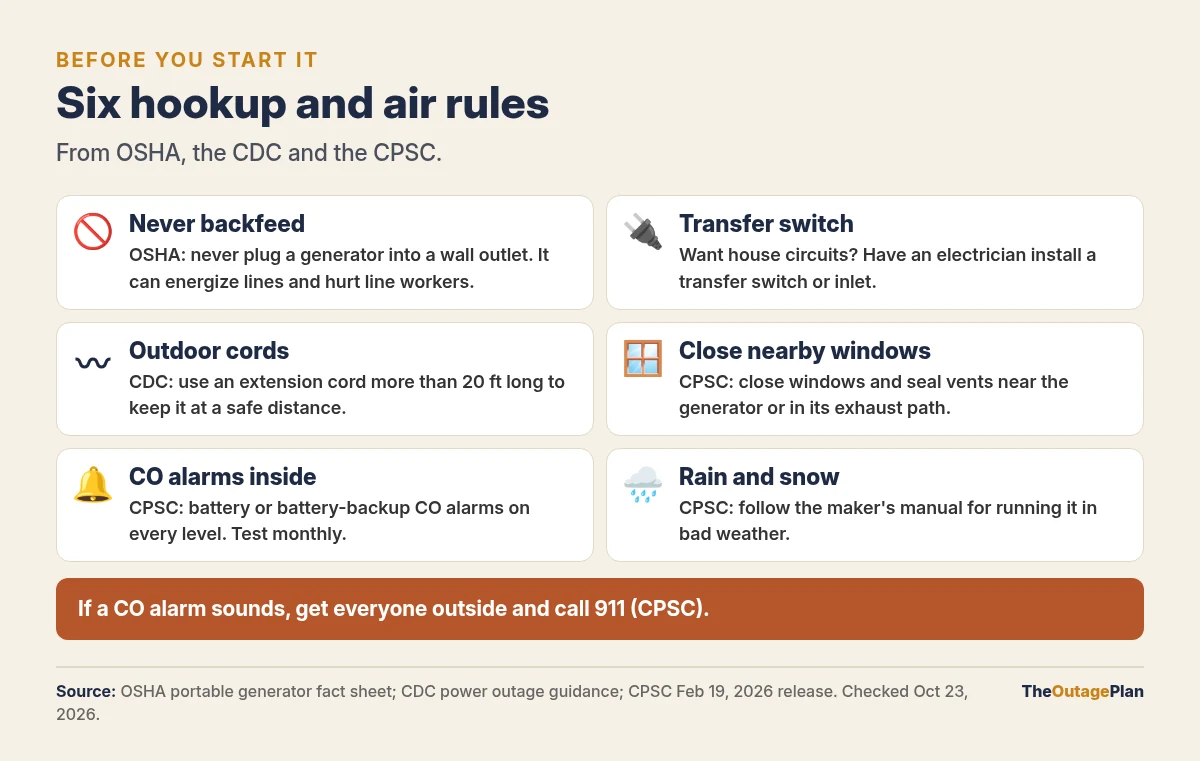
- Never plug a generator into a wall outlet. OSHA warns that backfeeding can electrocute utility workers (OSHA). For house circuits, have an electrician install a transfer switch or inlet.
- Use a long outdoor cord. The CDC says to use an extension cord more than 20 feet long so the generator stays a safe distance away (CDC). See our extension cord picks.
- Rain and snow: follow the maker’s manual. The CPSC says it may call for a rated generator tent, or for waiting until the weather passes.
Before the next outage
- List what you’ll run at once. Add up those running watts, then leave room for the largest starting watts. Check each appliance’s label.
- Start it monthly. The CPSC says to check and maintain it so it works when needed.
- Test your CO alarms now, on every level.
- Stock fuel the safe way. See our generator fuel storage guide for cans, stabilizer and propane.
FAQ
How far from the house should a generator be?
At least 20 feet, outside, per the CPSC, with the exhaust pointed away. The CDC says more than 20 feet from any window, door or vent.
Can you run a generator in the garage with the door open?
No. The CPSC says never to run one in a garage; opening doors or windows won’t provide enough ventilation.
Is a generator with CO shutoff worth it?
Yes. The CPSC says to look for one, and in 2024 it estimated that models certified to the PGMA G300-2018 and UL 2201 standards reduce CO deaths by an estimated 87% and 100%, respectively (CPSC). You still need indoor CO alarms.
Can you plug a generator into a wall outlet?
No. OSHA warns that backfeeding can electrocute utility workers. Use cords, or an electrician-installed transfer switch.
Specs checked Oct 23, 2026, from WEN’s, Champion’s and Westinghouse’s product pages and the Amazon listings. CO and hookup guidance from the CPSC, the CDC (CO basics) and OSHA. We haven’t hands-on tested these generators.