
Heads up: Some links on this page are affiliate links. If you buy through them, we may earn a commission at no extra cost to you. As an Amazon Associate, we earn from qualifying purchases. Full disclosure
Testing note: We haven’t hands-on tested these cords. Specs come from Southwire’s and Champion’s product pages and the Amazon listings, checked Oct 22, 2026.

Bottom line: A generator has to run outside, so you need a heavy, outdoor-rated cord to bring its power to your appliances. Our pick is the Southwire 12/3 SJTW, 50 ft: 12-gauge wire, rated 15 A, UL listed. With a power station, you often need no cord at all: set the station next to the fridge and plug the fridge straight in. Still choosing a generator? See our dual-fuel generator picks.
Our pick
Southwire 12/3 SJTW outdoor cord, 50 ft: 12-gauge wire, 15 A, 125 V, a weather-resistant vinyl jacket and a lighted end.
Need a short cord from a power station? The Southwire 14/3, 25 ft. Have a generator with a 30 A locking outlet? Champion’s 48033 cord.
Pick the gauge by load and length

Find the amps on the appliance’s nameplate, then match the cord. The Electrical Safety Foundation (ESFi) says the cord’s rating must be at least as high as what you plug into it, and its chart calls for thicker wire on longer cords. A lower gauge number means thicker wire (ESFi).
On the jacket, W means rated for outdoor use, and ESFi says never to use an indoor cord outdoors. So a cord marked SJTW is the kind to run from a generator.
Our picks
Our pick: Southwire 12/3 SJTW, 50 ft
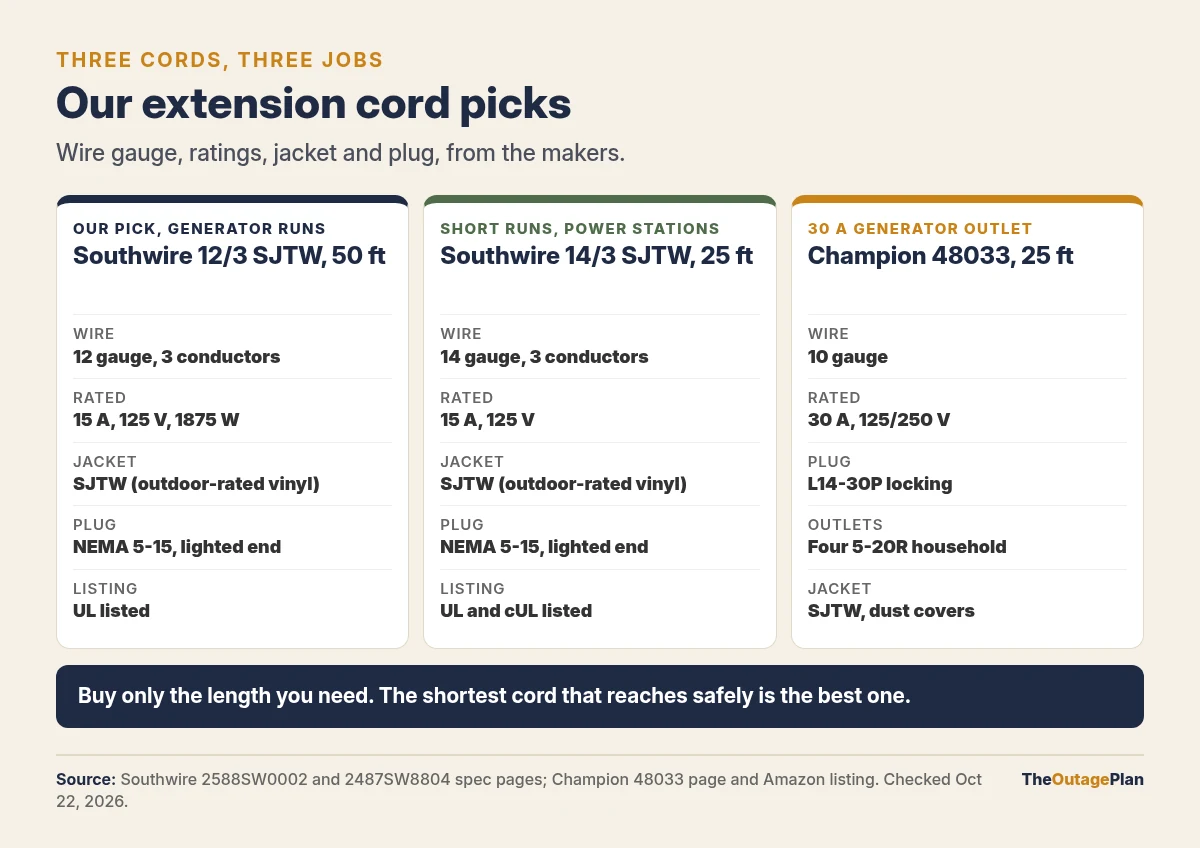
A 50 ft, all-copper 12/3 cord rated 15 A, 125 V, 1,875 W, with an SJTW vinyl jacket that Southwire says resists moisture, abrasion and sunlight. It has a NEMA 5-15 plug, a lighted end and is UL listed (Southwire). That length lets a generator sit outside, 20 ft or more from the house, and still reach.
The catch: it’s a single-outlet cord, so it’s one appliance per cord. Amazon showed low stock when we checked.
Full maker specs: Southwire 2588SW0002
- Wire: 12/3 (12 gauge, 3 conductors), all copper
- Rating: 15 A, 125 V, 1,875 W
- Jacket: SJTW vinyl, yellow
- Plug: NEMA 5-15P, lighted end
- Length: 50 ft
- Weight: About 6.5 lb, per Southwire
- Listing: UL listed
For short runs: Southwire 14/3 SJTW, 25 ft
A 25 ft, 14/3 cord rated 15 A, 125 V, with an SJTW jacket, a lighted end and UL and cUL listings (Southwire). ESFi’s chart rates 14 gauge for 14 to 15 A at 25 to 50 ft. It suits a power station that can’t sit right next to the appliance.
The catch: at 14 gauge, it’s not the cord for a 100 ft run. Stick to the length on the chart.
Full maker specs: Southwire 2487SW8804
- Wire: 14/3 (14 gauge, 3 conductors)
- Rating: 15 A, 125 V
- Jacket: SJTW vinyl, red
- Plug: NEMA 5-15P, lighted end
- Length: 25 ft
- Weight: About 2.5 lb, per Southwire
- Listing: UL and cUL listed
- Warranty: Limited lifetime, per Southwire
For a 30 A generator outlet: Champion 48033, 25 ft
This cord plugs into a generator’s 30 A locking outlet (L14-30) and splits it into four 20 A household outlets (5-20R). Champion lists 10-gauge wire with an outdoor-rated SJTW jacket, dust covers and a 125/250 V rating (Champion).
The catch: it only fits generators with an L14-30 outlet, so check yours. We didn’t see a UL listing on Champion’s page.
Full maker specs: Champion 48033
- Plug: NEMA L14-30P locking (30 A)
- Outlets: Four NEMA 5-20R household outlets
- Wire: 10 gauge, SJTW jacket
- Rating: 30 A, 125/250 V
- Length: 25 ft
- Weight: 9.5 lb, per Champion
- Warranty: 1-year limited, per Champion
Safety rules before you plug in

- Generator outside only. The CPSC says never to run one in a home, garage, basement or shed, and to keep it at least 20 ft from the house with the exhaust pointed away (CPSC).
- Never plug a generator into a wall outlet. OSHA warns that backfeeding can electrocute utility workers (OSHA). Use cords to appliances, or an electrician-installed transfer switch.
- One appliance per cord. ESFi says not to plug one cord into another (ESFi), run cords through walls, doorways or floors, or cover them, since heat can’t escape.
- Fridges: skip the cord if you can. GE strongly recommends against extension cords on refrigerators. If you use one, GE says it must be a UL-listed, 3-wire grounding cord rated 15 A or more (GE Appliances).
Before the next outage
- Size the load first. Our guide to how long a power station runs a fridge covers watts and surge.
- Choosing between the two? See power station vs. generator.
- Add CO alarms if you’ll run a generator. See our CO alarm picks.
- Lay out the cord route now, in daylight, not during the storm.
FAQ
What gauge extension cord does a refrigerator need?
GE recommends no extension cord. If you must use one, GE says to use a UL-listed, 3-wire grounding cord rated at least 15 A. ESFi’s chart rates 14 gauge for 14 to 15 A at 25 to 50 ft, and 12 gauge for 14 to 15 A at 100 ft.
Can you use an indoor extension cord with a generator?
No. The generator has to be outdoors, and ESFi says never to use an indoor cord outdoors. Look for a W on the jacket, such as SJTW.
Can you plug two extension cords together?
No. ESFi says never to extend a cord by plugging it into another one. Use one cord long enough for the job, sized for the load.
Does a power station need an extension cord?
Often not. A station makes no exhaust, so it can sit next to the appliance. Plug the appliance in directly, especially a fridge.
Specs checked Oct 22, 2026, from Southwire’s and Champion’s product pages and the Amazon listings. Safety guidance from ESFi, the CPSC, GE Appliances and OSHA. We haven’t hands-on tested these cords.