
Heads up: Some links on this page are affiliate links. If you buy through them, we may earn a commission at no extra cost to you. As an Amazon Associate, we earn from qualifying purchases. Full disclosure
Testing note: We haven’t hands-on tested this gear. Specs come from Siemens, Eaton Tripp Lite and the Amazon listings, checked Oct 23, 2026. This is an explainer, not wiring instructions.

Bottom line: When the power comes back on after an outage, it can return with surges or spikes that damage electronics (Ready.gov). Unplug what you can during the outage. For lasting protection, use two layers: a whole-house surge protector at the main panel, installed by a licensed electrician, plus plug-in surge protectors for the TV, computer and router.
Our pick
Siemens FSPD140 BoltShield: a UL 1449 Type 2 whole-house surge protector with a 140 kA surge rating, status lights and an audible alarm, per Siemens. An electrician mounts it next to your panel.
For your devices: a Tripp Lite 8-outlet strip rated 1,440 joules.
Why power coming back is the risky part
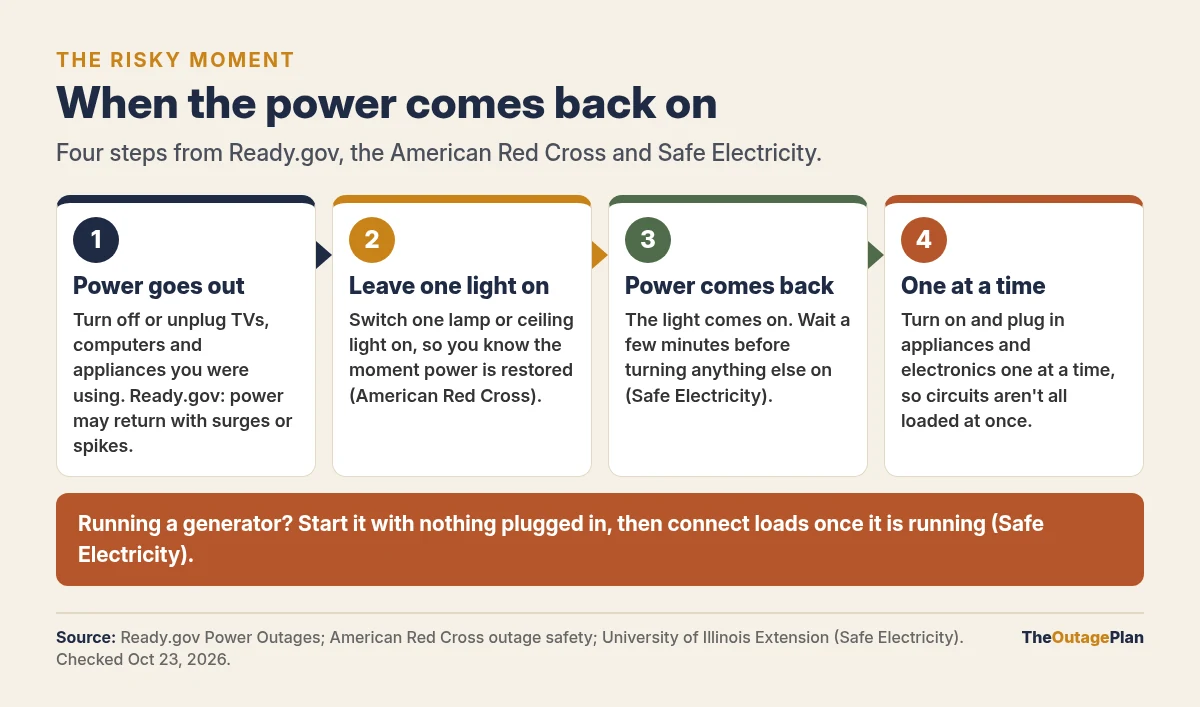
Ready.gov says power “may return with momentary surges or spikes that can cause damage,” and advises disconnecting appliances and electronics during an outage (Ready.gov). The Red Cross gives the same advice (Red Cross).
- Turn off or unplug TVs, computers and appliances that were running when the power went out (Red Cross).
- Leave one light on so you know when the power is back (Red Cross).
- Wait a few minutes after power returns, then turn things back on one at a time. Safe Electricity says switching everything on at once could overload circuits (Safe Electricity).
- Running a generator? Start it with nothing plugged in, then add loads one by one (Safe Electricity). See our transfer switch guide.
Outages aren’t the only source. ESFi cites a NEMA estimate that 60% to 80% of surges start inside the home, from large appliances switching on and off (ESFi).
Whole-house vs. plug-in surge protectors
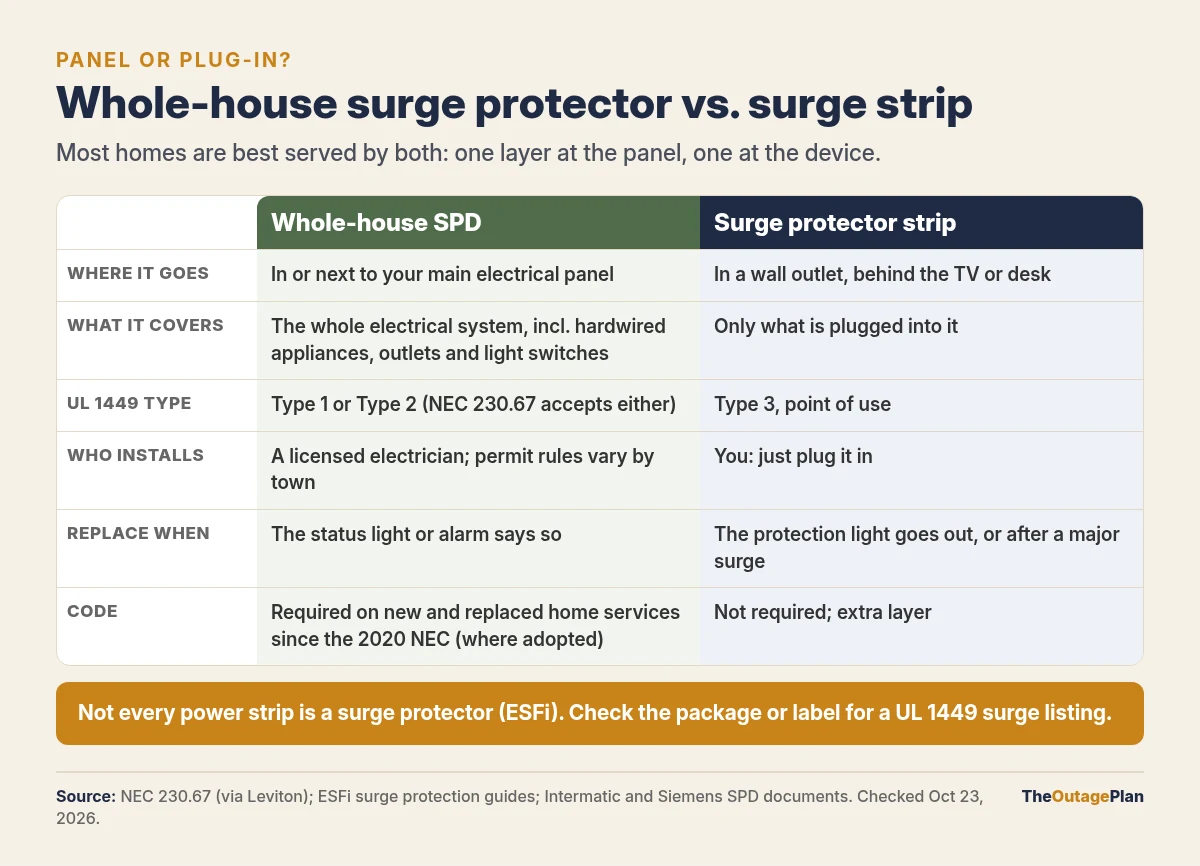
Whole-house (at the panel). ESFi says a whole-home surge protector protects your entire electrical system, including large appliances, outlets and light switches, and must be installed by a qualified electrician (ESFi). These are UL Type 1 or Type 2 devices (ESFi).
Plug-in strips (at the device). These are Type 3, point-of-use devices (ESFi). They protect only what’s plugged into them, and ESFi says they need replacing over time or after a major surge (ESFi).
Use both. A panel unit can’t stop surges from inside the home. A strip can’t protect your furnace, well pump or other hardwired gear.
Code note: Since the 2020 National Electrical Code, section 230.67 requires a Type 1 or Type 2 surge protector on services supplying homes, including when service equipment is replaced. The 2023 edition added a minimum 10 kA nominal discharge rating (Leviton, Leviton flyer). Code adoption varies by state and city, so ask your electrician which edition applies.
What to look for
- A real surge listing. ESFi warns that not all power strips offer surge protection (ESFi). Look for UL 1449 on the package.
- An indicator light. ESFi says to choose a protector with a light or alarm that tells you when it’s no longer working (ESFi).
- Joules (strips). The joule rating is how much surge energy the strip is rated to absorb. More is better for pricier electronics.
- kA ratings (whole-house). Check the Type (1 or 2), the surge current rating, and a nominal discharge rating (In) of at least 10 kA (Leviton).
- No protection stops a direct lightning strike (ESFi). In a lightning storm, unplugging is still the safest move.
Our surge protection picks
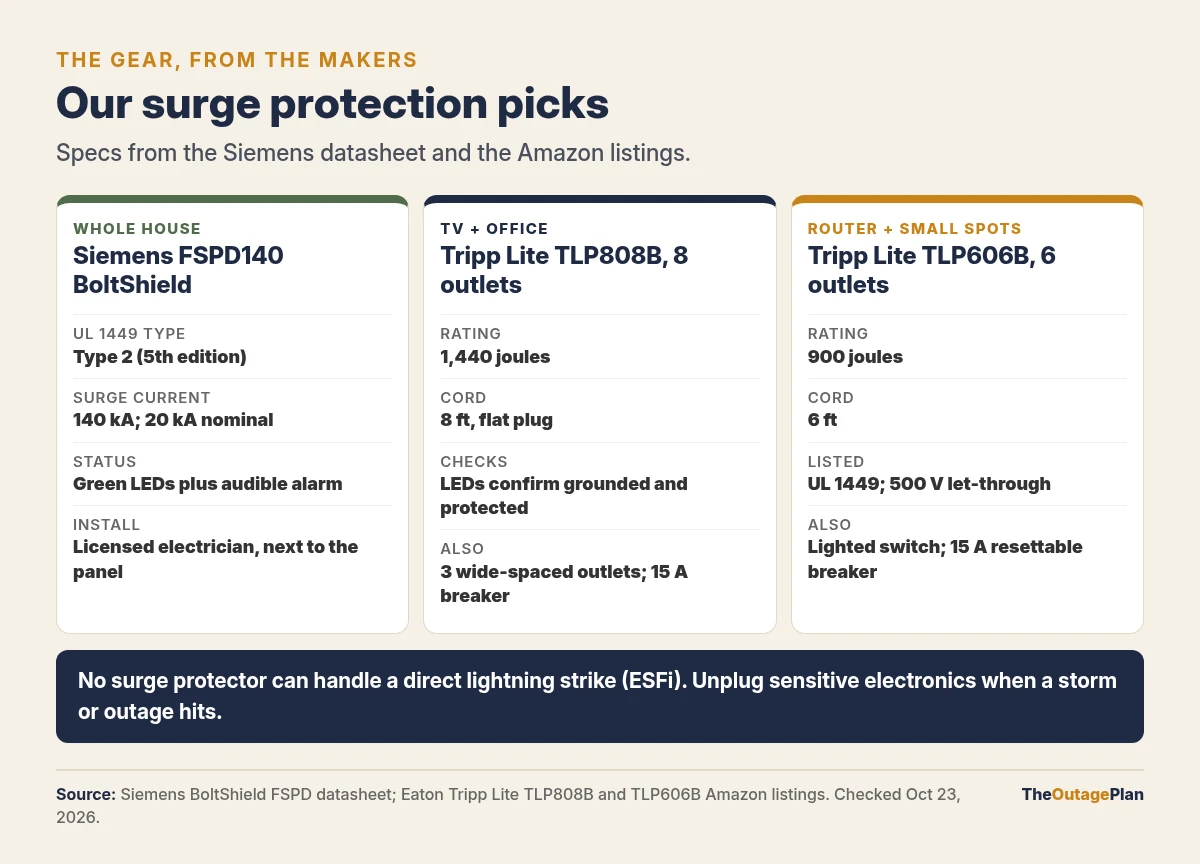
Whole house: Siemens FSPD140 BoltShield
A UL 1449 Type 2 surge protector for 120/240 V single-phase panels. Siemens rates it at 140 kA surge current and 20 kA nominal discharge, well above the 10 kA code minimum, and it covers all modes (line-neutral, line-ground, neutral-ground). Three green LEDs, a red fault light and an audible alarm show its status (Siemens).
The catch: it mounts outside the panel and is wired in, so plan on a licensed electrician.
Full maker specs: Siemens FSPD140
- Type: UL 1449 Type 2 (5th edition)
- Surge current: 140 kA
- Nominal discharge (In): 20 kA
- Short-circuit rating: 200 kA
- System: 120/240 V, single-phase, 3-wire
- Protection modes: L-N, L-G, N-G
- Status: 3 green LEDs, red fault LED, audible alarm
- Enclosure: NEMA 4X polycarbonate, 7.95 x 3.06 x 2.75 in
- Mounting: Next to the panel, 18 in #12 AWG leads
TV and office: Tripp Lite TLP808B
An 8-outlet strip rated 1,440 joules, with an 8 ft cord and a flat, right-angle plug that fits behind furniture. Three outlets are spaced for bulky adapters, and LEDs confirm the outlet is grounded and the strip is protecting (Eaton).
Full maker specs: Tripp Lite TLP808B
- Outlets: 8 (3 widely spaced)
- Surge rating: 1,440 joules
- Cord: 8 ft, flat right-angle plug
- Breaker: 15 A
- Indicators: Protection present (green) and grounded (red) LEDs
- UL 1449 let-through: 330 V L-G, 400 V L-N, 400 V N-G
- Listing: UL 1449, cUL
Router and small spots: Tripp Lite TLP606B
A compact 6-outlet strip rated 900 joules with a 6 ft cord, lighted switch and a green protection LED (Eaton). One outlet fits a bulky adapter. A good fit for a modem and router; see our Wi-Fi in an outage guide.
Full maker specs: Tripp Lite TLP606B
- Outlets: 6
- Surge rating: 900 joules
- Cord: 6 ft
- Breaker: 15 A resettable
- Filtering: EMI/RFI
- UL 1449 let-through: 500 V
- Listing: UL 1449, cUL
FAQ
Do you need a surge protector for a power outage?
The risk comes when power returns. Ready.gov says it may come back with surges or spikes that can cause damage. Unplug electronics during the outage, and use surge protectors for what stays plugged in.
Is a whole-house surge protector required?
Since the 2020 National Electrical Code, section 230.67 requires a Type 1 or Type 2 surge protector on home electrical services, including when service equipment is replaced. Local adoption varies, so ask a licensed electrician.
Can you install a whole-house surge protector yourself?
ESFi says a whole-home surge protector must be installed by a qualified electrician. It’s wired into your panel, so hire a licensed electrician and ask whether your area needs a permit.
Does a surge protector stop lightning?
No. ESFi says no surge protection can handle a direct lightning strike. During a lightning storm, unplugging electronics is the safest choice.
Specs checked Oct 23, 2026, from Siemens, Eaton Tripp Lite and the Amazon listings. Guidance from Ready.gov, the American Red Cross, Safe Electricity, ESFi and Leviton (NEC 230.67). We haven’t hands-on tested this gear.