
Heads up: Some links on this page are affiliate links. If you buy through them, we may earn a commission at no extra cost to you. As an Amazon Associate, we earn from qualifying purchases. Full disclosure
Important: We’re not medical advisers, and this is planning information, not medical advice. Your prescriber and your oxygen supplier (often called a DME, or durable medical equipment, company) should set your backup plan. Ready.gov says people who use powered medical equipment at home should talk to their doctor or health care provider about keeping it running in an outage (Ready.gov). Start there.
Testing note: We haven’t hands-on tested any power station with an oxygen concentrator. Power figures come from Inogen, Philips Respironics, Invacare, Drive DeVilbiss, and CAIRE manuals and spec sheets. Station specs come from EcoFlow, BLUETTI, and Jackery, all checked Oct 19, 2026. Runtimes are our estimates.
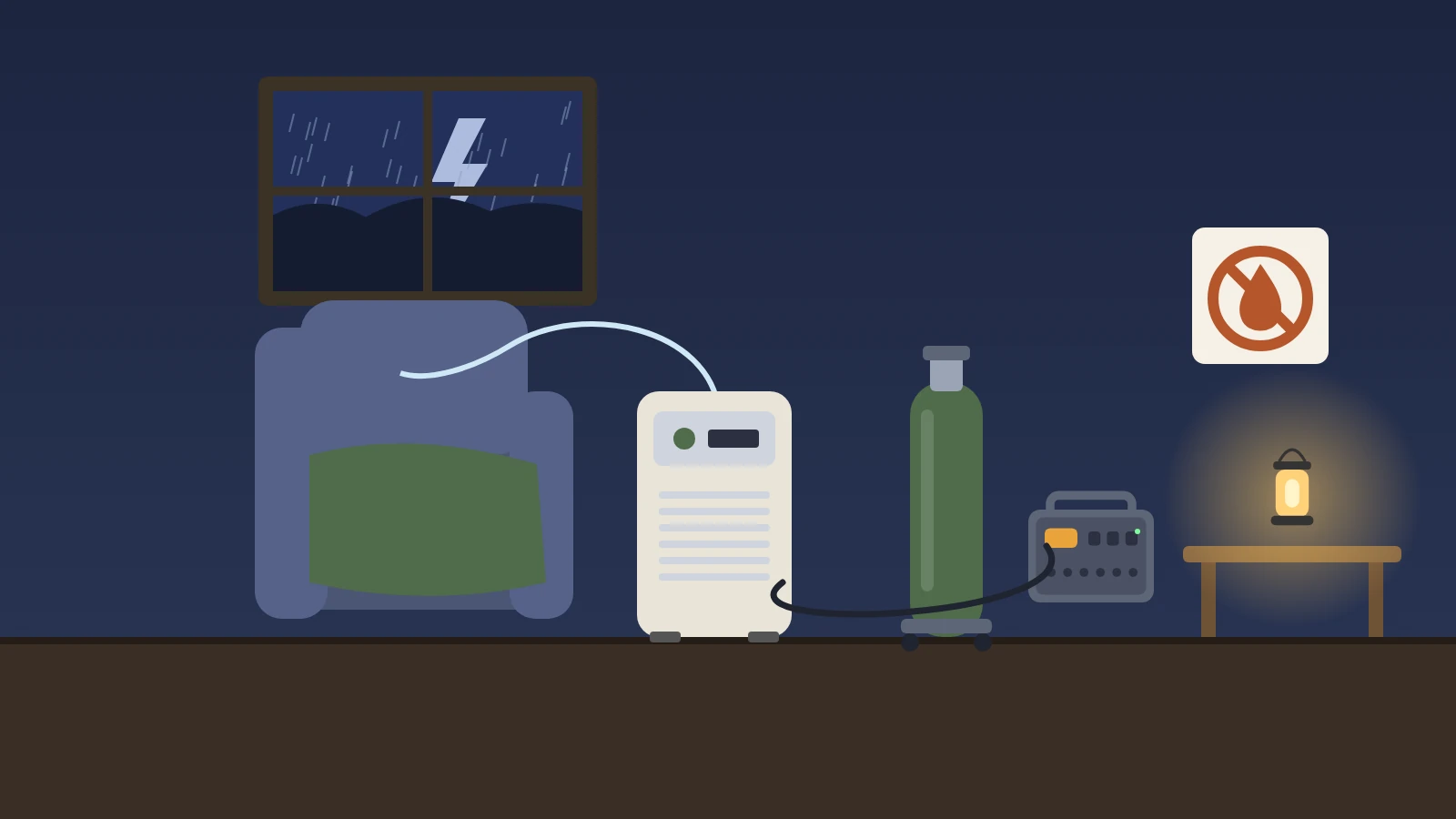
Bottom line: Yes, for a few hours, but it’s a bridge, not the backup plan.
- Home concentrators draw a lot. Makers list about 100 W (Inogen At Home on setting 2) up to 400 W (Invacare Platinum 5). That’s roughly two to seven times the 56.1 W ResMed lists as typical for its AirSense 11 CPAP.
- A ~1 kWh station runs one for about 2 to 10 hours, by our math, depending on the machine and setting. Oxygen is often prescribed around the clock, so that won’t carry you through a long outage.
- The concentrator manuals we read all call for an alternate oxygen source in an outage. In practice that means cylinders from your supplier.
- A portable oxygen concentrator (POC) is the better fit. Its own batteries cover hours, and a station can recharge them through the maker’s AC power supply.
- Fire is the outage risk people forget. Candles, lighters, and gas lanterns don’t belong near oxygen. Use battery lights instead.
First, a backup that needs no electricity
A concentrator makes oxygen from room air, so it stops the moment the power does. The makers are blunt about it:
- Inogen recommends an alternate source of oxygen in case of a power outage or mechanical failure, and says to ask your equipment provider which backup system to use (Inogen At Home manual).
- Philips Respironics says that if your prescriber has determined an interruption in oxygen could have serious consequences, an alternate source should be available for immediate use. Its alarm table tells you to connect to a backup oxygen source and call your home care provider (EverFlo manual).
- Invacare and CAIRE both recommend an alternate source of supplemental oxygen for a power outage, alarm, or mechanical failure (Invacare Platinum manual, CAIRE FreeStyle Comfort manual).
Ready.gov’s emergency kit list for people with disabilities includes a backup supply of oxygen (Ready.gov). Ask your supplier:
- How many cylinders you should keep, and how long each lasts at your prescribed setting
- How to switch to them, and who in your home knows how
- How fast they can deliver more during a storm, and what to do if they can’t
Don’t stretch a battery by turning your flow down unless your clinician has told you that’s OK. That’s a medical call, not a power one.
How much power home concentrators draw
Stationary concentrators plug into a wall outlet and run a compressor. What each maker publishes:
- Inogen At Home (GS-100): 100–240 VAC; 100 W on setting 2, 275 W max (Inogen)
- Drive DeVilbiss 5 Liter (525DS): 310 W average; 275 W at 1.2 LPM and below (Drive DeVilbiss)
- Philips Respironics EverFlo: 120 VAC ±10%, 60 Hz; 350 W average (Philips brochure)
- Invacare Platinum 5: 120 VAC ±10%, 60 Hz, 4.3 A rated input; 400 W average (Invacare manual)
Two of these are no longer sold new. Philips Respironics lists January 25, 2024 as the end of US sales for the EverFlo, with service through January 25, 2029 (Philips). Invacare exited its respiratory line in November 2022, and React Health bought it in 2023 (React Health). Plenty of both are still in homes, which is why we list them.
What about startup surge? A compressor pulls extra current for a moment when it starts. None of the four manuals or spec sheets we read lists a startup or inrush figure, so we can’t give you one. For scale, our three stations are rated for 1,500 to 1,800 W continuous and 2,700 to 3,600 W surge, several times the running watts above. Still, test your own machine on your station, with your supplier’s OK, before you need it.
Your machine’s label wins. Find the model on the back or bottom, then check its manual. If the number isn’t there, ask your supplier.
How long our three stations can run one
We use Jackery’s planning formula, capacity × 0.85 ÷ watts, for all three stations as our own estimate. The 0.85 covers conversion losses (Jackery).
Here’s what one charge buys on the EcoFlow DELTA 3 Plus (1,024 Wh), the BLUETTI AC180 (1,152 Wh), and the Jackery Explorer 1000 v2 (1,070 Wh):
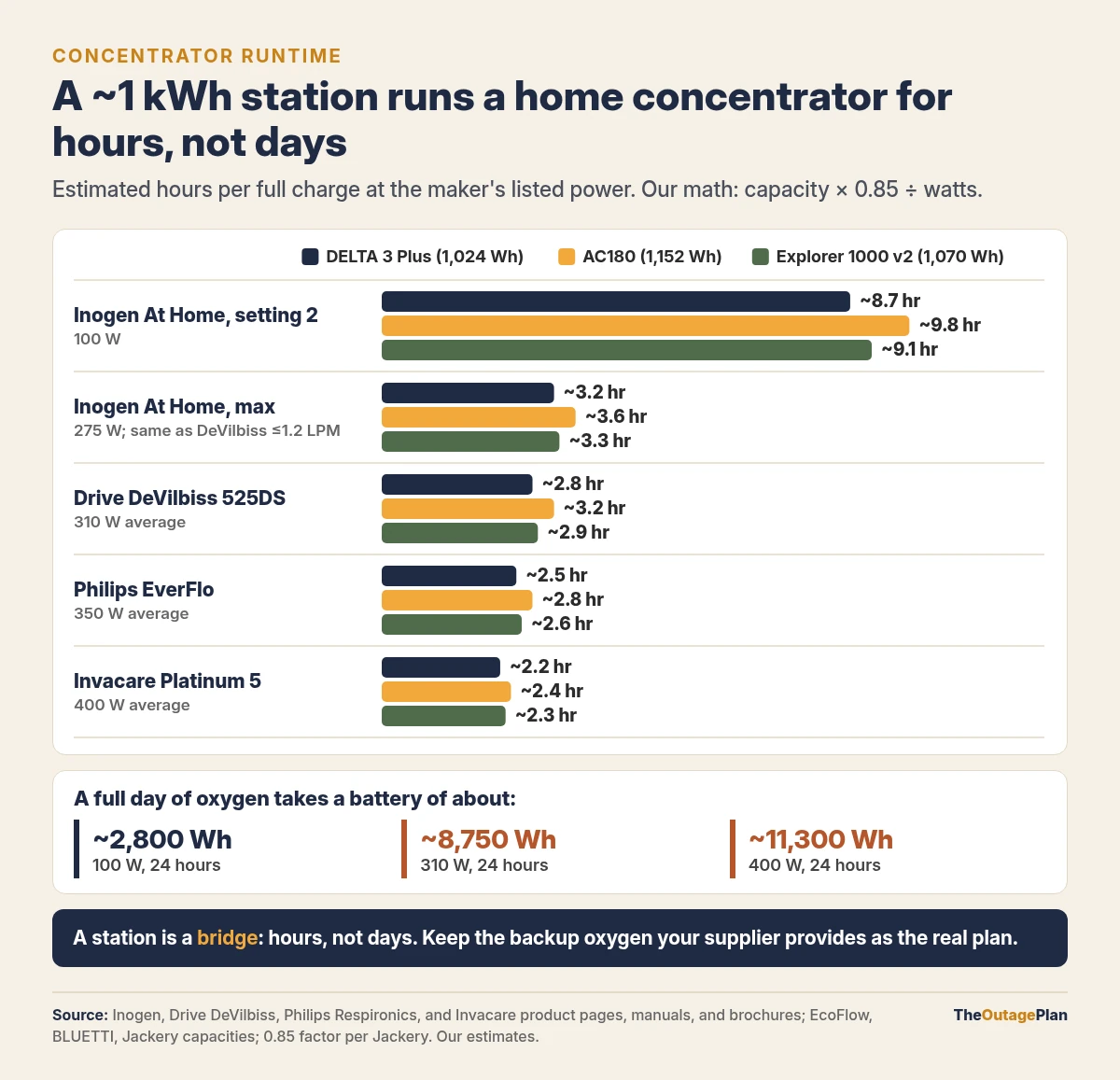
Capacities are from EcoFlow, BLUETTI, and Jackery. Runtimes are our estimates, not manufacturer claims, and real runtime varies with your setting, room temperature, and battery age. EcoFlow says the DELTA 3 Plus expands to 5 kWh with extra batteries (EcoFlow). By our math, that runs a 100 W concentrator for about 42 hours, or a 310 W one for about 14 hours.
So a station is best used to:
- Keep oxygen flowing while you switch to cylinders calmly, without a scramble in the dark
- Cover a short outage or a planned shutoff of a few hours
- Save your cylinders for the overnight hours or a trip to somewhere with power
To recharge a station during a longer outage, see how much solar you need or using a generator only to recharge.
Portable oxygen concentrators are the better fit
A POC runs on its own batteries and plugs into AC or a car outlet. That makes it much easier to keep going in an outage, if you have one or your supplier can provide one.
Inogen One G5 (Inogen G5 manual):
- AC power supply input: 100 to 240 VAC, 50 to 60 Hz
- DC power cable input: 13.5 to 15.0 VDC, 10 A max
- Battery: hours by setting are in the chart below; Inogen’s spec sheet says its times are on flow setting 1 (Inogen spec sheet)
- Inogen says to keep a charged battery in the unit when running on AC or DC power, so it keeps running if external power is lost
CAIRE FreeStyle Comfort (CAIRE manual):
- AC power: 100 to 240 VAC, 50 to 60 Hz
- DC power: 11 to 18 VDC, 10 A max
- Battery, single / double: setting 1 up to 8 / 16 hours, setting 2 up to 4 / 8, setting 3 up to 3 / 6, setting 4 up to 2.25 / 4.5, setting 5 up to 2 / 4
- Recharge: 3.5 hours single, 6 hours double
- CAIRE says not to connect external power without a battery pack installed
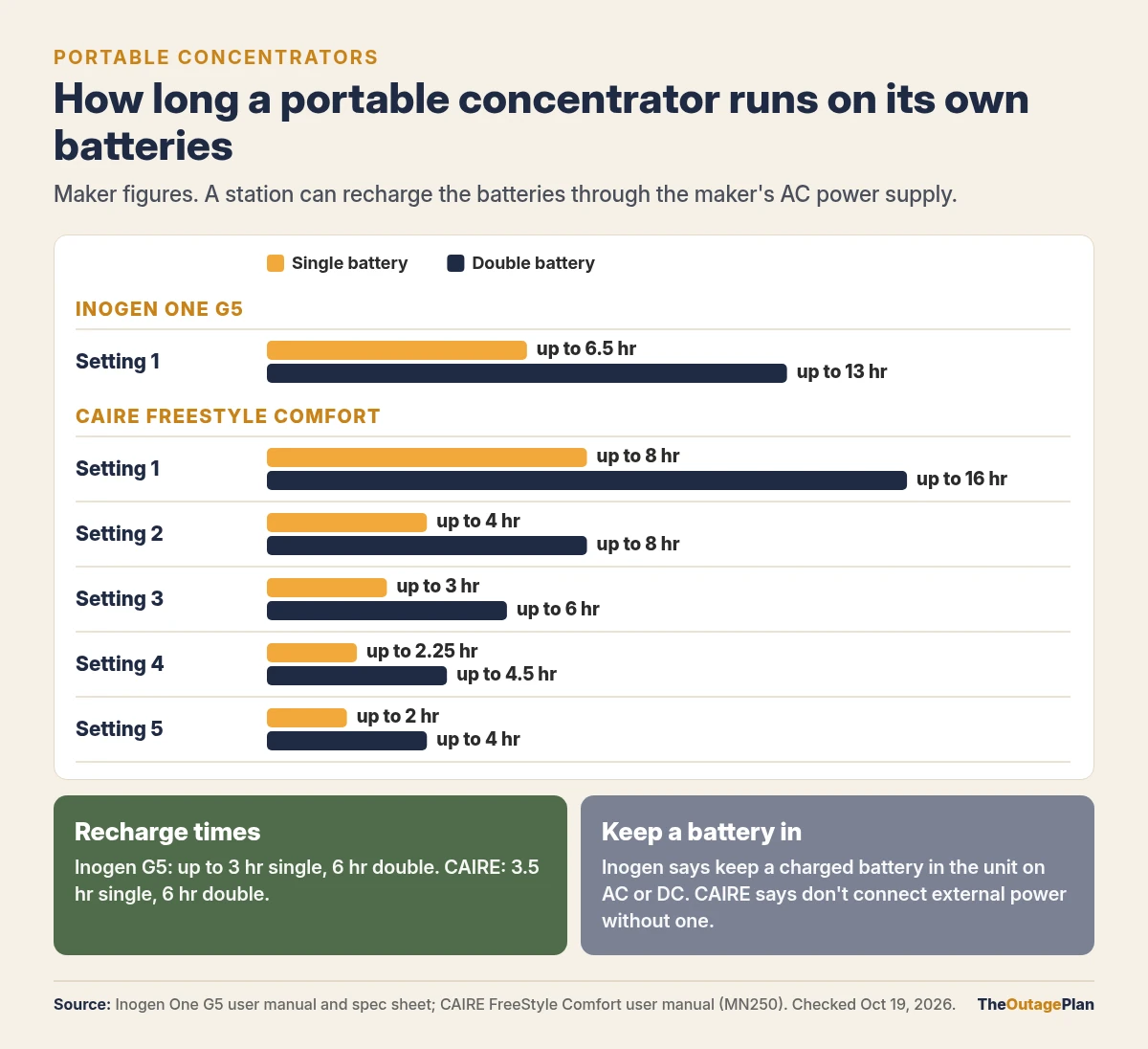
Neither manual lists how many watts the POC draws from AC or DC, so we can’t run the station math for these the way we did above. One way to get a real number: plug the POC into your station during a test and read the output watts on the station’s display. Do it with your supplier’s OK, and with your cylinders ready.
Philips SimplyGo: Philips lists January 25, 2024 as the end of US sales for the SimplyGo and SimplyGo Mini, with service through January 25, 2029 (Philips).
Use the AC power supply, and be careful with the 12 V outlet
The simplest setup is the POC maker’s own AC power supply plugged into a station’s AC outlet. Both makers list a 100 to 240 VAC input, and our stations put out 120 V AC.
The car outlet is where it gets tricky. The makers’ DC cords are designed for vehicle outlets:
- Inogen lists a DC input of 13.5 to 15.0 VDC. Our stations’ car outlets are rated 12.6 V (EcoFlow DELTA 3 Plus) (EcoFlow), 12 V regulated (BLUETTI AC180) (BLUETTI), and 12 V (Jackery Explorer 1000 v2) (Jackery). On paper, all three are below Inogen’s listed range.
- CAIRE’s 11 to 18 VDC range covers 12 V. But CAIRE’s DC instructions are written for vehicles, and they start with turning on the vehicle. CAIRE also says not to use the DC supply with extensions, splitters, or adapters.
- Inogen says not to use its DC cable with a cigarette plug splitter or an extension cable, and not to jump-start a car with it connected.
If you want to use a station’s 12 V outlet, ask the POC maker or your supplier first. Otherwise, stick with the AC power supply.
What the station makers say about medical devices
Read the power station’s fine print as closely as the concentrator’s:
- Jackery says its portable power stations are not recommended for medical devices, life-support equipment, or other uses where a power interruption could cause injury or loss of life (Jackery).
- EcoFlow says the DELTA 3 Plus isn’t intended for powering life-sustaining medical equipment. For other medical equipment, it says to check with the equipment’s maker first for any restrictions on using an external power source (EcoFlow manual).
- BLUETTI’s AC180 page doesn’t address medical use that we could find, so ask BLUETTI before relying on one.
Sine wave: EcoFlow lists pure sine wave output for the DELTA 3 Plus (EcoFlow manual), and BLUETTI lists a pure sine wave inverter for the AC180 (BLUETTI). The Explorer 1000 v2 spec table on Jackery’s page doesn’t name the waveform, so ask Jackery. Whatever you use, pick a pure sine wave inverter for medical equipment.
Pass-through (UPS) mode: If you leave the concentrator plugged into a station that’s plugged into the wall, the station switches to battery when the grid drops. EcoFlow lists a 10 ms transfer time for the DELTA 3 Plus (EcoFlow manual). Jackery says the Explorer 1000 v2 switches in under 20 ms (Jackery), and its manual calls this a “non-professional” UPS function. None of the concentrator makers we read says whether their machine rides through a gap like that, so test it with your supplier before you count on it.
Extension cords and adapters
The concentrator makers are strict about this:
- Philips: do not use extension cords or electrical adapters with the EverFlo.
- Invacare: no extension cords.
- CAIRE: do not use extension cords with the FreeStyle Comfort, or plug too many things into the same outlet.
- Inogen: avoid extension cords. If one must be used, use a UL-marked cord of at least 18 gauge, and don’t connect any other device to it.
So set the station right next to the concentrator and plug straight in. Keep other big loads off that station. Inogen and CAIRE also warn against blocking the air intake and exhaust, so give both machines room to breathe.
Generators and oxygen
The FDA says to read your device’s instructions, or call the distributor or manufacturer, to find out whether it can be used with batteries or a generator (FDA). If your supplier approves a generator:
- Keep it outside. The CDC says to run a generator outdoors, more than 20 feet from windows, doors, and vents, and never in your home or garage, even with the doors open (CDC).
- Use a battery CO alarm. The CDC says to use a battery-powered or battery-backup CO detector when you run a generator. The First Alert CO710 has a sealed 10-year battery.
- Keep fuel away from the oxygen. NFPA says to keep oxygen cylinders at least 5 feet from heat sources, open flames, and electrical devices (NFPA). Store and refuel the generator well away from where oxygen is used and stored.
A generator that only recharges the station, outside, keeps the concentrator on clean battery power indoors. See our power station vs. generator guide.
Fire safety when the lights are out
Oxygen makes fires start easier and burn faster. NFPA says oxygen soaks into furniture, clothing, hair, and bedding, and that smoking materials are the leading cause of medical oxygen fires (NFPA). An outage adds new risks:
- No candles. NFPA says candles, matches, wood stoves, and even sparking toys can be ignition sources and shouldn’t be used in a home where oxygen is in use. CAIRE says no smoking, candles, or open flames in the same room as the device or its tubing.
- Battery lights only. The FDA says to use battery-powered flashlights or lanterns, not gas lights or torches, when oxygen is in use (FDA). An Energizer PRO-360 lantern lights a room, and an Energizer Vision HD+ headlamp keeps both hands free for tubing and cylinders. Energizer auto-on lights come on by themselves when the power cuts out. More options are in our emergency light bulbs guide.
- Keep heaters back. Inogen says not to use the At Home near open flame, matches, radiant heaters, oil, grease, solvents, or aerosols. For the G5, it says no smoking or open flames within 10 feet while it’s in use.
- Post the signs. NFPA says to post No Smoking and No Open Flames signs inside and outside the home. CAIRE says “No Smoking – Oxygen in Use” signs must be displayed where oxygen is used.
- Turn it off when nobody’s using it. Philips and Inogen both say not to leave the cannula on bedding or chair cushions with the concentrator running, because the oxygen makes those materials flammable.
Get on the lists before the outage
Utilities sometimes cut power on purpose for wildfire safety, and those shutoffs can be large. One example:

None of these keep the power on, but they help people find you:
- Your utility. Ready.gov says you can ask your power provider to put you on a list for priority power restoration (Ready.gov). Many utilities run a medical baseline or life-support program. PG&E, for example, lists oxygen concentrators as qualifying life-support equipment, and its Medical Baseline customers get extra alerts before a Public Safety Power Shutoff (PG&E). Ask yours what it offers. Our grid alerts guide explains why these programs don’t guarantee power.
- Your fire department and power company. The FDA’s power outage booklet for home medical device users lists both as contacts to notify when power is lost and restored (FDA booklet). It’s a fill-in plan you can print and keep with the concentrator.
- Public health. The FDA says that if you depend on a device to keep you alive, seek emergency services right away, and if possible notify your local public health authority to ask for evacuation before severe weather (FDA).
- HHS emPOWER. This federal program gives public health agencies de-identified Medicare data on people who rely on electricity-dependent medical equipment, so they can plan outreach in disasters (HHS emPOWER). There’s nothing to sign up for, but it’s one reason your health department may call. Don’t count on it.
Oxygen outage checklist
- ☐ Backup oxygen cylinders from your supplier, and everyone at home knows how to switch over
- ☐ Supplier’s 24-hour number, prescriber’s number, and your prescribed settings written down
- ☐ Concentrator model and its power rating noted from the label or manual
- ☐ Utility medical or life-support program signed up for, if you qualify
- ☐ Fire department and power company told that someone at home uses oxygen
- ☐ FDA power outage booklet filled out and kept with the concentrator
- ☐ If you’re using a station: tested on it with your supplier’s OK, plugged in directly with no extension cord
- ☐ POC batteries charged, with the AC power supply packed
- ☐ Battery lanterns and headlamps where the candles used to be
- ☐ “No Smoking” signs posted, and a battery CO alarm if a generator is in the plan
- ☐ A place to go with power, like a friend’s house, hospital, or shelter
FAQ
Can you run an oxygen concentrator on a power station?
Yes, for a few hours. A home concentrator draws about 100 to 400 W, by its maker’s figures. A ~1 kWh station runs one for about 2 to 10 hours by our math. Check with your supplier and the station maker first, and keep cylinders as your real backup.
How long will a power station run your oxygen concentrator?
Divide the station’s watt-hours by your machine’s watts, then multiply by 0.85. A 1,024 Wh DELTA 3 Plus runs a 100 W Inogen At Home for about 8.7 hours and a 400 W Invacare Platinum 5 for about 2.2 hours. Those are our estimates.
Can you use a generator with your oxygen concentrator?
Only if your device’s instructions or maker allow it, the FDA says. Run any generator outdoors, more than 20 feet from windows, doors, and vents, with a battery CO alarm inside. Keep fuel well away from your oxygen.
Do you need backup oxygen tanks if you have a power station?
Yes. Inogen, Invacare, and CAIRE recommend an alternate oxygen source for power outages, and Philips says to have one ready when an interruption could have serious consequences. A station buys hours. Cylinders don’t depend on any battery at all.
Can you charge a portable oxygen concentrator from a power station?
Usually through its AC power supply, which Inogen and CAIRE list for 100 to 240 VAC. The 12 V car outlet is less certain: Inogen lists a 13.5 to 15.0 VDC input, higher than our stations’ 12 to 12.6 V car outlets. Ask the maker before using it.
The three stations, battery lights, and CO alarm are on our Gear page. For a CPAP’s numbers, see our CPAP backup power guide, and to size a station for the rest of the house, start with our power station sizing guide.
Concentrator data checked Oct 19, 2026, from the Inogen At Home product page and user manual, the Inogen One G5 user manual and spec sheet, the Drive DeVilbiss 5 Liter product page, the Philips Respironics EverFlo brochure and user manual, Philips’ US portfolio update, the Invacare Platinum manual (part no. 1118353), React Health, and the CAIRE FreeStyle Comfort user manual. Station specs are from EcoFlow, BLUETTI, and Jackery. Safety guidance is from the FDA, CDC, NFPA, Ready.gov, HHS emPOWER, and PG&E. Runtimes and battery sizes are our estimates, not manufacturer claims. Your device’s manual and your supplier win. This is general information, not medical or electrical advice.