
Heads up: Some links on this page are affiliate links. If you buy through them, we may earn a commission at no extra cost to you. As an Amazon Associate, we earn from qualifying purchases. Full disclosure
Testing note: We haven’t hands-on tested these products. Specs come from Pilgrim Home & Hearth, General Tools and the Amazon listings, checked Oct 29, 2026.

Bottom line: The CDC lists a fireplace that’s up to code, with plenty of dry firewood, as a backup heat source for a winter storm, if it’s vented to the outside (CDC). Burning more often during a long outage means more hot ashes. Ashes go in a metal container with a lid, outside, at least 10 feet from your home (USFA).
Our pick
Pilgrim Home & Hearth 19504 Air Insulated Ash Bucket: a steel bucket with a double-walled bottom, a tight-fitting lid and heavy-duty handles, plus a lifetime warranty, per Pilgrim. Ships from and sold by Amazon.com when we checked.
Before you light it in an outage
- Vented only. Use a fireplace or wood stove only if it’s properly vented to the outside and doesn’t leak gas into the house (CDC). Never use your oven to heat your home (USFA).
- CO alarm first. Install a battery-powered carbon monoxide alarm (CDC). Make sure your smoke alarms work too.
- 3 feet clear, screen on. Keep anything that can burn at least 3 feet away, and keep a glass or metal screen in front of the fireplace (USFA).
- Put it out at night. USFA says to put the fire out before you go to sleep or leave home (USFA). For overnight warmth, plan on sleeping bags or an indoor tent in one warm room.
- Chimney checked. Have it inspected and cleaned every year by a professional (USFA). NFPA says fireplace and chimney fires are 6% of home heating fires but 19% of the property damage (NFPA).
The hot-ash routine, step by step
- Scoop ashes into a metal container with a tight-fitting lid. Never a plastic bucket, cardboard box or paper bag; embers can ignite them (NH DES).
- Keep the lid on. Oxygen can reignite hidden embers (NH DES).
- Take it outside and set it on a surface that won’t burn, like dirt, gravel or concrete (EPA, NH DES).
- At least 10 feet from the house, and away from the garage, porch or shed (USFA, NH DES).
- Wait. Hot embers can stay alive for up to 72 hours even when the ashes feel cool, so let them cool for several days before you dump them (NH DES).
Burn dry wood, and how to check it
- EPA says to burn only dry, split, well-seasoned wood, seasoned for at least 6 months, and that wood burns best at less than 20% moisture. Test it with a wood moisture meter (EPA).
- Store firewood outdoors, off the ground, with only the top covered (EPA).
- Start fires with dry kindling or all-natural fire starters. Never use gasoline, kerosene or charcoal starter (EPA).
- Don’t burn trash, cardboard, painted or pressure-treated wood, or plywood (EPA). USFA and CDC also say not to burn paper in a fireplace (USFA, CDC).
- Keep a fire extinguisher handy (EPA).
Wood stove tips
- Use a stove tested by a qualified lab (USFA).
- Keep the stove doors closed unless you’re loading or stoking the fire. EPA says harmful chemicals like carbon monoxide can get into your home otherwise (EPA).
- Build hot fires; EPA says a smoldering fire is not safe or efficient for most stoves (EPA).
- Check your stove or insert’s manual before burning artificial logs (EPA).
Our ash bucket and firewood picks
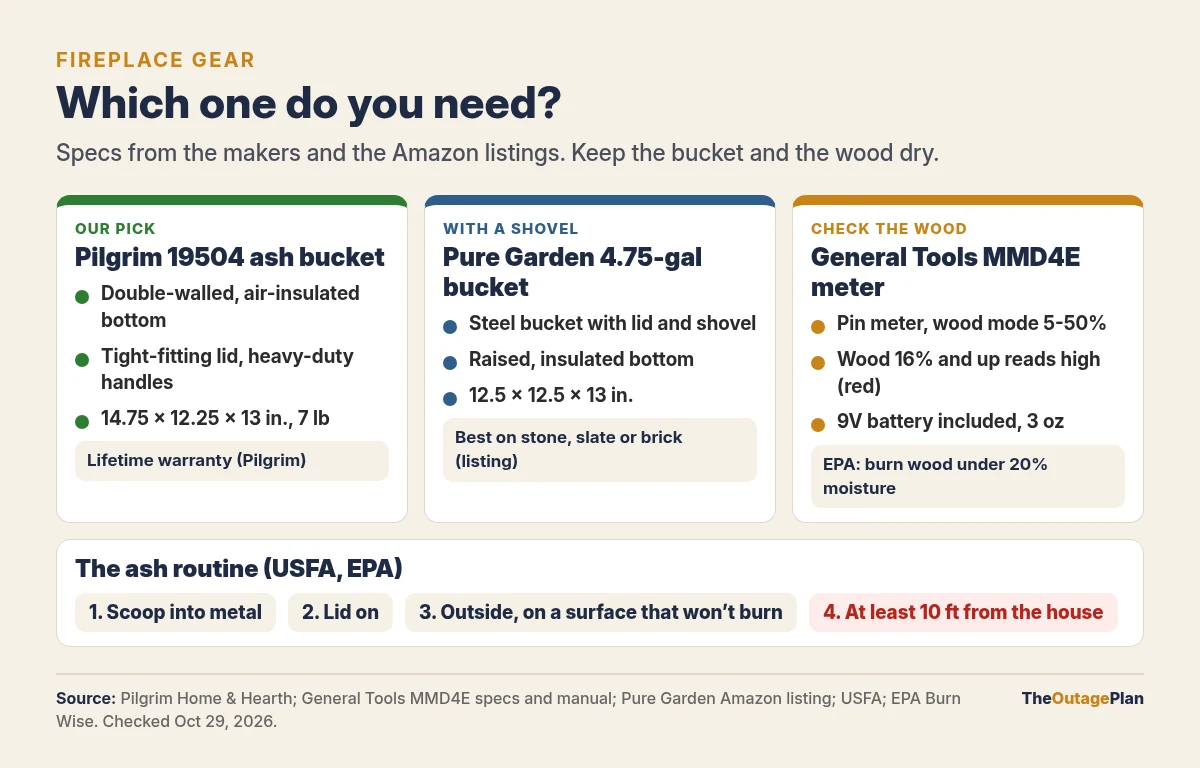
Check the seller and stock before you buy, since both can change. Whatever you pick, it’s only safe if the lid stays on and it sits outside on a surface that won’t burn.
Our pick: Pilgrim Home & Hearth 19504 Air Insulated Ash Bucket
Pilgrim lists a double-walled bottom plate to keep ashes and coals contained, a tight-fitting lid, heavy-duty handles and a lifetime warranty. It measures 14.75 x 12.25 x 13 in. and weighs 7 lb, per Pilgrim (Pilgrim). The Amazon listing adds heavy-gauge steel. Ships from and sold by Amazon.com on Oct 29, in stock (Amazon listing).
Full specs: Pilgrim 19504
- Material: Heavy-gauge steel (Amazon listing), black
- Bottom: Double-walled, air-insulated bottom plate
- Lid: Tight-fitting lid
- Handles: Heavy-duty handles
- Size: 14.75 x 12.25 x 13 in. (Pilgrim)
- Weight: 7 lb (Pilgrim)
- Warranty: Lifetime (Pilgrim)
With a shovel: Pure Garden 4.75-Gallon Ash Bucket
A steel bucket with a lid and a matching shovel, so you have the scoop and the can in one box. The listing describes a heat-resistant wooden grip handle and a raised bottom with thermal insulation, and says it works best on stone, slate and brick hearths. Capacity is 4.75 gallons (Amazon listing). Ships from and sold by Amazon.com on Oct 29, in stock.
Full specs: Pure Garden 50-210
- Material: Steel, black
- Capacity: 4.75 gallons
- Bucket: 12.5 x 12.5 x 13 in.
- Shovel: 14.25 x 4.5 in.
- Handle: Heat-resistant wooden grip
- Bottom: Raised, with thermal insulation
- Includes: Bucket, lid and shovel
Check the wood: General Tools MMD4E Moisture Meter
EPA says wood burns best under 20% moisture and suggests testing it with a meter (EPA). This pin meter reads 5-50% in wood mode, with indicator blocks for low (5-11.9%), medium (12-15.9%) and high (16% and up) moisture. The 9V battery is included, it weighs 3 oz, and the pin cap doubles as a calibration check, per General Tools (General Tools, manual). Ships from and sold by Amazon.com on Oct 29, in stock.
Full specs: General Tools MMD4E
- Type: Pin-type meter, 0.3 in. pins
- Range: Wood 5-50%; building materials 1.5-33%
- Accuracy: ±2%; 0.1% resolution
- Display: Backlit LCD with hold button
- Power: 9V battery (included); auto-off after 3 minutes
- Size: 6.0 x 2.6 x 0.8 in., 3 oz
- Extras: Calibration check in the cap, replacement pins
- Warranty: 1-year limited (General Tools)
More for heating safely: our space heater on a power station guide, indoor propane heater picks, CO alarm picks and fire extinguisher picks.
FAQ
Is it safe to use a fireplace when the power goes out?
Yes, if it’s up to code and vented to the outside, the CDC says. Keep anything that can burn 3 feet away, use a screen, have a battery-powered CO alarm, and put the fire out before you sleep.
How long do fireplace ashes stay hot?
Longer than they look. New Hampshire’s environmental agency says embers can stay alive for up to 72 hours. Keep ashes in a lidded metal can outside, at least 10 feet from the house, for several days.
Can you put fireplace ashes in a plastic bucket or trash can?
No. Use a metal container with a tight-fitting lid. Plastic buckets, cardboard boxes and paper bags can catch fire from hidden embers.
Specs checked Oct 29, 2026, from Pilgrim Home & Hearth, General Tools and the Amazon listings. Safety rules from USFA, CDC, EPA Burn Wise, NFPA and New Hampshire DES. We haven’t hands-on tested these products.