
Heads up: Some links on this page are affiliate links. If you buy through them, we may earn a commission at no extra cost to you. As an Amazon Associate, we earn from qualifying purchases. Full disclosure
Testing note: We haven’t hands-on tested these products. Specs come from Farberware, Secura and Bodum, checked Oct 29, 2026.
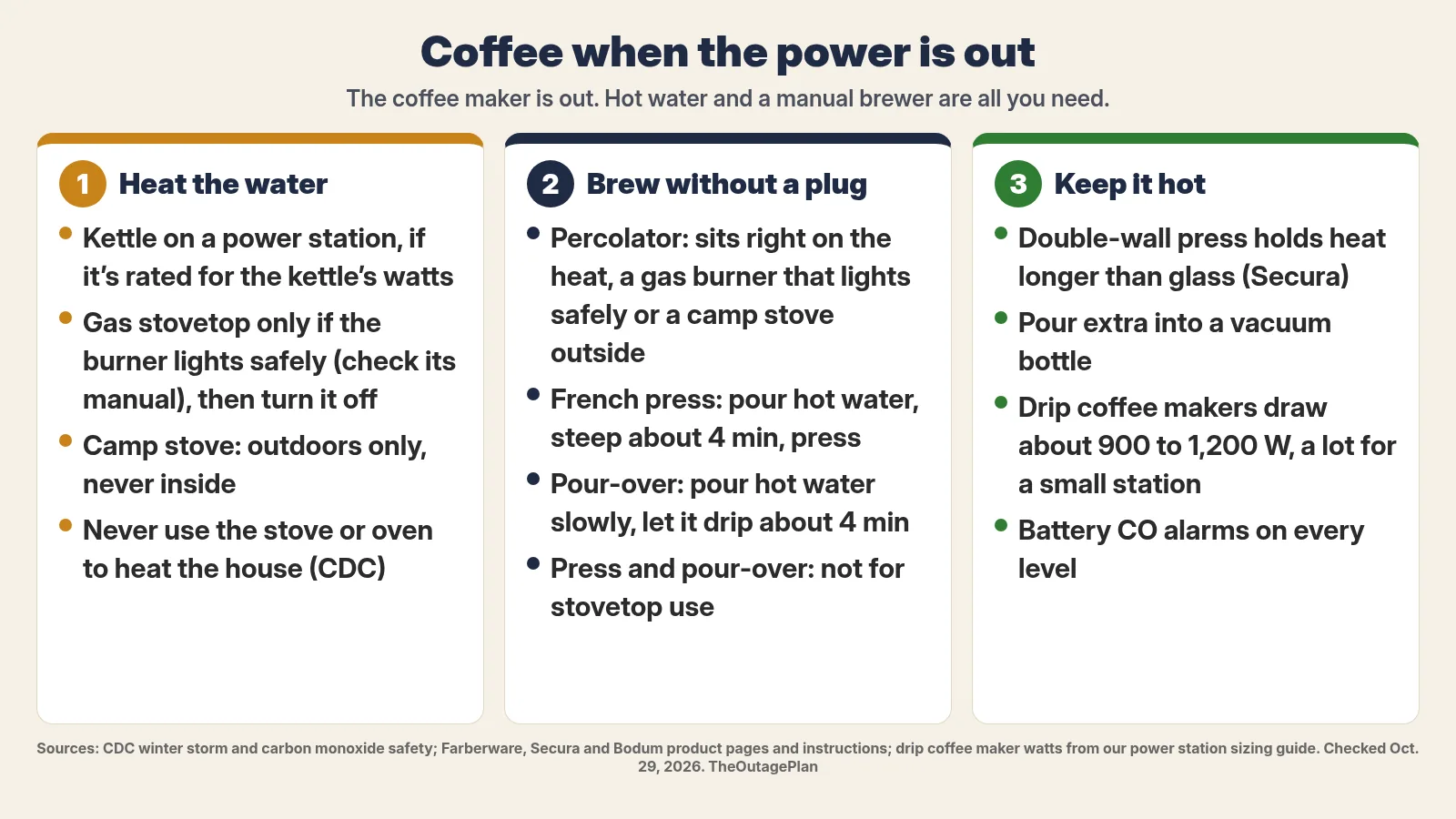
Bottom line: A drip coffee maker needs a plug, and it draws about 900 to 1,200 W (our sizing table). With the power out, all you need is hot water and a brewer that doesn’t plug in. Our pick is the Farberware Classic Yosemite percolator: stainless steel, a permanent filter basket, and it heats and brews in one pot on a gas burner or a camp stove outside.
Our pick
Farberware Classic Yosemite 8-cup percolator: brews 4 to 8 cups right on the burner, with a permanent stainless filter basket (no paper filters) and a glass knob that shows when it starts to perk, per Farberware. Not for induction. Ships from and sold by Amazon.com when we checked.
Step 1: Heat the water safely
- Gas stovetop, for the pot only. If your burner can be lit safely with a match (check the range’s manual), heat the water or the percolator, then turn it off. The CDC says never use a gas stove or oven to heat your home (CDC).
- Camp stove, outdoors only. The CDC says never use a portable gas camp stove indoors, and never use grills or camp stoves inside your home, basement or garage (CDC, CDC). See our camp stove picks and where to set one up.
- Kettle on a power station. It works if the station is rated for more watts than the kettle. Our hot water bottle guide has the math for one kettle fill.
- CO alarms inside. The CPSC says to put battery-operated or battery-backup CO alarms on every level and outside sleeping areas (CPSC). See our CO alarm picks.
Is your tap water safe?
If you know or suspect your water is unsafe after a storm or a water main break, the CDC says to use bottled, boiled or treated water for drinking and cooking. To boil it, bring clear water to a rolling boil for 1 minute (3 minutes above 6,500 feet), then let it cool (CDC). Follow your local health department’s advice.
Coffee counts as drinking water, so brew with water you know is safe. See our water storage guide.
How to brew with each type
- Percolator: add water to the pot and ground coffee to the basket, set it on the heat and watch the glass knob; Farberware says it shows when percolating begins (Farberware).
- French press: Secura says 1 rounded tablespoon of coarse coffee per 4 oz cup, hot (not boiling) water, leave about 1 in. of space at the top, steep at least 4 minutes, then press (Secura manual, linked on its product page).
- Pour-over: Bodum says 1 rounded tablespoon of filter-ground coffee per 4 oz cup and hot, not boiling, water; it takes about 4 minutes to drip (Bodum, Bodum manual).
The French press and the pour-over are not for stovetop use, per Secura and Bodum. Heat the water in a kettle or pot first.
Keep coffee and water hot for later
- Secura says its double-wall press keeps coffee hot much longer than a glass press (Secura manual, linked on its product page).
- Pour extra hot water or coffee into a vacuum bottle so you don’t have to light the stove again. See our thermos and food jar picks.
- No grinder that works without power? Stock pre-ground coffee in your emergency food kit.
Our manual coffee maker picks
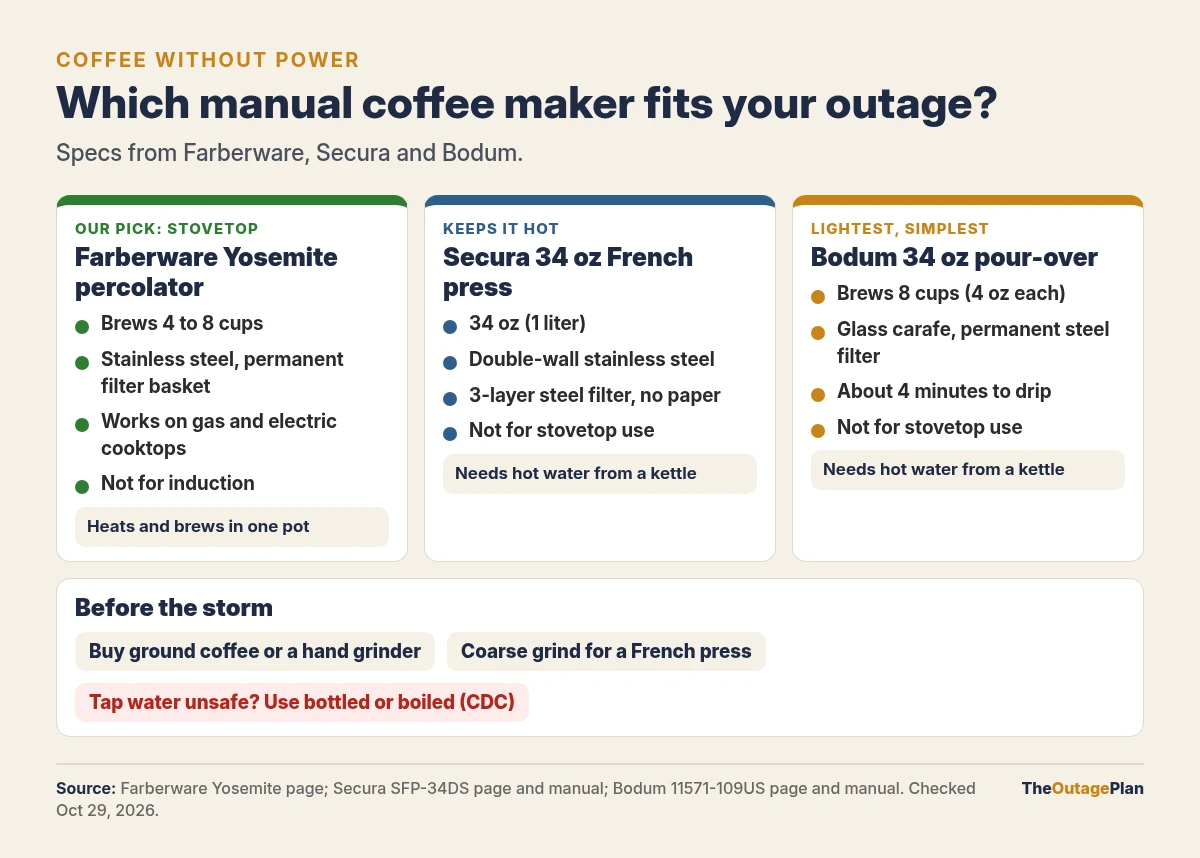
Check the seller and stock before you buy, since both can change. None of the three needs a plug or paper filters.
Our pick: Farberware Classic Yosemite 8-cup percolator
A stovetop percolator in heavy-duty stainless steel that brews 4 to 8 cups. It has a permanent filter basket, so there are no paper filters to run out of, a glass knob that shows when percolating begins, and a stay-cool handle. Farberware says it works on any stovetop, but it’s not induction-suitable, and it’s dishwasher safe except the knob and pump tube spring (Farberware). Ships from and sold by Amazon.com on Oct 29, in stock (Amazon listing).
Full specs: Farberware Yosemite 50124
- Capacity: 4 to 8 cups
- Material: Stainless steel
- Filter: Permanent filter basket
- Cooktops: Gas and electric; not induction
- Size: 9.25 x 6.25 x 8.25 in. (Amazon listing)
- Weight: 2.3 lb (Amazon listing)
- Cleaning: Dishwasher safe except knob and pump tube spring
- Warranty: Limited lifetime (Farberware)
Keeps it hot: Secura 34 oz stainless French press
An 18/10 stainless steel, double-wall French press that holds 34 oz (1 liter). Secura says the double wall holds heat, and it uses a 3-layer stainless steel filter with a bonus screen, plus a cool-touch handle and knob. It’s dishwasher safe (Secura). The manual says it’s not for stovetop use, so heat the water first (Secura manual, linked on its product page). Ships from and sold by Amazon.com on Oct 29, in stock.
Full specs: Secura SFP-34DS
- Capacity: 34 oz (1,000 ml)
- Material: 18/10 stainless steel, double wall
- Filter: 3-layer stainless steel, plus a bonus screen
- Heat source: Not for stovetop use; add hot water
- Size: 6.1 x 6.7 x 9.8 in. (Amazon listing)
- Weight: 2.4 lb (Amazon listing)
- Cleaning: Dishwasher safe
Lightest, simplest: Bodum 34 oz pour-over
A borosilicate glass carafe with a permanent stainless steel mesh filter. It makes 34 oz (8 cups of 4 oz) and drips in about 4 minutes, per Bodum (Bodum). The manual says it’s not for stovetop use, the glass isn’t shatterproof, and to keep kids away from hot coffee (Bodum manual). Ships from and sold by Amazon.com on Oct 29, in stock.
Full specs: Bodum 11571-109US
- Capacity: 34 oz (8 cups of 4 oz)
- Material: Borosilicate glass carafe
- Filter: Permanent stainless steel mesh
- Brew time: About 4 minutes
- Heat source: Not for stovetop use; add hot water
- Weight: 1.2 lb (Amazon listing)
- Cleaning: Carafe and filter dishwasher safe
More for cooking and eating with no power: our camp stove picks, thermos and food jar picks, emergency food kits and winter storm checklist.
FAQ
How do you make coffee when the power is out?
Heat water safely, on a gas burner that lights with a match (then turn it off), a camp stove outdoors, or a kettle on a power station. Then brew with a percolator, French press or pour-over. A percolator can go right on the burner.
Can you use a French press or pour-over on the stove?
No. Secura and Bodum both say their brewers are not for stovetop use. Heat the water in a kettle or pot, then pour it in hot but not boiling.
Can you run a coffee maker on a power station?
Only if the station is rated for its watts. Drip coffee makers draw about 900 to 1,200 W, a lot for a small station. A manual brewer with stove-heated water uses no battery at all.
Specs checked Oct 29, 2026, from Farberware, Secura and Bodum. Safety rules from the CDC and CPSC. We haven’t hands-on tested these products.