
Heads up: Some links on this page are affiliate links. If you buy through them, we may earn a commission at no extra cost to you. As an Amazon Associate, we earn from qualifying purchases. Full disclosure
Testing note: We haven’t hands-on tested these freeze alarms. Specs come from the makers’ manuals, websites and Amazon listings, checked Oct 26, 2026.
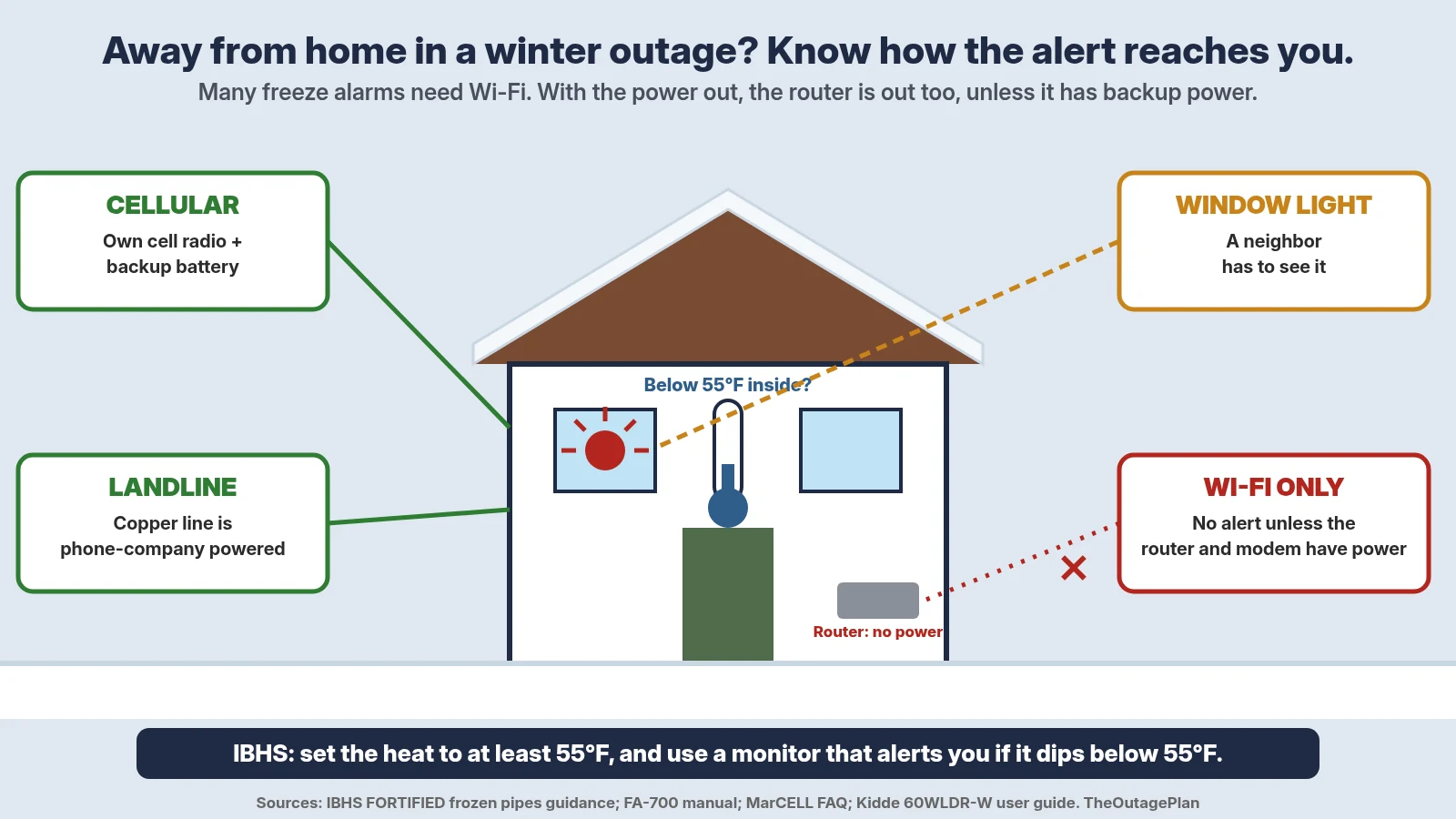
Bottom line: If you’re away when a winter storm knocks out power, a freeze alarm is only useful if its warning can reach someone. Most smart sensors send alerts over Wi-Fi, and with the power out your router and modem go down too, unless they have backup power. For a house that may sit empty, pick an alert with its own path out: a cellular monitor with a backup battery, or a landline dialer on a standard copper phone line. Add a local siren or flashing light as a second layer.
Our pick
MarCELL cellular monitor: it uses its own cellular connection, not your Wi-Fi or phone line, and a backup battery keeps it running about 24 to 48 hours after the power goes out, per MarCELL. It sends a text, call or email when the temperature crosses your limit or the power drops. It needs a MarCELL service plan.
Why an empty house needs an alert
- Heat loss freezes pipes. Without power, most furnaces stop, and a house cools for hours or days. Pipes in basements, crawl spaces, attics, garages and outside walls freeze first (Red Cross).
- Catch it early. IBHS says to keep the thermostat at 55°F or higher and install a monitor that alerts you if the inside temperature dips below 55°F (IBHS FORTIFIED). That leaves time to act before pipes freeze.
- The alert needs a way out. This is where most buyers get caught. Our frozen pipes guide covers the rest of the plan.
How each alert reaches you with the power out
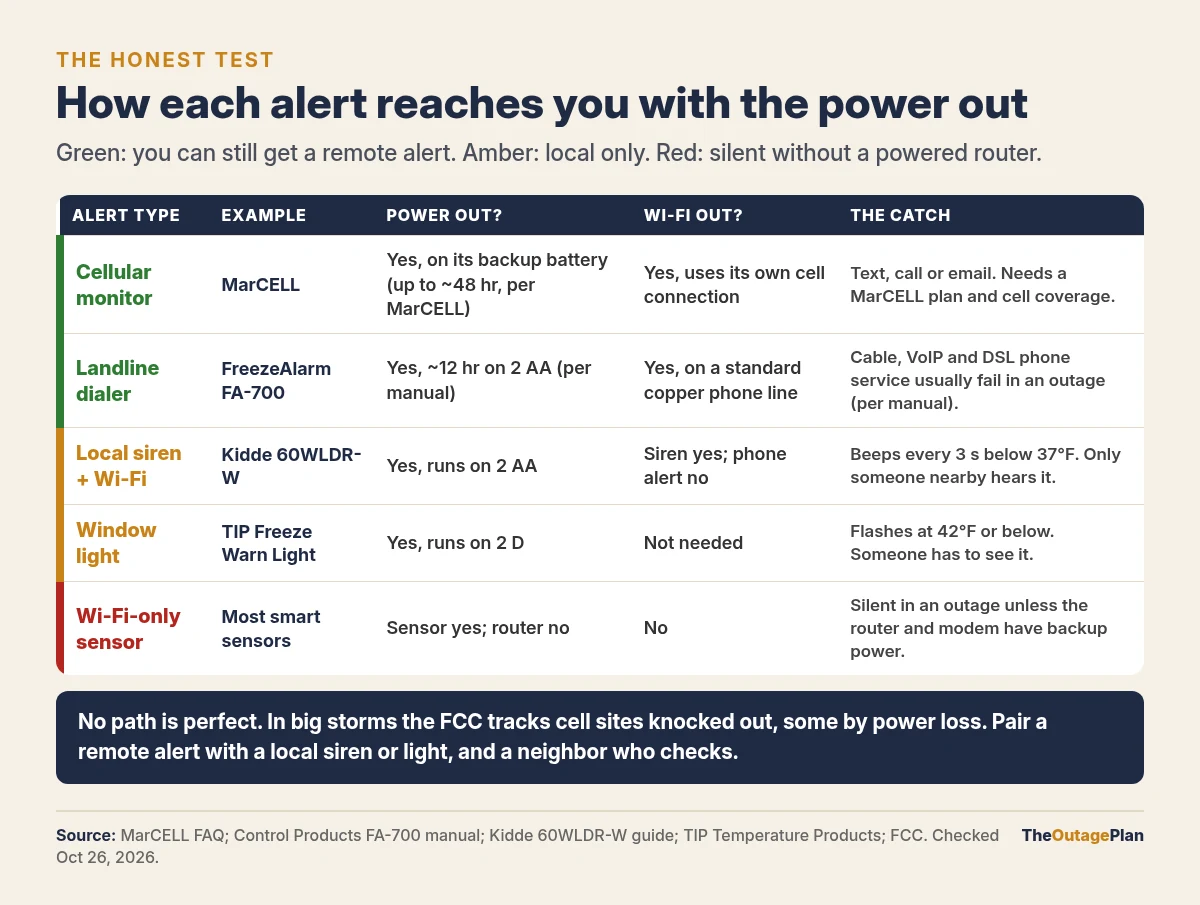
- Cellular: works. MarCELL runs on its own cell connection, with no Wi-Fi or phone line needed. Its battery lasts about 24 to 48 hours in an outage, and it reports a power loss after about 8 to 10 seconds (MarCELL FAQ).
- Landline: works, on a copper line. The FA-700 manual says a standard phone line gets its power from the phone company and is usually not affected when the power goes out. It also says many DSL, digital and cable phone services don’t work in a power failure, so the alarm can’t call out (FA-700 manual). The FCC says the same about internet phone service unless you have backup power (FCC).
- Local siren: works, but only nearby. The Kidde 60WLDR-W beeps every 3 seconds below 37°F even without Wi-Fi. Its phone alerts need Wi-Fi, and Kidde says they’re only as reliable as your home network (Kidde guide).
- Window light: works, if someone sees it. A flashing light needs a neighbor who knows what it means.
- Wi-Fi only: usually silent. It can still work if your router and modem are on backup power. See our Wi-Fi in an outage guide.
No path is perfect. During Winter Storm Fern in January 2026, FCC reports listed cell sites out of service, some due to power loss (FCC). Pair a remote alert with a local one, and a neighbor who checks.
Freeze alarm checklist

- Placement. Put the sensor where pipes are most likely to freeze: a cabinet on an outside wall, a basement or a crawl space (Red Cross).
- Set it early. An alert well above freezing gives you time. IBHS suggests 55°F (IBHS).
- Test before you leave. The FA-700 manual says to run a test call and have someone confirm it (FA-700 manual). TIP says to put its sensor in the freezer for a few minutes and watch the light flash (TIP).
- Batteries. Put in fresh ones each winter. The FA-700 can’t take a new phone number while it’s on battery alone (FA-700 manual).
- When it alarms, get someone to the house. Open cabinet doors under sinks, and if pipes freeze, thaw them with a hair dryer or heating pad, never an open flame (Red Cross). If the heat can’t come back, shutting off the main water valve limits the damage.
- Stay safe. Never run a generator, grill or camp stove indoors to heat the house (Ready.gov). Our CO alarm picks cover the rest.
Our freeze alarm picks

We ranked these by one question: will the warning reach someone with the power and Wi-Fi out? No freeze alarm we picked was sold by Amazon.com itself on Oct 26, 2026, so these come from other sellers (noted below). Check the seller and stock before you buy, since both can change.
Our pick: MarCELL Cellular Temperature, Humidity and Power Monitor
MarCELL works on its own 4G LTE-M cell connection, with no Wi-Fi or phone line needed (MarCELL). It checks the temperature, humidity and power every 10 seconds. It sends a text, phone call or email when a reading crosses your limits or the power goes out. The built-in battery runs it about 24 to 48 hours after an outage (MarCELL FAQ). This listing is the Verizon version (Amazon listing). It needs a MarCELL service plan and a usable cell signal where it sits. Ships from Amazon and sold by Meet MarCELL on Oct 26.
Full maker specs: MarCELL
- Connection: 4G LTE-M cellular (this listing: Verizon)
- Alerts: Text, phone call, email
- Checks: Temperature, humidity, power every 10 seconds
- Backup: Built-in battery, about 24 to 48 hours (MarCELL FAQ)
- Power-loss alert: After about 8 to 10 seconds without power
- Needs: MarCELL service plan
Have a copper landline: FreezeAlarm FA-700
The FA-700 calls one phone number with a recorded message when the temperature drops below 45°F, and it keeps calling until someone cancels. It can also alarm above 85°F, set by a switch (FA-700 manual). It plugs into the wall, and two AA backup batteries (not included) give about 12 hours of power in an outage, per the manual. It only works in an outage on a standard copper phone line, not cable, DSL or VoIP service (Amazon listing). Ships from Amazon and sold by Gabriel Galore on Oct 26, with only 1 left, so check stock.
Full maker specs: FreezeAlarm FA-700
- Alerts: Calls 1 programmed number, repeats until canceled
- Trigger: Below 45°F, or above 85°F (switch)
- Power: Plug-in adapter, 2 AA backup (not included)
- Backup time: About 12 hours on good alkalines (manual)
- Works in an outage on: Standard copper phone line only
Local siren plus app: Kidde 60WLDR-W
Below 37°F, this Kidde beeps every 3 seconds and blinks red, with or without Wi-Fi. It also senses water leaks, and its alarm is rated 85+ dB at 3 ft (Kidde guide). It runs on 2 AA batteries (included). On 2.4 GHz Wi-Fi it also sends app alerts, but those stop when the router loses power. Treat it as a local alarm in an outage (Amazon listing). Ships from Amazon and sold by Raw Innovation LLC on Oct 26.
Full maker specs: Kidde 60WLDR-W
- Freeze alarm: Below 37°F, beep and red LED every 3 seconds
- Also detects: Water leaks
- Sound: 85+ dB at 3 ft
- Power: 2 AA batteries (included)
- App alerts: Need 2.4 GHz Wi-Fi and a powered router
Simplest: TIP Freeze Warn Light
No app, no plan. The light flashes at 42°F or below and stops at 52°F. It runs on 2 D batteries (included) for about 500 hours of flashing (TIP). A 20 ft sensor cable lets you put the sensor near pipes and the light in a window a neighbor can see. It’s for indoor use, and TIP says to replace the batteries every year (Amazon listing). Sold by TIP TEMPerature Products on Oct 26, with limited stock.
Full maker specs: TIP Freeze Warn Light
- Alert: Flashing light at or below 42°F, stops at 52°F
- Power: 2 D batteries (included), about 500 hours of flashing
- Sensor: Thermo-switch on a 20 ft cable
- Mount: Magnetic base, indoor use
- Batteries: Replace every year (TIP)
More for a winter storm: our frozen pipes guide, winter storm checklist, Wi-Fi in an outage guide and roof rake picks.
FAQ
Do Wi-Fi freeze alarms work in a power outage?
Usually not for remote alerts. The sensor may run on batteries, but your router and modem need power to send the alert. Kidde says its app alerts are only as reliable as your home Wi-Fi. Put the router and modem on a backup battery, or choose a cellular or landline alarm.
What temperature should a freeze alarm be set to?
IBHS recommends a monitor that alerts you if the inside temperature drops below 55°F, the same as its minimum thermostat setting. A higher alert gives you time to get help before pipes freeze.
Will a landline freeze alarm work when the power is out?
On a standard copper phone line, usually yes, because the phone company powers the line. The FA-700 manual says many DSL, digital and cable phone services don’t work in a power failure, so the alarm can’t call out.
Do cellular freeze alarms need a subscription?
MarCELL does. It needs a MarCELL service plan to send texts, calls and emails over its cell connection. In return, it doesn’t depend on your Wi-Fi, internet or phone line.
Specs checked Oct 26, 2026, from the MarCELL website and FAQ, the FreezeAlarm FA-700 manual, the Kidde 60WLDR-W user guide, TIP Temperature Products and the Amazon listings. Guidance from IBHS FORTIFIED, the American Red Cross, the FCC and Ready.gov. We haven’t hands-on tested these freeze alarms.