
Heads up: Some links on this page are affiliate links. If you buy through them, we may earn a commission at no extra cost to you. As an Amazon Associate, we earn from qualifying purchases. Full disclosure
Testing note: We haven’t hands-on tested these power stations. Specs come from EcoFlow’s, Goal Zero’s and Jackery’s spec pages and the Amazon listings, checked Oct 21, 2026. Runtimes are our estimates.
Bottom line: A station under 1,000 Wh keeps Wi-Fi, lights, phones and a laptop going through a night or more, and runs a CPAP for about a night by our math. It’s light enough to carry from room to room. It won’t run a fridge and freezer all day; for that, plan on about 1 kWh or more.
Our pick
EcoFlow RIVER 2 Pro: 768 Wh at about 18.2 lb, the most battery in our three picks. EcoFlow says it recharges from the wall, 0 to 100%, in about 70 minutes, so it’s full again soon after the power comes back.
Is under 1,000 Wh enough?
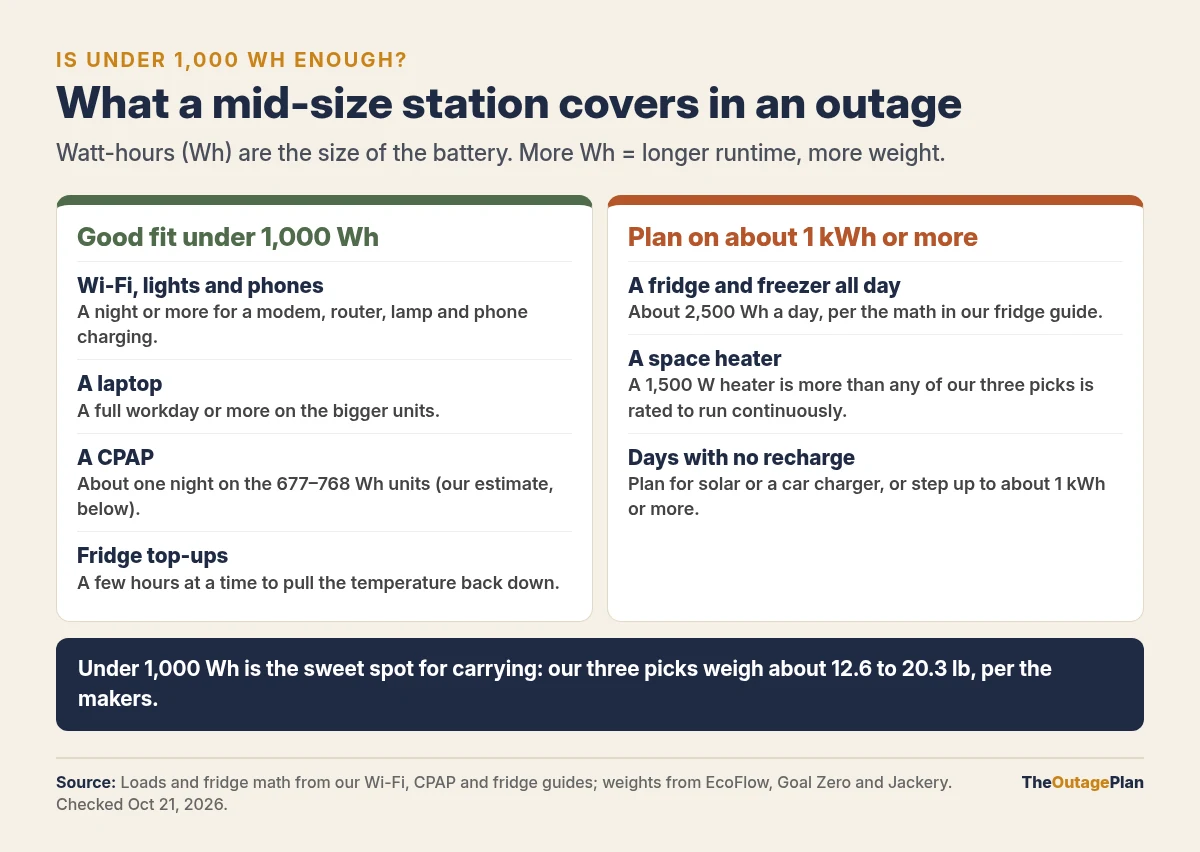
Watt-hours (Wh) are the size of the battery; watts (W) are how much it can deliver at once. Under 1,000 Wh is the sweet spot for essentials you can carry. If you need a fridge and a freezer all day, see our fridge and freezer picks or whole-home picks. Not sure what you need? Our sizing guide walks through it.
How long they run
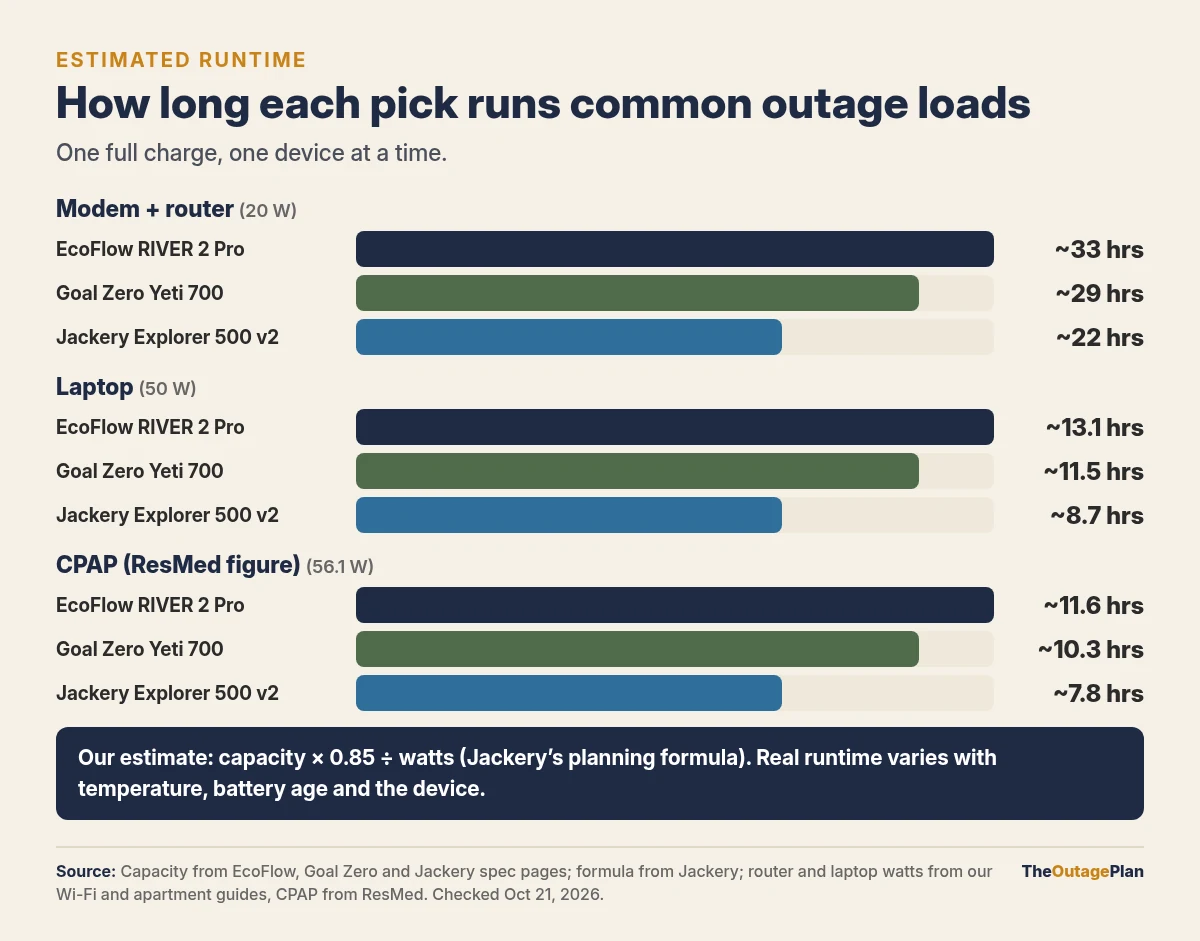
By our math, the RIVER 2 Pro runs a modem and router for about 33 hours, and a CPAP for about 11.6 hours, or roughly one night. Run several things at once and the hours drop. For longer outages, add a way to recharge: see recharging a power station with solar.
Our picks

Our pick: EcoFlow RIVER 2 Pro
The most battery in this group: 768 Wh with 800 W of AC output, and X-Boost mode lets it run some higher-wattage appliances up to 1,600 W, per EcoFlow. It weighs about 18.2 lb and recharges from the wall 0 to 100% in about 70 minutes. It can switch to battery in under 30 ms when the power cuts out (EcoFlow calls this EPS), and EcoFlow rates the LFP battery for 3,000 cycles to 80%+ capacity (EcoFlow).
The catch: solar input tops out at 220 W, so solar refills are slower than on newer models. EcoFlow notes it can get as loud as 62 dB when charging or discharging at high wattage.
Full maker specs: EcoFlow RIVER 2 Pro
- Capacity: 768 Wh, LFP; 80%+ capacity after 3,000 cycles
- AC output: Pure sine wave, 800 W total (surge 1,600 W); 4 AC outlets per the Amazon listing
- Recharge: AC up to 940 W, 0–100% in about 70 min; solar 220 W max; car; USB-C 100 W
- Other outputs: USB-C 100 W; USB-A 12 W; 12 V car outlet
- Size and weight: About 18.2 lb; 270 × 260 × 226 mm (about 10.6 × 10.2 × 8.9 in)
- Temperatures: Charge 32–113°F; discharge 14–113°F
- Switchover: EPS under 30 ms
Rugged pick: Goal Zero Yeti 700
Built for the garage, the porch or a stormy tailgate: Goal Zero rates it IPX4 for water resistance and lists a discharge range of -4 to 140°F. It has 677 Wh, 600 W continuous AC (1,000 W surge), a 100 W USB-C port and two 30 W USB-C ports, and weighs 20.3 lb. Fast AC charging takes about 1.7 hours, and Goal Zero backs it with a 5-year warranty (Goal Zero).
The catch: 600 W is the lowest AC output of our three, so skip it for a microwave or a coffee maker. Goal Zero lists solar input at 200 W max.
Full maker specs: Goal Zero Yeti 700
- Capacity: 677 Wh, LiFePO4; 4,000 cycles to 80%
- AC output: Pure sine wave, 600 W continuous, 1,000 W surge
- Recharge: AC fast charge 500 W (about 1.7 hrs) or low speed 340 W (about 3 hrs); solar 200 W max (about 3.8 hrs); car charger about 6 hrs
- Other outputs: USB-C PD 100 W; 2 × USB-C 30 W; 2 × USB-A 18 W; 12 V ports
- Size and weight: 20.3 lb; 11.32 × 7.84 × 8.55 in
- Temperatures: Charge 32–125.6°F; discharge -4–140°F
- Shelf life: 12–18 months, per Goal Zero
- Warranty: 5 years
Lightest: Jackery Explorer 500 v2
The easiest to carry: 512 Wh at about 12.6 lb (5.7 kg), with 500 W of AC output and 1,000 W peak. It recharges from the wall in about 1.3 hours, takes up to 200 W of solar, and Jackery rates the battery for 6,000 cycles to at least 70% capacity (Jackery). Good for Wi-Fi, lights, phones and a laptop in a small home.
The catch: only two AC outlets, and Jackery says its switchover takes about 20 ms, so it isn’t a true zero-interruption UPS. For a CPAP, check our CPAP backup guide first.
Full maker specs: Jackery Explorer 500 v2
- Capacity: 512 Wh, LiFePO4; 6,000 cycles to 70% or more
- AC output: Pure sine wave, 500 W total over 2 outlets; 1,000 W peak
- Recharge: AC about 1.3 hrs; solar 200 W max; car about 6 hrs
- Other outputs: USB-C 100 W and 30 W; USB-A 18 W; 12 V car port
- Size and weight: About 12.6 lb (5.7 kg); 31.1 × 20.5 × 15.7 cm (about 12.2 × 8.1 × 6.2 in)
- Switchover: About 20 ms, per Jackery
- Fan noise: 30 dB or less, per Jackery
- Warranty: 3 years, extendable by 2
Want something smaller or bigger? Our apartment picks include a 286 Wh budget station and three ~1 kWh units. To pair a station with panels, see our solar generator kit picks. Shopping a sale? Use our power station buying checklist.
Before the next outage
- Charge it to full when a storm is in the forecast, and top it off every few months in storage.
- Know your watts: add up what you’ll plug in with our sizing guide.
- Plan a recharge: a solar panel or your car’s 12 V outlet.
- Keep it indoors and dry. Unlike a gas generator, a power station makes no exhaust; see power station vs. generator.
- Heat is a different job. For winter, see our space heater and power station guide.
FAQ
What size power station do you need for a power outage?
Add up the watts of what you’ll run and the hours you need. Under 1,000 Wh covers Wi-Fi, lights, phones, a laptop, and a CPAP for about a night. A fridge and freezer all day takes about 2,500 Wh a day, so plan on about 1 kWh or more with a way to recharge.
Can a power station under 1,000 Wh run a refrigerator?
Yes, for a while, but not all day. A fridge and freezer together take about 2,500 Wh a day in our fridge guide’s example. A station this size works best for a few hours at a time to pull the temperature back down.
How long will a 768 Wh power station last?
By our estimate (768 × 0.85 ÷ watts), about 33 hours on a 20 W modem and router, about 13 hours on a 50 W laptop, and about 11.6 hours on a 56.1 W CPAP. Running several things at once shortens that.
Which power station under 1,000 Wh is the lightest?
Of our three picks, the Jackery Explorer 500 v2, at about 12.6 lb (5.7 kg) per Jackery. The EcoFlow RIVER 2 Pro is about 18.2 lb and the Goal Zero Yeti 700 is 20.3 lb.
Specs checked Oct 21, 2026, from EcoFlow’s, Goal Zero’s and Jackery’s spec pages and the Amazon listings. Runtimes are our estimates using Jackery’s planning formula. We haven’t hands-on tested these power stations.