
Heads up: Some links on this page are affiliate links. If you buy through them, we may earn a commission at no extra cost to you. As an Amazon Associate, we earn from qualifying purchases. Full disclosure
Testing note: We haven’t hands-on tested these batteries or this charger. Specs come from Panasonic and the Amazon listings, checked Oct 24, 2026.
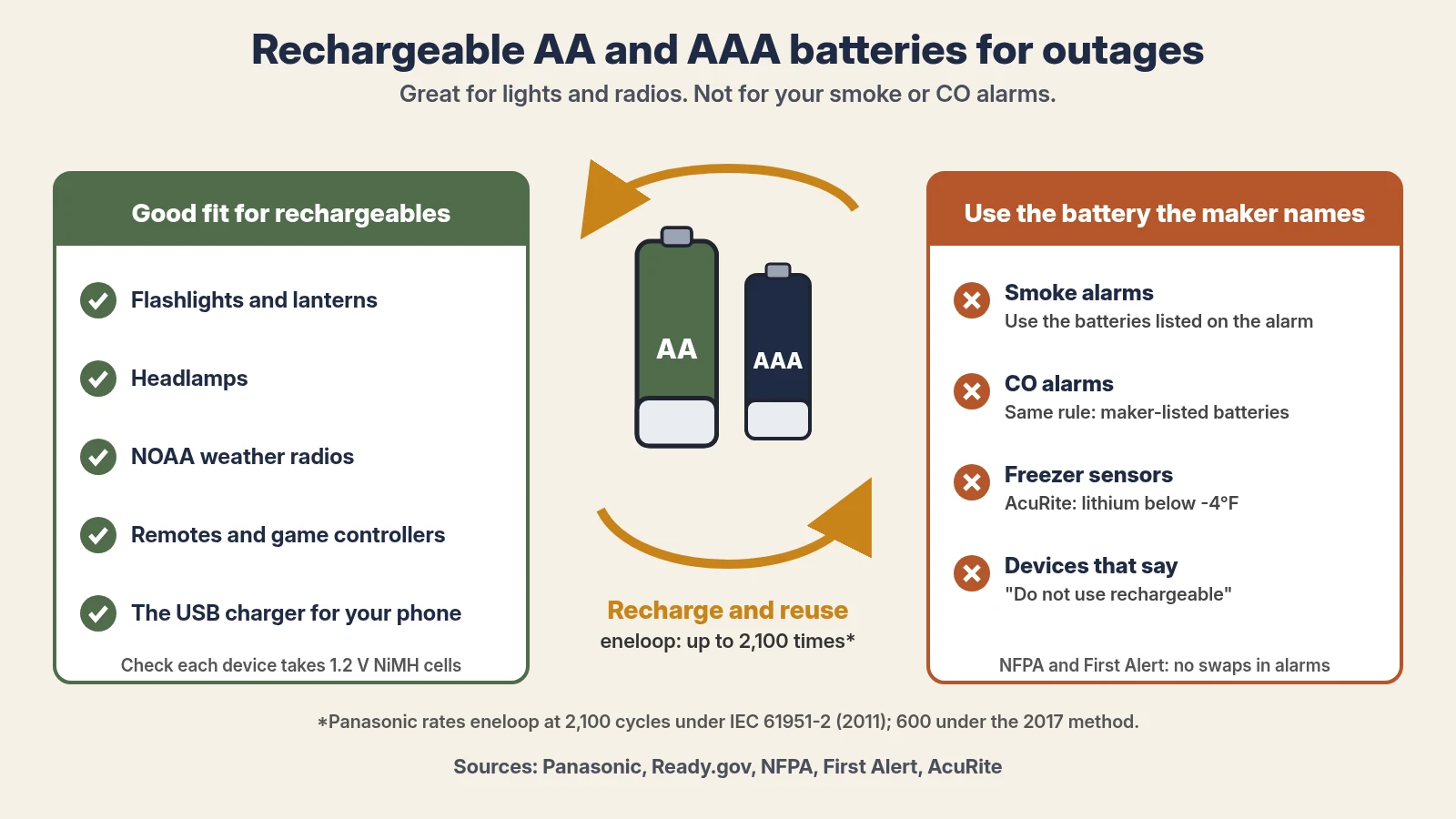
Bottom line: Ready.gov puts extra batteries on its basic kit list and says to have flashlights for every household member (Ready.gov, Ready.gov). Low self-discharge rechargeables like Panasonic eneloop cover the flashlights, radios and headlamps, and a USB charger lets you refill them from a power bank when the grid is down. Keep smoke and CO alarms on the batteries their makers list.
Our pick
Panasonic eneloop AA, 8-pack: Panasonic rates them for up to 2,100 recharges and up to 70% of their charge after 10 years in storage, so a kit drawer doesn’t drain them.
To refill them with no wall power: the Panasonic BQ-CC87, a USB charger.
Where rechargeables fit, and where they don’t
Good fits: flashlights, lanterns, headlamps, weather radios, remotes and kids’ toys. NiMH rechargeables run at 1.2 V instead of the 1.5 V of alkalines, so Amazon Basics says to check that each device works with 1.2 V cells (Amazon Basics listing).
Not for alarms. NFPA says to use the batteries the smoke alarm’s maker lists, because the alarm may not work properly with a different kind (NFPA). First Alert doesn’t recommend rechargeables in its alarms: their lower voltage can trigger low-battery chirps and shorten backup time (First Alert). See our CO alarm guide.
Not for freezer sensors in deep cold. AcuRite calls for alkalines, or lithium AAs below -4°F, and no rechargeables; see our fridge thermometer guide.
Why “low self-discharge” matters for an outage kit
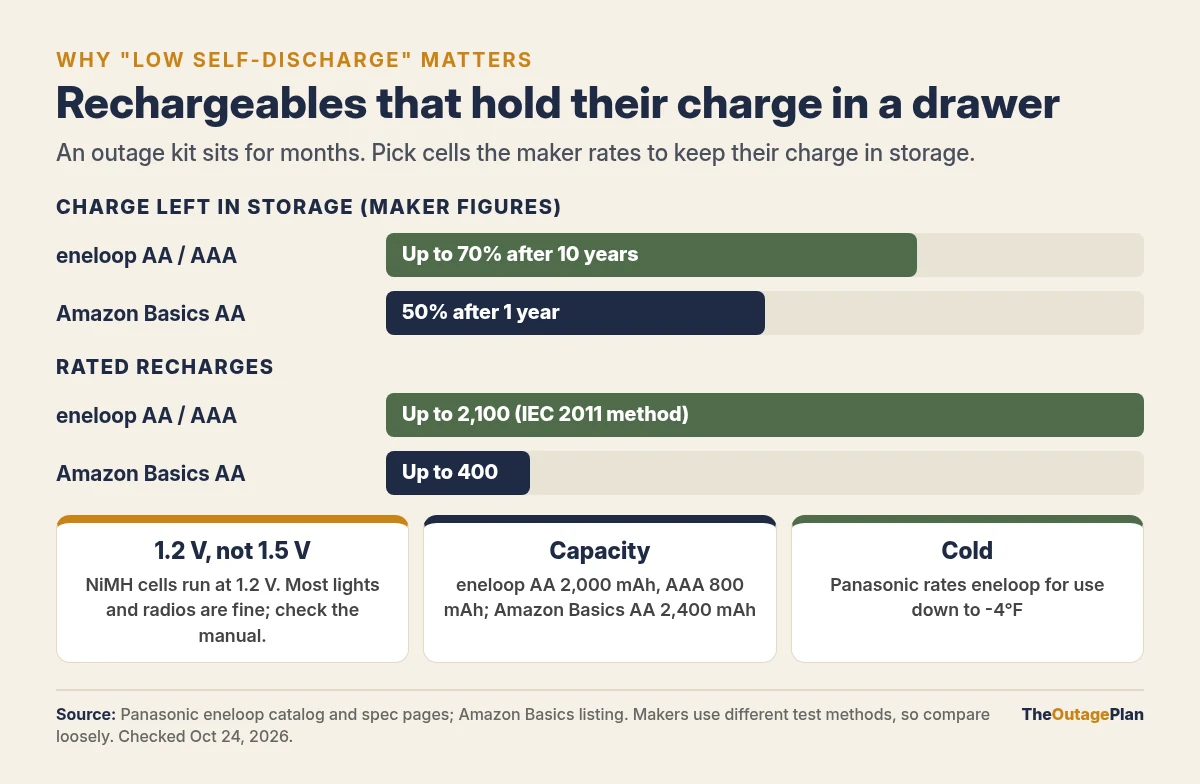
Outage batteries sit for months, so how much charge they keep in storage matters as much as capacity.
- eneloop: up to 70% after 10 years in storage, up to 2,100 recharges, rated down to -4°F, and they arrive pre-charged (Panasonic). Panasonic notes the 2,100 figure uses an older IEC test; under the 2017 method it’s 600 (Panasonic).
- Amazon Basics AA: higher capacity (2,400 mAh), but rated to keep 50% after 1 year and for up to 400 recharges (Amazon Basics listing).
Makers test differently, so compare loosely. For a drawer kit, storage rating is what we weigh first.
How to recharge AA batteries during an outage
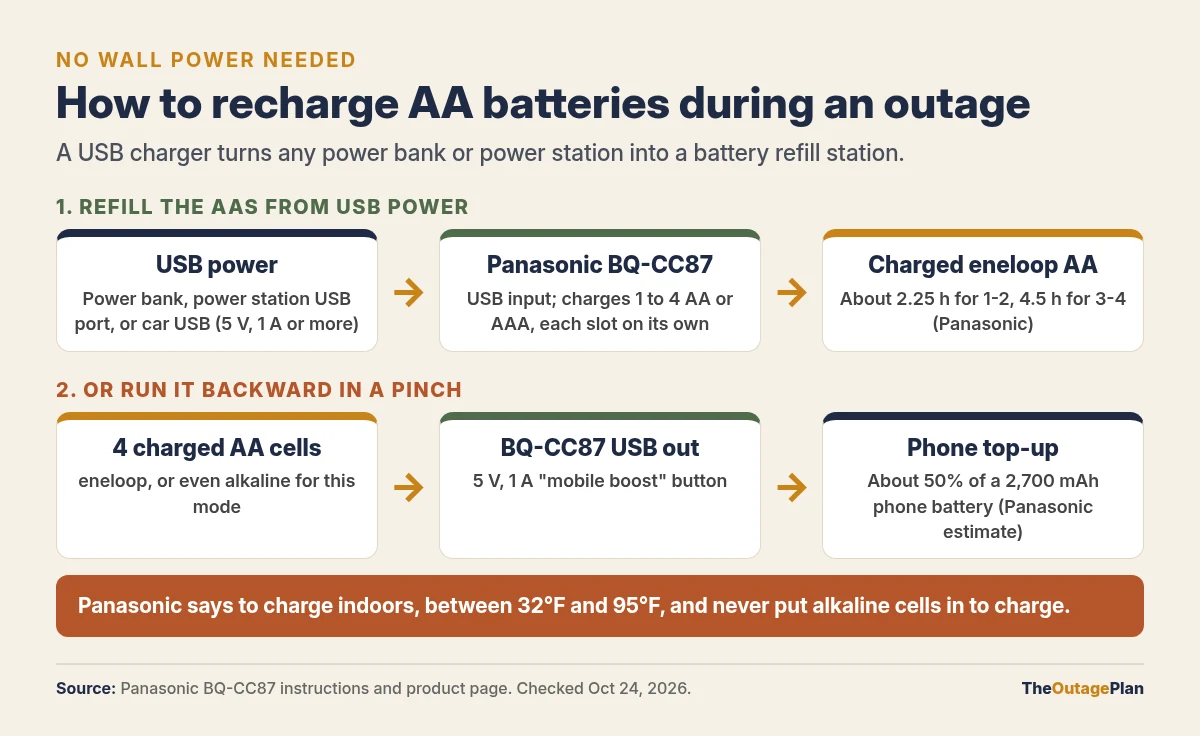
Most chargers plug into a wall outlet. The BQ-CC87 takes USB power (5 V, 1 A or more) instead, so a power bank, a power station’s USB port or a car USB port can refill your AAs (Panasonic).
- Charge time: about 2.25 hours for 1 or 2 eneloop AA, 4.5 hours for 3 or 4 (Panasonic).
- Run it backward: with 4 charged AAs in, a button turns it into a 5 V, 1 A USB source. Panasonic estimates 4 eneloop AA give a 2,700 mAh phone battery about a 50% charge (Panasonic).
- Charge indoors, 32°F to 95°F, and never try to charge alkalines (Panasonic).
Keep cells together as a set: Amazon Basics’ battery tips say not to mix batteries in one device (Amazon Basics listing).
Our rechargeable battery picks
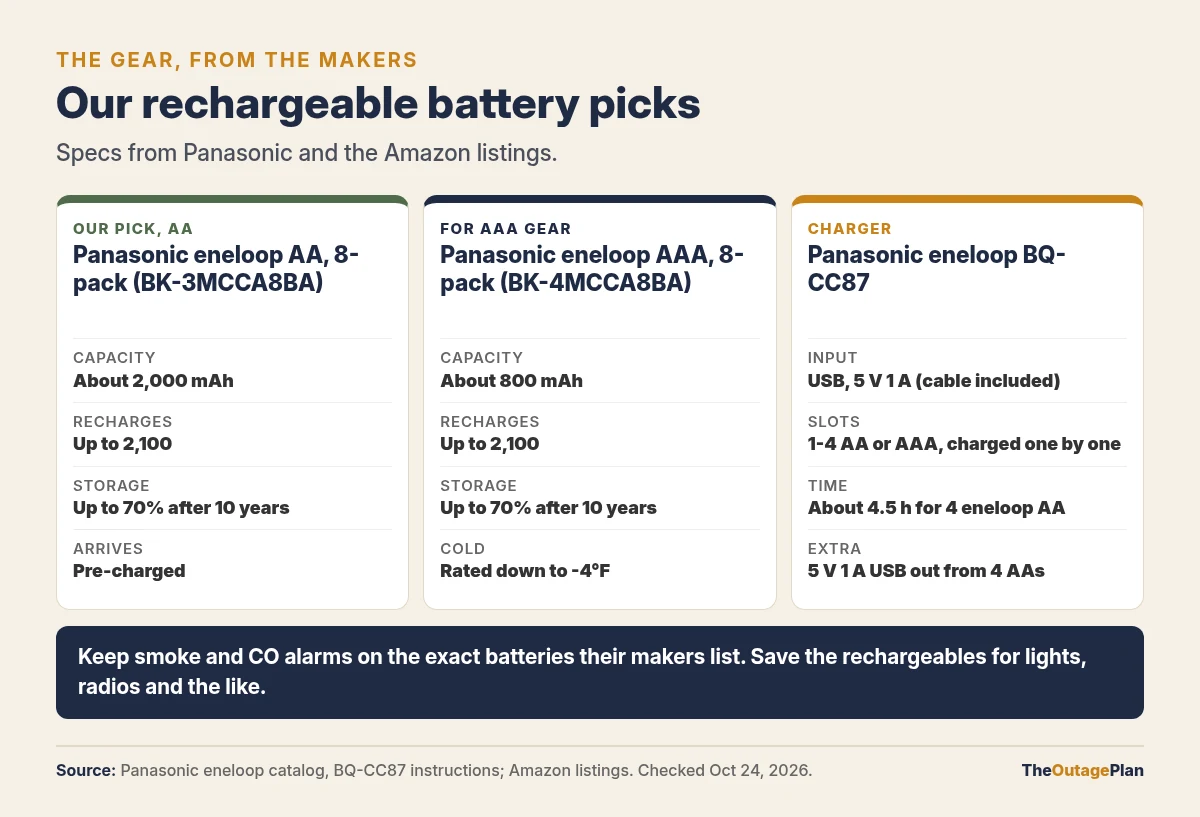
For most lights and radios: Panasonic eneloop AA, 8-pack
About 2,000 mAh per cell, up to 2,100 recharges, up to 70% charge after 10 years in storage, and usable down to -4°F (Panasonic). Eight cells cover a couple of flashlights and a radio with spares.
Full maker specs: eneloop AA (BK-3MCCA8BA)
- Chemistry: NiMH, 1.2 V
- Capacity: About 2,000 mAh
- Recharges: Up to 2,100 (IEC 61951-2 2011 method)
- Storage: Up to 70% after 10 years
- Cold: Rated down to -4°F
- Pack: 8 AA, pre-charged
For headlamps and remotes: Panasonic eneloop AAA, 8-pack
The same eneloop ratings in AAA size, about 800 mAh per cell (Panasonic). Many headlamps and small lights take AAA; see our headlamp and lantern picks.
Full maker specs: eneloop AAA (BK-4MCCA8BA)
- Chemistry: NiMH, 1.2 V
- Capacity: About 800 mAh
- Recharges: Up to 2,100 (IEC 61951-2 2011 method)
- Storage: Up to 70% after 10 years
- Cold: Rated down to -4°F
- Pack: 8 AAA, pre-charged
To recharge with no wall power: Panasonic BQ-CC87
A 4-slot USB charger that charges 1 to 4 AA or AAA cells each slot on its own, and shuts off when charging is done (Panasonic). A USB cable comes in the box, and any 5 V, 1 A or stronger USB source can run it (Panasonic).
Full maker specs: Panasonic BQ-CC87
- Input: USB micro-B, 5 V 1 A
- Charges: 1-4 AA or AAA Panasonic NiMH cells
- Time (eneloop AA): About 2.25 h for 1-2, 4.5 h for 3-4
- USB output: 5 V 1 A from 4 AA cells
- Charge temperature: 32°F to 95°F, indoors
- Weight: About 3 oz
Budget option: the Amazon Basics AA 8-pack has more capacity per cell, but lower storage and recharge ratings, so it suits gear you use every week more than a kit drawer.
FAQ
Are rechargeable batteries good for a power outage?
Yes, for lights, radios and other everyday gear, as long as you can recharge them. Low self-discharge NiMH cells like eneloop are rated to keep most of their charge in storage, and a USB charger can refill them from a power bank.
Can you charge AA batteries without electricity?
Yes, with a USB charger like the Panasonic BQ-CC87, which runs on 5 V USB power from a power bank, a power station or a car USB port. Panasonic lists about 4.5 hours for four eneloop AA.
Can you use rechargeable batteries in a smoke detector?
No, not unless the maker lists them. NFPA says to use the batteries named on the alarm or in its instructions, and First Alert says the lower voltage of rechargeables can cause low-battery chirps and shorter backup time.
How long do eneloop batteries hold a charge?
Panasonic rates standard eneloop to keep up to 70% of their charge after 10 years in storage at 68°F. Real results vary with how they’re stored and used.
Specs checked Oct 24, 2026, from Panasonic and the Amazon listings. Guidance from Ready.gov, NFPA, First Alert and AcuRite. We haven’t hands-on tested these batteries or this charger.