
Heads up: Some links on this page are affiliate links. If you buy through them, we may earn a commission at no extra cost to you. As an Amazon Associate, we earn from qualifying purchases. Full disclosure
Testing note: We haven’t hands-on tested these products. Specs come from Westinghouse, Champion and GenTent, checked Oct 29, 2026.
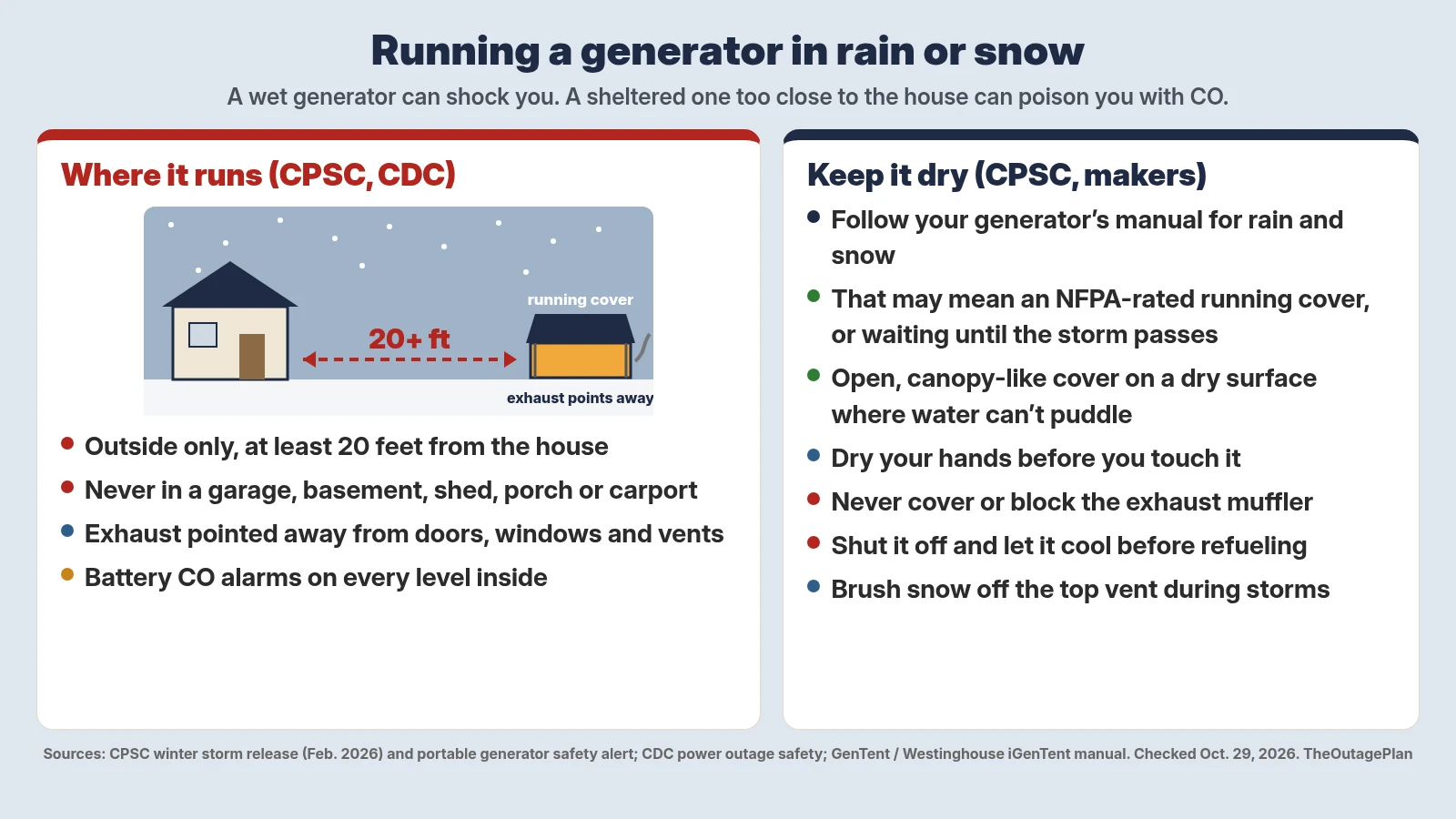
Bottom line: Winter storms knock out power in wet weather, right when you need the generator. CPSC says to follow the maker’s instructions in wet weather, which may include using an NFPA-rated noncombustible generator tent, or to wait until the rain or snow passes (CPSC). A cover keeps it dry. It doesn’t change the rule that the generator runs outside, at least 20 feet from the house (CPSC).
Our pick
Westinghouse WGenTent: a clamp-on running cover for open-frame generators with an 80-107 in. perimeter, rated for 70 mph forecast winds and an 18 in. snow load, per Westinghouse. Ships from and sold by Amazon.com when we checked.
The rules a cover doesn’t change
- Outside only, 20+ feet away. Never run it in a home, garage, basement, crawlspace or shed, even with doors or windows open. Don’t run it on a porch or in a carport either (CPSC). CDC says never closer than 20 feet to any window, door or vent (CDC).
- Exhaust away from the house. Point it away from the home, and close windows and seal vents near the generator (CPSC).
- CO alarms inside. Put battery-powered or battery-backup CO alarms on each level of the home (CPSC). CPSC says nearly 100 people die each year from generator CO.
- Dry ground, dry hands. If it’s wet, run it under an open, canopy-like structure on a dry surface where water can’t reach it, puddle or drain under it. Dry your hands before touching it (CPSC).
Running in snow: what the manual says
From the GenTent manual for the Westinghouse iGenTent (manual):
- Never cover or block the exhaust muffler.
- Never put the refueling door on the muffler side.
- Always shut the generator off before fueling. CPSC adds: let it cool first (CPSC).
- Don’t use it in forecast winds above 70 mph.
- During snow, periodically brush built-up snow off the top vent.
Also from CPSC: clear snow away from your furnace and dryer vents so CO doesn’t build up inside (CPSC).
Cords and hookup
- Use heavy-duty outdoor-rated extension cords (CPSC). CDC says the cord should be more than 20 feet long so the generator can sit far enough away (CDC).
- Never plug a generator into a wall outlet (backfeeding). Use a transfer switch or interlock put in by an electrician (CPSC).
- Store fuel safely and stabilize it; see our fuel storage guide.
How to measure for a fit
Westinghouse sizes its covers by perimeter: 2 x length + 2 x width of the generator, leaving out wheels and handles (Westinghouse).
- Open-frame generators: WGenTent fits 80-107 in.
- Fully encased inverters: iGenTent fits up to 124 in.
- Champion open frame: Storm Shield 100376 fits Champion models from 4,000 to 12,500 starting watts (Champion). GenTent lists fits for other brands too (GenTent).
If you own our generator pick, the Westinghouse WGen9500DFc, check the fit list on the WGenTent page.
Our generator running cover picks

Check the seller and stock before you buy, since both can change. All three are designed by GenTent and attach without tools, per the makers.
Our pick: Westinghouse WGenTent (open frame)
For open-frame generators with an 80-107 in. perimeter, and Westinghouse lists fit for its open-frame models up to and including the 11500 Series and the ecoGen10000. Westinghouse rates it for 70 mph forecast winds and an 18 in. (55 lb) snow load, with fabric that resists cracking down to -15°F. It has a vented top and a refueling door, and you can reposition the generator without taking it off (Westinghouse). Ships from and sold by Amazon.com on Oct 29, in stock (Amazon listing).
Full specs: Westinghouse WGenTent
- Fits: Open-frame generators, 80-107 in. perimeter
- Wind: 70 mph forecast winds
- Snow: 18 in. / 55 lb snow load
- Cold: Fabric cold crack -15°F
- Size: 36 x 24 in., adds 18 in. to generator height
- Weight: 4.4 lb
- Mount: No tools; vented top; refueling door
- Warranty: 1-year limited (Westinghouse)
For inverters: Westinghouse iGenTent
For fully encased inverter generators. Westinghouse says it fits all of its fully encased inverters and other inverters up to a 124 in. perimeter. It straps on with no tools and has the same 70 mph and 18 in. (55 lb) snow ratings, and -15°F fabric (Westinghouse). Ships from and sold by Amazon.com on Oct 29, in stock. Pair it with a power station vs. generator check if you’re still deciding.
Full specs: Westinghouse iGenTent
- Fits: Fully encased inverters up to 124 in. perimeter
- Wind: 70 mph forecast winds
- Snow: 18 in. / 55 lb snow load
- Cold: Fabric cold crack -15°F
- Size: 36 x 24 in., adds 18 in. to generator height
- Weight: 5 lb
- Mount: Straps, no tools
- Warranty: 1-year limited (Westinghouse)
For Champion owners: Champion Storm Shield 100376
Made by GenTent for Champion open-frame generators from 4,000 to 12,500 starting watts. Champion lists ratings for 70 mph winds and 18 in. of snow per day, NFPA 701 flame-retardant vinyl with RF-welded seams, a large refueling door and an apron for the electrical panel (Champion). Ships from and sold by Amazon.com on Oct 29, in stock.
Full specs: Champion 100376
- Fits: Champion open-frame generators, 4,000-12,500 starting watts
- Wind: 70 mph winds
- Snow: 18 in. of snow per day
- Material: NFPA 701 flame-retardant vinyl, RF-welded seams
- Size: 36 x 24 x 18 in.
- Weight: 4.4 lb
- Mount: Clamps to the frame, no tools
- Warranty: 1-year limited, plus lifetime tech support (Champion)
More for running a generator in a storm: our portable generator picks, fuel storage guide, winter storm checklist and battery snow blower picks.
FAQ
Can you run a generator in the rain or snow?
Only as the maker’s manual allows. CPSC says that may include an NFPA-rated noncombustible generator tent, or waiting until the rain or snow passes. Keep it on a dry surface, 20 feet or more from the house.
Does a generator tent make it safe to run closer to the house?
No. A cover only keeps it dry. CPSC says to run it outside at least 20 feet from the house, never in a garage, porch or carport, with the exhaust pointed away.
Can you refuel a generator under a running cover?
Only after you shut it off. CPSC says to turn it off and let it cool before refueling, and the GenTent manual says to always shut the generator off before fueling.
Specs checked Oct 29, 2026, from Westinghouse, Champion and GenTent. Safety rules from CPSC and CDC. We haven’t hands-on tested these products.