
Heads up: Some links on this page are affiliate links. If you buy through them, we may earn a commission at no extra cost to you. As an Amazon Associate, we earn from qualifying purchases. Full disclosure
Testing note: We haven’t hands-on tested these stations through a shutoff. Utility and safety facts come from the official pages linked below, and station specs come from each maker’s product page, checked Oct 18, 2026. Runtimes are our estimates.
Bottom line: A Public Safety Power Shutoff is a planned outage during dangerous fire weather. Utilities usually try to warn you a day or two ahead, and say a shutoff can last from several hours to multiple days, so plan for up to three days:
- Make sure your utility can reach you, and join any medical or extra-alert program you qualify for.
- Charge everything at the first alert, including a power station sized for your must-run loads. The BLUETTI AC180 holds the most of our three picks (1,152 Wh), and the EcoFlow DELTA 3 Plus can expand to about 5 kWh for longer shutoffs, per EcoFlow.
- Keep the fridge and freezer closed, with a Taylor 5924 fridge/freezer thermometer inside so you know what’s still safe.
What a PSPS is
Utilities may temporarily turn off power to specific areas to reduce the risk of fires caused by electric equipment. That’s a Public Safety Power Shutoff (PSPS), as California’s utility regulator puts it (CPUC). The usual triggers are strong winds, low humidity, and dry vegetation (SCE, Colorado PUC). PG&E also weighs National Weather Service Red Flag Warnings (PG&E).
It isn’t only a California thing. Oregon has PSPS notification rules (OAR 860-300-0050), and Colorado’s PUC calls it a common wildfire mitigation practice (Colorado PUC). If you live in or near wildland anywhere in the country, check whether your utility has a PSPS program.
You can lose power even if it’s calm at your house. Your circuit may cross a windy, high-risk area before it reaches you, so neighbors on different circuits can keep power or come back at different times (SCE). Underground lines can lose power too if they connect to overhead lines that are shut off (SDG&E). A PSPS is different from a rotating outage on a tight grid day; see our grid emergency alerts guide.
How much notice you get
Each utility says it aims for the timing below, and each warns that notice may be short or may not come at all when conditions shift quickly:
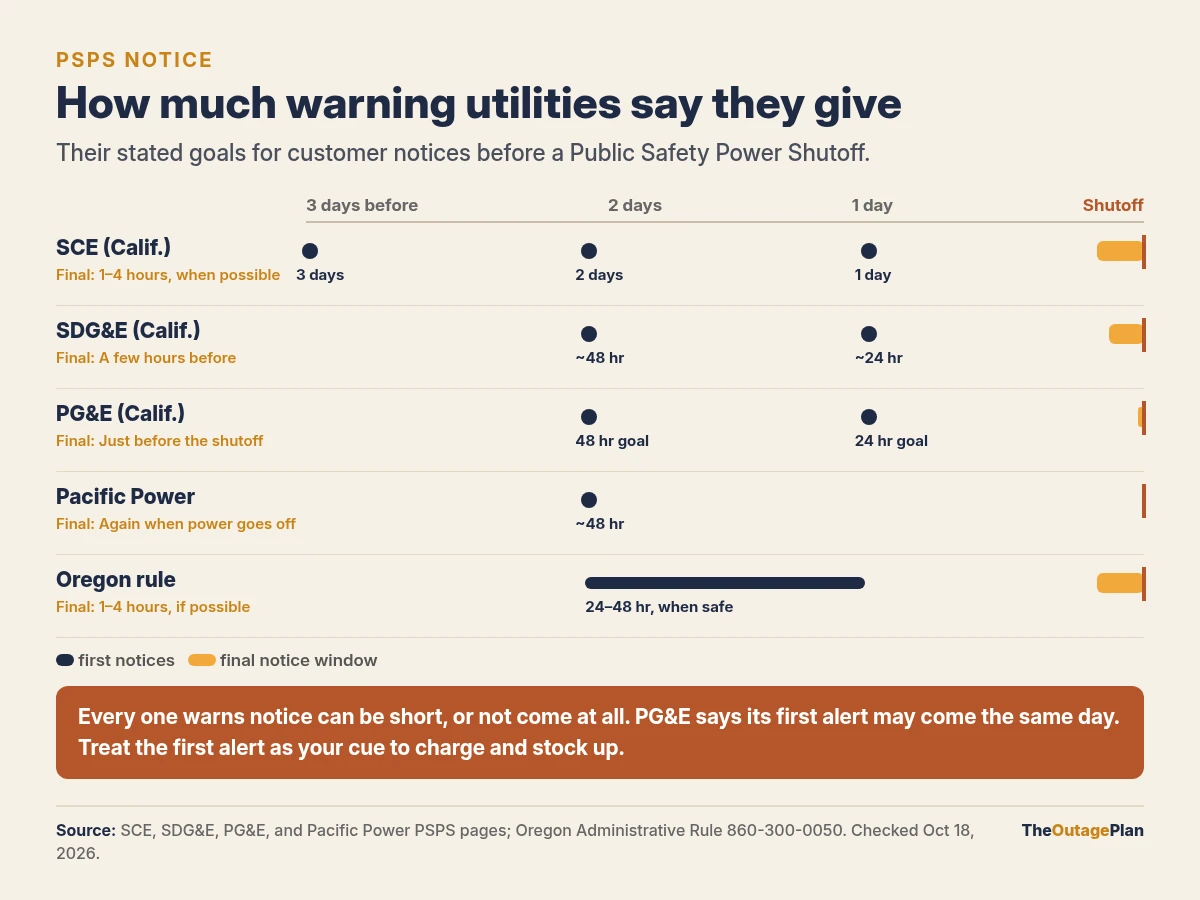
Because forecasts change, PG&E’s first alert may come the same day (PG&E), so keep a baseline kit ready all season.
Renting or caring for someone? Alerts go to the account holder, so set up address alerts: PG&E’s Address Alerts, SCE’s Address Level Alerts, or SDG&E’s Alerts by SDGE app, which tracks up to five addresses with no account needed.
How long a shutoff lasts
Power stays off until the fire weather passes, then crews inspect the lines before turning power back on, mostly in daylight:
- SDG&E: a PSPS “can last from several hours to multiple days,” and crews need 4–8 hours of daylight to inspect lines (SDG&E).
- SCE: events “may last over 24 hours,” and inspections “typically take up to eight hours,” longer if daylight is needed (SCE).
- PG&E: its goal is to restore all customers within 24 hours after severe weather has passed (PG&E guide, 2024).
Add the windy days to the inspection time and a 1 to 3 day plan is a sensible target. Oregon’s PUC goes further and suggests being 2 Weeks Ready (Oregon PUC).
Real shutoffs can run longer than that. One example:

If someone at home relies on power for medical needs
Start with your doctor or equipment provider: Ready.gov says to make an outage plan for powered devices and refrigerated medicines, and to ask how long each medication can be stored warmer (Ready.gov). Then sign up with your utility:
- PG&E Medical Baseline: extra PSPS alerts, which may include multiple texts, calls, or a doorbell ring. Acknowledge them so PG&E knows you got them (PG&E). Not eligible? You can self-certify for Vulnerable Customer Status.
- SCE Medical Baseline Allowance: if SCE can’t reach you, it says it will send a technician to your door (SCE). SDG&E’s program may include in-person contact attempts (SDG&E).
- Pacific Power: customers who use a powered device can self-identify for additional PSPS notifications (Pacific Power).
- Colorado: the PUC tells customers who rely on powered medical devices to arrange backup power or a plan to relocate, and links to Xcel Energy’s medical programs (Colorado PUC).
Ask about backup batteries. PG&E’s Portable Battery Program offers no-cost batteries to qualifying medical-device users in shutoff-affected areas (PG&E), SCE’s Critical Care Backup Battery program offers free portable batteries to eligible customers, and SCE and SDG&E list rebates on power stations or generators in PSPS-affected areas.
Check the station maker’s position too. Jackery says its stations are not recommended for medical devices or life-support equipment (Jackery). Our CPAP backup power guide walks through one machine’s numbers, and our oxygen concentrator guide covers home oxygen. For life-sustaining equipment, the provider’s plan and a place to go come first.
Keeping the fridge and freezer safe
The free part matters most: keep the doors closed. A closed fridge keeps food safe for up to 4 hours. A full freezer holds a safe temperature for about 48 hours, or 24 hours if it’s half full (FoodSafety.gov). Throw out perishable food that’s been at 40°F or above for more than 2 hours,, and never taste it to check.
What that means in a 1 to 3 day shutoff:
- Let a full freezer coast and spend your battery on the fridge. Full holds about twice as long as half full.
- Use coolers with ice if needed (Ready.gov). SCE and SDG&E Community Resource Centers list ice among their services, and SCE also lists insulated cold bags for medications.
- Refrigerated medicine: Ready.gov says if the power is out for more than a day, discard medication that should be refrigerated unless the label says otherwise, and call your doctor or pharmacist. Plan this one ahead of time. If it’s insulin, our insulin outage guide covers the FDA’s storage rules and coolers that need no power.
The keep-or-toss list is in our food safety guide. For battery runtimes, see best power station for a refrigerator and freezer and how long a power station runs a refrigerator.
Sizing a power station for a 1 to 3 day shutoff
We use Jackery’s planning formula, capacity × 0.85 ÷ watts (Jackery), for all three stations as our own estimate. The 0.85 covers conversion losses. Example loads, as in our earlier guides: a fridge with a 600 kWh/year EnergyGuide label (about 68.5 W average), a ResMed AirSense 11 CPAP at its 56.1 W typical draw (ResMed), and a modem plus router at 42 W from their adapter labels. Swap in your own watts.

What the chart says:
- A ~1 kWh station is enough for the small, critical loads. By our math it runs the example CPAP for about two nights, or the CPAP plus 12 hours of Wi-Fi for close to a day.
- The fridge is the big one. Three days of it takes nearly 6 kWh with no recharging. That’s more than even a fully expanded DELTA 3 Plus, so a three-day fridge plan needs recharging, a cooler, or both.
- Inverter: rated AC output is 1,800 W on the DELTA 3 Plus and AC180 and 1,500 W on the Explorer 1000 v2, per each maker. Plenty for these loads, but a heater drains a ~1 kWh battery fast (our space heater math).
- Leave critical gear plugged in. EcoFlow lists a switchover time under 10 ms when the DELTA 3 Plus is used as a UPS, so a router may ride through the moment power drops (EcoFlow).
The full method is in our sizing guide; power station vs. generator covers when fuel makes more sense.
Recharging with solar during a shutoff
Don’t count on the label number. Each maker’s maximum solar input:
- DELTA 3 Plus: 1,000 W (2 × 500 W), and EcoFlow says it charges fully in about 70 minutes at that input (EcoFlow).
- AC180: 500 W. BLUETTI says that allows a full charge in about 3 hours on a sunny day (BLUETTI).
- Explorer 1000 v2: 400 W across two ports. Jackery notes its 200 W panel rating is measured in an ideal laboratory, and real output changes with light intensity and the sun’s angle (Jackery).
Those assume full sun. Wildfire smoke cuts solar output. The U.S. Department of Energy reports that smoke caused measured drops of 9.4% to 37.8% in power production at monitored solar sites in the western U.S. (DOE). EIA found that California’s grid-scale solar output fell nearly 30% in the first two weeks of September 2020 as wildfire smoke spread (EIA). DOE adds that ash on panels reduces output. Treat solar as a top-up, not your whole plan. For panel sizing and peak sun hours, see how much solar you need.
Car charging is a slow backup. Jackery lists about 12 hours to charge the Explorer 1000 v2 from a car adapter. Never run a car in an attached garage, even with the door open (CDC). SDG&E and Oregon’s PUC both suggest keeping your gas tank at least half full.
Comms, alerts, and Wi-Fi
- Several ways to get alerts: Ready.gov recommends the FEMA app, local community alerts, and Wireless Emergency Alerts, which need no sign-up, plus air quality alerts (Ready.gov).
- A NOAA weather radio like the Midland WR120 sounds for weather alerts with AA backup. A crank radio like the Midland ER310 keeps you on AM/FM and NOAA if the phone network struggles. See our emergency radio guide.
- Phones charged, plus a power bank. Ready.gov says to keep phones charged when wildfires could be in your area and to have backup charging. Anker lists the Anker Power Bank 20K, 87W at 20,000 mAh with up to 65 W from its built-in USB-C cable.
- Wi-Fi: SCE notes that portable power stations can keep phones, laptops, and some routers running. Home internet still depends on your provider’s network having power. Our Wi-Fi and internet backup guide covers modem math, the provider question, and satellite backup. SCE and SDG&E Community Resource Centers also offer Wi-Fi and device charging.
Smoke at home: Ready.gov suggests a room closed off from outside air with a portable air cleaner, and an N95 mask if available (Ready.gov). Add the air cleaner’s watts to your plan. If you’re told to evacuate, go.
Before-and-during checklist
- ☐ Your utility has your current phone, text, and email, and Address Alerts are set for anyone you look after
- ☐ Medical Baseline, medical certificate, or vulnerable-customer status signed up for where you qualify, and backup battery programs asked about
- ☐ A plan with your doctor or pharmacist for powered devices and refrigerated medicine
- ☐ Power station charged to 100% at the first alert, with your must-run loads’ watts written down
- ☐ Solar panels tested once in daylight, and the car charging cable packed
- ☐ Thermometers in the fridge and freezer, cooler ready
- ☐ Phones, power banks, flashlights, and radios charged, with spare batteries
- ☐ Gas tank at least half full, and you know how to open the garage door by hand (SDG&E; see our garage door outage guide)
- ☐ Nearest Community Resource Center found on the utility’s outage map
- ☐ Sensitive electronics unplugged during the outage, to avoid surges when power returns (Ready.gov)
- ☐ Go-bag ready in case a shutoff turns into an evacuation (see our 72-hour outage kit checklist)
FAQ
How much warning do you get before a PSPS?
Usually a day or two: SCE says up to 3 days, SDG&E and Pacific Power about 48 hours, and Oregon’s rule 24–48 hours when safe. All of them say notice can be short or missing when the weather changes fast.
How long will the power be off?
SDG&E says several hours to multiple days, SCE says it may be over 24 hours, and PG&E’s goal is restoration within 24 hours after the severe weather passes. Plan for up to three days.
Is a ~1 kWh power station enough for a PSPS?
For phones, lights, a CPAP, and Wi-Fi, often close to a day, longer with solar. For a fridge over 2 to 3 days, no: add expansion batteries, solar, a cooler, or a generator run safely outdoors.
Does Medical Baseline keep the power on during a PSPS?
No. These programs mean extra alerts and sometimes in-person contact, not an exemption. Have your own backup plan and somewhere to go.
All three stations, the thermometer, the radios, and the power bank are on our Gear page.
Utility and safety facts checked Oct 18, 2026, from the CPUC, PG&E, SCE, SDG&E, Pacific Power, the Oregon PUC and Oregon Administrative Rules, the Colorado PUC, Ready.gov, FoodSafety.gov, DOE, and EIA. Specs are from EcoFlow, BLUETTI, Jackery, ResMed, and Anker. Runtimes are our estimates, not manufacturer or utility claims. Programs and notice timelines change, so your utility’s current page wins. This is general information, not medical or electrical advice.