
Heads up: Some links on this page are affiliate links. If you buy through them, we may earn a commission at no extra cost to you. As an Amazon Associate, we earn from qualifying purchases. Full disclosure
Testing note: We haven’t hands-on tested any fan or air conditioner on these stations. Fan and AC wattages come from Lasko, Vornado, Frigidaire, and Midea spec pages, and station specs come from each maker’s page or manual, all checked Oct 19, 2026. Runtimes are our estimates.
Bottom line: Fans, yes, for a long time. A small window AC, yes, but only for an hour or two. Central air, no.
- Fans: a 20 in. box fan or a Vornado-style circulator runs about 8 to 36 hours on one charge of a ~1 kWh station, depending on speed. USB and DC fans last far longer.
- Window AC: a 6,000 BTU Frigidaire rated at 500 W runs about 1.7 to 2 hours nonstop, and an 8,000 BTU Midea inverter unit rated at 720 W about 1.2 to 1.4 hours.
- Central AC: a typical 3-ton outdoor unit runs on 208/230 V, and its compressor alone needs more than these 120 V stations put out, and nearly 10 times as much at startup.
- Your body comes first. The CDC says fans only help when it’s under 90°F indoors. Above that, a cooling center beats any battery.
Why heat waves and outages show up together
Ready.gov defines extreme heat as temperatures above 90°F for at least two to three days, says it causes the most deaths each year of any weather hazard, and warns that heat waves may cause you to lose power (Ready.gov). High demand can also bring rotating outages (see our grid alerts guide), and a hurricane or a wildfire power shutoff can leave you in summer heat for days.
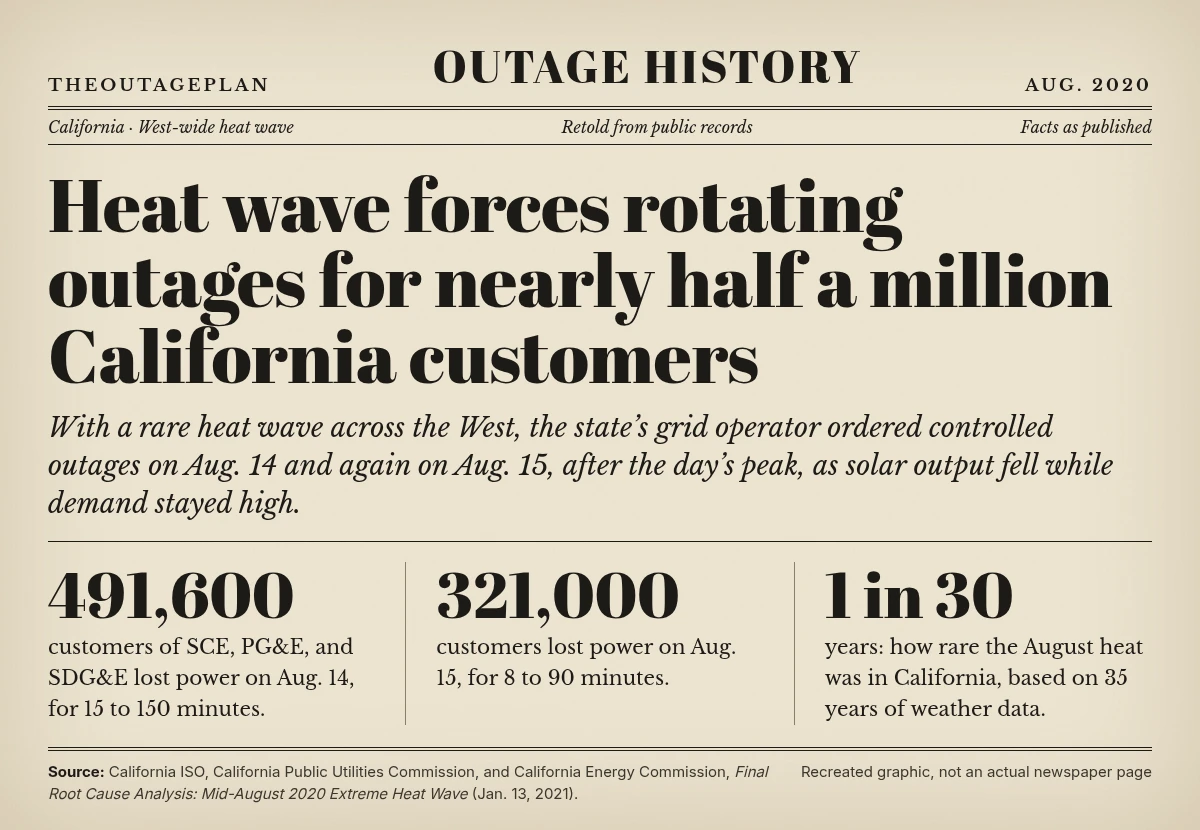
When a heat wave strains the grid, operators can cut power on purpose. One example:
The stations and the math
We use the same math as our other guides: capacity × 0.85 ÷ watts, where 0.85 allows for inverter losses.
The three stations: the EcoFlow DELTA 3 Plus (1,024 Wh, expandable to 5 kWh; 1,800 W rated, 3,600 W surge per the EcoFlow manual), the BLUETTI AC180 (1,152 Wh; 1,800 W, 2,700 W surge per BLUETTI), and the Jackery Explorer 1000 v2 (1,070 Wh; 1,500 W, 3,000 W peak per Jackery). All three put out 120 V AC. For the full comparison, see DELTA 3 Plus vs. AC180 vs. Explorer 1000 v2.
Fans: the realistic way to stay cooler on battery
Here’s what one charge buys, using the makers’ own wattages for four fans, with two window ACs for comparison:
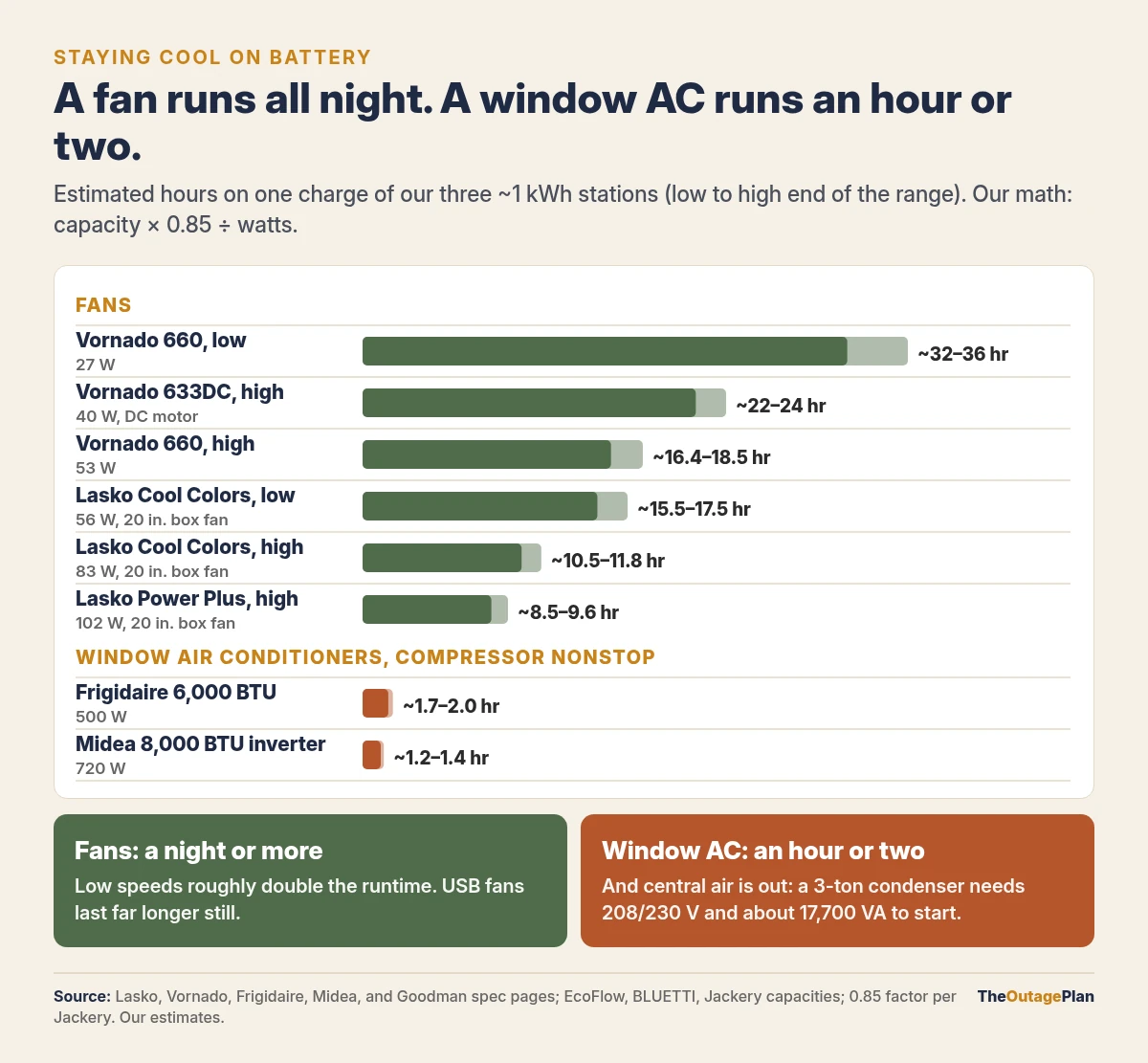
Expanded to 5 kWh, the DELTA 3 Plus runs these fans about 42 to 157 hours.
Low settings roughly double your runtime, but idle draw matters for small loads. BLUETTI’s runtime formula counts about 15 W of self-consumption for the AC180’s inverter (BLUETTI). Add that to a 53 W fan and the AC180’s estimate drops from about 18.5 hours to about 14.4. Turn AC output off when nothing needs it.
USB and rechargeable fans
Skipping the inverter helps a lot for small fans:
- Vornado PEBL PAK: a USB desk fan rated 3.4 W on high, 1.7 W on low (Vornado). On paper that’s days of runtime from a station’s USB port. A 20,000 mAh power bank can run a fan like this too.
- Vornado Fly Move: a rechargeable fan that Vornado rates at up to 17 hours per charge, with about 3.5 hours to recharge over USB-C (Vornado). Top a few up from the station by day for the beds at night.
Each station also has USB-C and 12 V car outputs (the DELTA 3 Plus’s car port is rated 12.6 V, 10 A), so check what your fan can plug into.
Fans have a limit, and it’s about your body
A fan moves air. It doesn’t lower the room temperature.
- The CDC says to use fans only if indoor temperatures are below 90°F. Above 90°F, a fan can increase body temperature (CDC).
- Ready.gov says not to rely on a fan as your primary cooling device, because fans “do not reduce body temperature or prevent heat-related illnesses” (Ready.gov).
- The National Weather Service warns that blowing a fan at someone may make them hotter when the heat index is above the 90s (NWS).
Fans fit warm nights and mild heat. Above 90°F inside, use cool showers, wet cloths, and a cooling center.
A small window AC: possible, but short
Two real units, from the makers’ own spec sheets:
- Frigidaire FFRE063WAE (6,000 BTU): 500 W, 4.7 A at 115 V, cools up to 250 ft², with “Low Voltage Start-up” listed (Frigidaire spec sheet).
- Midea MAW08V1QWT (8,000 BTU U-shaped inverter): rated input 720 W, rated current 8.78 A at 115 V, up to 350 ft² (Midea spec sheet).
If the compressor ran nonstop, which is likely in a real heat wave, that’s about 1.7 to 2 hours for the Frigidaire and 1.2 to 1.4 hours for the Midea (chart above), or about 8.5 and 5.9 hours on a 5 kWh DELTA 3 Plus.
When the room cools and the compressor cycles off part of the time, runtime stretches. Estimate only: if it ran half the time, the Frigidaire would last about 3.5 / 3.9 / 3.6 hours on the three stations. BLUETTI’s own load chart lists an 8,100 BTU air conditioner at about 0.9 hour on the AC180 (BLUETTI), so our numbers are in the same range.
Check the inverter and startup surge
A compressor pulls a burst of extra current as it starts (our sizing guide explains why).
- Neither spec sheet lists a startup (locked rotor) figure, so we can’t tell you the exact surge. Leave plenty of margin and test it on a normal day.
- Watts vs. volt-amps. Midea lists 720 W but 8.78 A; at 115 V that’s about 1,010 volt-amps. That’s still under all three stations’ rated output, but it’s the bigger number to plan with.
- BLUETTI’s limits. BLUETTI says not to run an air conditioner in the AC180’s Power Lifting Mode, and that its runtime formula isn’t suited to compressor loads like air conditioners (BLUETTI). Leave EcoFlow’s X-Boost off for the same reason.
- AC timeout. EcoFlow’s manual warns that the station’s AC timeout can switch the outlets off when an air conditioner cycles. Set it to “never” in the app (EcoFlow manual).
- The 3-minute delay. Frigidaire’s room AC manual says the cool circuit waits about 3 minutes to restart if the unit is turned off and on quickly, to protect the compressor. It also says not to use an extension cord or adapter plug, and not to share the outlet with other appliances (Frigidaire manual). Place the station within reach of the AC’s own cord.
The window AC has to be installed before the outage. Ready.gov lists installing window air conditioners and insulating around them as a before-the-heat step (Ready.gov).
Why central air is out of reach
A central AC’s outdoor unit is a different class of load. As one example, Goodman’s spec sheet for a 3-ton VSX13 condenser lists 208/230 V single-phase power, compressor rated load amps of 14.1, and locked rotor amps of 77 (Goodman). At 230 V, that’s roughly 3,240 VA running and about 17,700 VA at startup, before counting the indoor blower. These stations put out 120 V and 1,500 to 1,800 W. Even an expanded 5 kWh DELTA 3 Plus can’t start it.
Running house circuits takes a whole-home battery or a generator with a transfer switch installed by a licensed electrician. See power station vs. generator.
Solar recharge: helpful for fans, not for AC
Max solar input per the makers: 1,000 W for the DELTA 3 Plus (500 W per port), 500 W for the AC180, and 400 W for the Explorer 1000 v2 (EcoFlow manual, BLUETTI, Jackery).
- The AC180 and Explorer 1000 v2 can’t take in as much solar as the Midea AC draws, even at their maximum, and the Explorer can’t match the Frigidaire’s 500 W.
- Panels rarely hit their rating. Jackery notes its 200 W panel rating is measured in an ideal lab and real output varies with light intensity and angle (Jackery).
- A fan is a different story: an 83 W box fan is a small slice of even a modest solar setup. Run fans on daytime sun, and save stored battery for the fridge and the night.
Keep the station cool, too
Batteries have heat limits:
- DELTA 3 Plus: discharges at 14–113°F, with 68–86°F optimal. EcoFlow says a high-temperature warning means stop and move it away from heat sources to a ventilated spot (EcoFlow manual).
- AC180: discharges at -4–104°F, and between 86°F and 104°F its max output drops to 1,500 W. It charges at 32–104°F (BLUETTI).
- Explorer 1000 v2: discharges at 14–113°F and charges at 32–113°F (Jackery).
A closed-up house, a garage, or a car in the sun can pass those limits. Keep the station in the coolest room, out of direct sun.
Spend your battery wisely
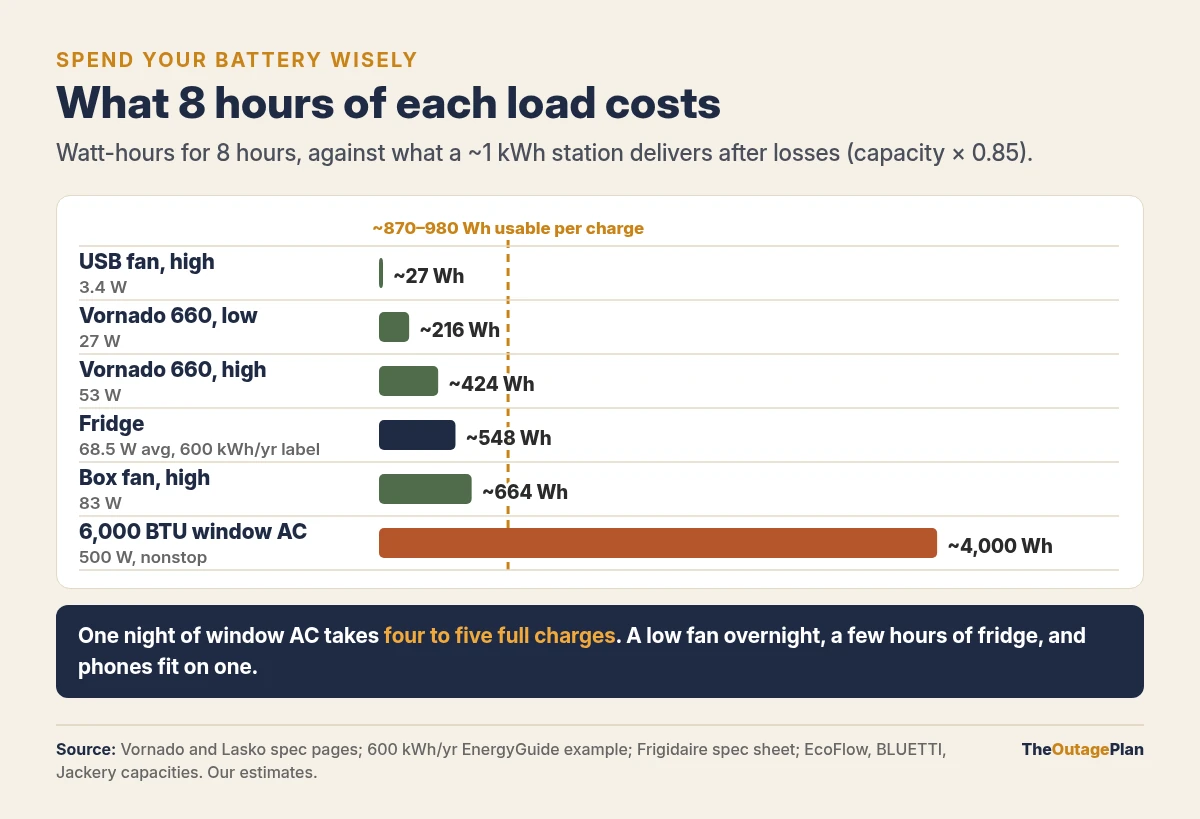
Our fridge runtime guide shows the fridge math in detail.
Food in the heat: a closed fridge keeps food safe for about 4 hours and a full freezer about 48 hours (24 if half full). Discard perishables that sat above 40°F for more than 2 hours (FoodSafety.gov). A fridge and freezer thermometer takes the guesswork out; see keeping food safe in an outage.
Medicines: the CDC says heat can cause outages, so plan ahead for refrigerated medications and electronic medical devices, and don’t stop or change medicines without talking to your doctor (CDC). If the power is out more than a day, Ready.gov says to discard refrigerated medicine unless the label says otherwise and to ask your doctor or pharmacist for a new supply (Ready.gov). For insulin in the heat, see how to keep insulin cool in an outage. For CPAP, see our CPAP backup power guide.
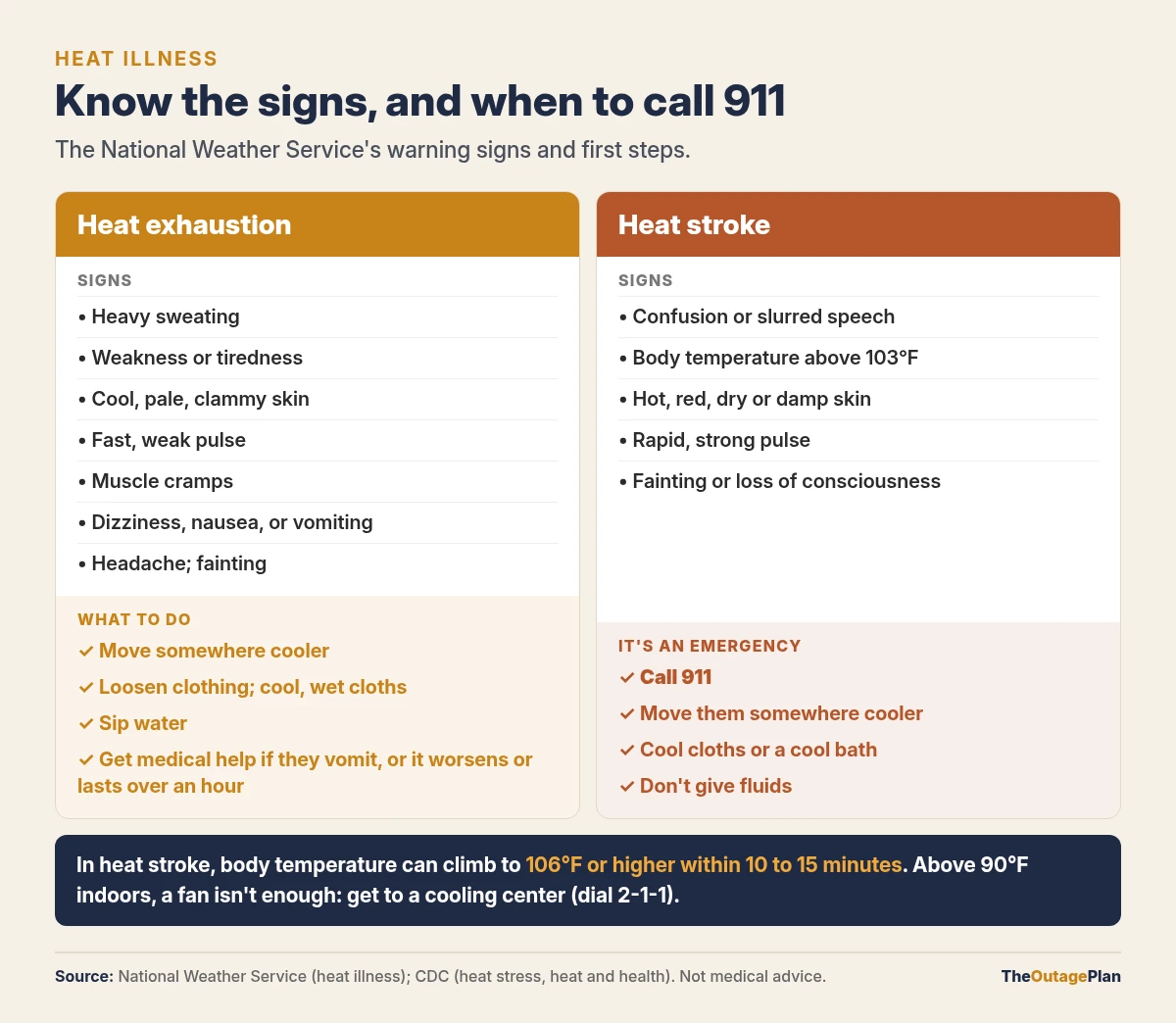
Heat illness: know the signs
The warning signs and first steps, per the National Weather Service. Heat stroke is an emergency: call 911. The CDC notes body temperature can climb to 106°F or higher within 10 to 15 minutes.
Who’s at higher risk: the CDC lists people 65 and older, infants and young children, pregnant women, people with heart disease, people (especially children) with asthma, and anyone working or exercising outside (CDC). Check on neighbors who live alone, and never leave people or pets in a closed car (Ready.gov).
Find a cooling center: dial 2-1-1, check the National Center for Healthy Housing’s cooling centers by state page, or contact your local health department or emergency management agency (CDC). Libraries and shopping malls can also work (Ready.gov).
Generators: keep them outdoors, at least 20 feet from windows, doors, and attached garages, and put a battery CO alarm on every level (Ready.gov).
Before-the-heat checklist
- ☐ Fan wattages written down (look for the label or the maker’s spec page)
- ☐ USB or rechargeable fans charged, one per bed
- ☐ Window AC installed and insulated, if you plan to use one, and tested on the charged station on a normal day
- ☐ Station’s AC timeout set to “never” and X-Boost or Power Lifting off for the AC
- ☐ Station stored in the coolest room, out of direct sun
- ☐ Blinds or drapes ready to close on sunny windows (Ready.gov)
- ☐ Fridge thermometer in place and a plan for refrigerated medicine
- ☐ Nearest cooling center found (2-1-1 or your health department)
- ☐ Extra water stored (see how much water to store)
- ☐ Phones, a weather radio, and flashlights charged (see our 72-hour outage kit checklist)
FAQ
Can a 1,000 Wh power station run a window air conditioner?
A small one, briefly. A 500 W, 6,000 BTU unit lasts about 1.7 to 2 hours nonstop, and a 720 W, 8,000 BTU unit about 1.2 to 1.4 hours. Test the startup on a normal day first.
How long will a box fan run on a power station?
A box fan rated at 83 W on high runs about 10.5 to 12 hours on our three stations, and roughly 15 to 17 hours on a 56 W low setting.
Can a power station run central air?
No. Central AC typically runs on 208/230 V, and its compressor draws far more than a 120 V, 1,800 W station can start or supply.
Can solar keep a window AC running?
Not on these stations. Even at their maximum solar input, the AC180 and Explorer 1000 v2 take in less than a 720 W AC draws, and real panel output is usually below the rating. Solar is a better fit for fans and the fridge.
Is a fan enough during a heat wave?
Not once it’s above 90°F indoors. The CDC says a fan can raise body temperature above that point. Go to a cooling center instead.
The three stations, the thermometer, the power bank, and the CO alarm are on our Gear page. For the winter side of the same problem, see can a power station run a space heater.
Fan and air conditioner specs checked Oct 19, 2026, from Lasko, Vornado, Frigidaire, Midea, and Goodman spec pages, sheets, and manuals. Station specs are from EcoFlow, BLUETTI, and Jackery. Health and safety guidance is from the CDC, the National Weather Service, Ready.gov (FEMA), and FoodSafety.gov. Runtimes and duty-cycle figures are our estimates, not manufacturer claims. Your appliance’s label and manual win. This is general information, not electrical or medical advice.